Are U.S. Stocks Better For Growth Than European Stocks?

European stocks look cheaper than U.S. stocks now based on P/E ratio and other factors. However U.S. stocks are better for better for growth than European stocks under Trump Presidency, according to Peter Fitzgerald of Aviva Investors quoted in a recent Citywire UK article. He also noted the one important reason on why investors’ perception that European equities are cheap is incorrect. From the article:

European equities aren’t as good a deal as investors believe, according to Peter Fitzgerald of Aviva Investors, who is looking to the US for growth following the election of Donald Trump.

Fitzgerald, global head of multi-asset at Aviva Investors, believes investors are failing to take into account the composition of indices when comparing US and European stocks. ‘There is the common belief that European equities are cheap but what is not taken into account is the composition of the index,’ he said.

‘You need to adjust the composition and factor in the S&P has 20% in technology [companies], which trade on higher multiples but Europe only has 2% in technology but more in financials and commodities. When you compare the adjusted market composition then you see [European equities] no longer look as cheap.’

European valuations have been pushed down by financials in particular, but despite European banks being inexpensive, Fitzgerald said he would rather back US banks which he regarded as more stable.

Source: Where on earth should you invest in the Trump era?, CityWire UK

Some of the sectors that are expected to grow strongly in the next few years are industrials, defense, transportation, infrastructure, healthcare and banking. Already many stocks in these sectors have shot up. Hence investors looking for growth-oriented companies can monitor these sectors and add stocks during pullbacks. Momentum should keep these stocks continue to vault higher in the coming year. A few companies that investors can consider are listed below:

Railroads: Kansas City Southern(KSU), Norfolk Southern Corp(NSC), CSX Corp (CSX), Canadian Pacific Railway Ltd(CP) and Union Pacific Corp (UNP)

Infrastructure, Defense: Caterpillar(CAT), United Technologies Corporation (UTX), The Boeing Company (BA), Martin Marietta Materials, Inc. (MLM)

Disclosure: Long CNI, CSX, UNP

The World’s Top 10 Fastest Trains

The world’s fastest train is the Maglev train of Japan. It runs upto 374 miles per hour and will be launched in 2027. The 2nd and 3rd fastest trains are the Shanghai maglev  at 268 mph and Harmony at 236 mph in China. Other high-speed trains include the iCE train in Germany, Talgo of Spain, Italo of Italy and TGV of France.

Photos of Japan Maglev Train:

japan-maglev-train-1

japan-maglev-train-2


In comparison, the the fastest train in the US is the Acela Express. It has a top speed of world-class just 150 mph and runs between Boston and Washington. The distance covered is only 456 miles. The reasons why the capitalist US woefully lags communist China and socialist Europe in hi-speed rail networks remains an unsolved mystery.

For more details on the top high-speed trains in the world checkout World’s top 10 fastest trains at China Daily site.

Why Staying Invested is Important For Success in Stock Investing

One of my favorite topics that I have written about in the past is the futility of trying to time the market. For most investors, the best strategy in equity investing is to simply hold stocks for the long-term. This is because nobody knows when markets will turn one way or the other. For example, the outcome of the recent US elections was totally unexpected and has led to a dramatic rise in stock prices. Hence investors that continue to stay invested have seen solid gains in recent weeks.Similarly investors who rode out the great recession of the 2008-09 have mostly recovered their losses and have even seen gains.

I came across an article at Vanguard Canada in which the author Chris Tidmore showed that the stock market’s best and worst days tend to happen close together. To put it another way, sharp declines are closely followed by strong rises and vice versa. Hence timing the market by selling at the top and buying back at the bottom is impossible to execute.

From the article:

As Charles Dickens more eloquently put it, countless positive and negative things in life are hard to separate. Many times we see this when we look at the equity markets over the short term. Markets can be extremely volatile on a daily basis (even intraday).

You’ve probably seen a chart illustrating the effect of being invested during the best days in the stock market while avoiding the worst days. What often isn’t discussed is the difficulty in trying to successfully time the market either to elude the worst days or capture the best days.

To help you explain the challenges of timing the market to clients, we looked at the 20 worst and 20 best days in the United States equity market from 1990 through 2015. What we found is that all but one of the worst days were within a month of at least one extreme “up” day.

The stock market’s best and worst days have tended to happen close together

Standard & Poor’s 500 Index daily returns, 1990–2015

Figure 1

Source: Vanguard.

It’s clear that the best of times and the worst of times—on a daily basis—haven’t been that far apart in the stock market. It’s also clear that the only way to guarantee never missing the best days is to stay invested.

Source: When the worst of times is the best of times, Vanguard Canada

The takeaway: Staying invested thru the worst of times and the best of times is the smart way to build wealth by investing in stocks.

The Top 15 Corporate Tax Havens

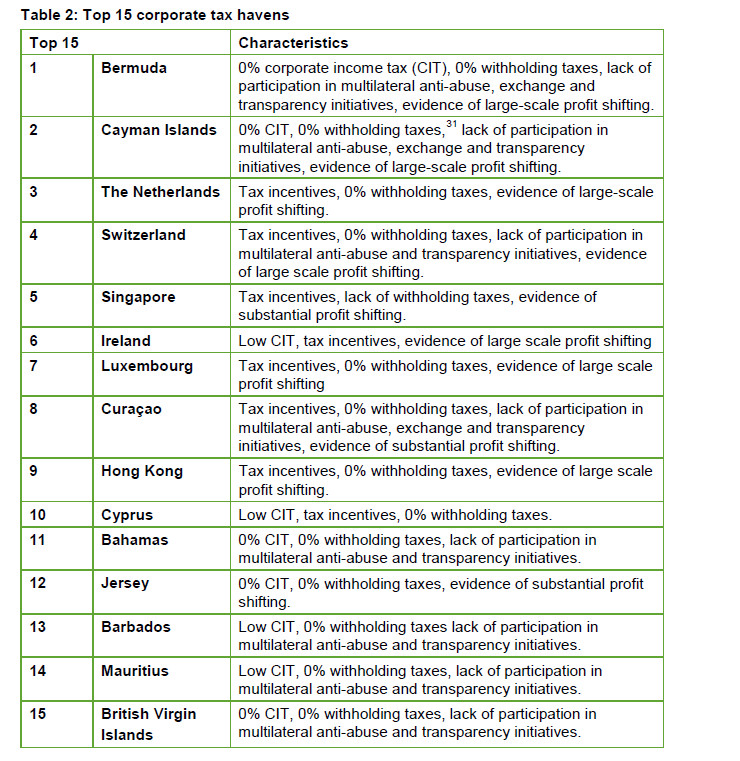
The UK-based global charity Oxfam published a study on corporate tax havens and how they deprive countries of billions of dollars in funds.The top five corporate tax havens are: Bermuda, Cayman Islands, The Netherlands, Switzerland and Singapore. The full list of corporate tax havens are shown below:

Click to enlarge

top-15-corporate-tax-haves

Source: TAX BATTLES – The dangerous global Race to the Bottom on Corporate Tax, Oxfam

Hat tip: Oxfam exposes ‘world’s worst tax havens’, DW

Why Invest In New Zealand Dividend Stocks?

Investors looking for dividend stocks should consider companies from New Zealand. Some of the reasons why New Zealand dividend equities are attractive for income are listed below:

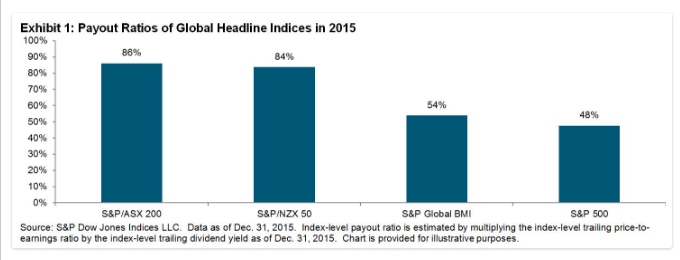
New Zealand firms have one of the highest dividend payout ratios in the world. For example, in 2015 the payout ratio was 84% of earnings. This vastly exceeds the 48% payout ratio in the US  and 54% globally.

Click to enlarge

dividend-payout-ratio-of-major-indices

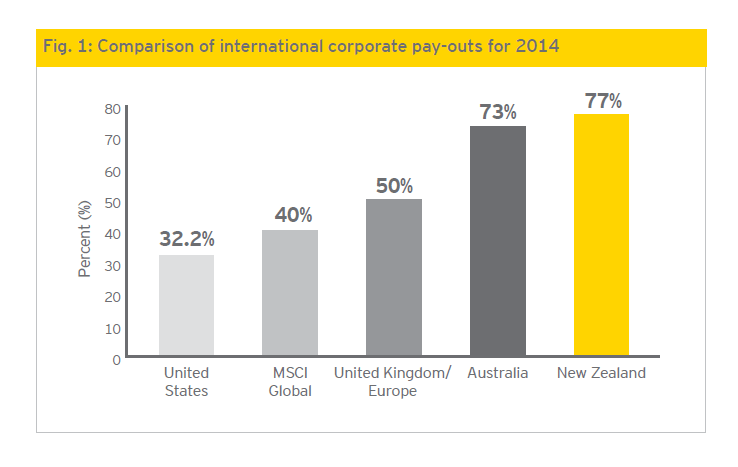
New Zealand tops in the payout ratio across markets for 2014 shown below:

payout-ratio-new-zealand-stocks-2014

One of the main reasons for the high payout ratio is due to a unique tax policy called the dividend imputation. This simply means it prevents double taxation of dividends – once at the company-level and next at the individual level – by giving tax credits to investors on dividends received.

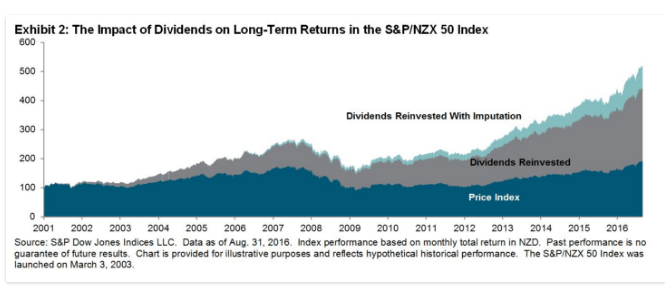
The total long-term return of stocks (which included price appreciation and dividend reinvestment) is boosted greatly due to the investor-friendly dividend policy as shown in the chart below:

Click to enlarge

sp-nzx-50-index-long-term-returns-with-dividend-reinvested

Because New Zealand is a small country with opportunities for growth limited for companies, many prefer to distribute their profits to investors. Because investors benefit from the favorable tax regime they are satisfied with companies distributing their earnings as opposed to wasting them on some wasteful projects.

How to invest in New Zealand stocks?

It is a shame that none of the major Kiwi firms trade on the US exchanges. However over 35 stocks trading on the OTC markets some options for US investors to invest directly.

So the simplest and easiest way to gain access to New Zealand is via the iShares MSCI New Zealand Capped ETF (ENZL). It holds 27 companies and the distribution yield is 2.72%.

Sources:

Disclosure: No Positions