Knowledge is Power: Globalisation, Car Habbit, Emerging Markets Edition

Other Interesting links from bookmarks:

  1. Railroad Stocks 2015: Guide to Rail Stocks & Investments
  2. Travelling on the Trans-Siberian in style: wi-fi, gyms, libraries, restaurant carriages, children’s playrooms – even arrange for your own carriage to be attached to the train
  3. The Art of Doing Nothing
  4. Deducting a Loss in an IRA « The Investment Conversation
  5. REITs Review: Looking Beyond the Price Tag – Context | AB
  6. Is It Too Late to Catch the Emerging-Market Rally? – Context | AB
  7. Why are so many active funds underperforming? – Citywire Money
  8. FTSE 100 Index – Wikipedia
  9. America’s road trip: will the US ever kick the car habit? | Cities | The Guardian
  10. Why Aren’t Americans Getting Raises? Blame the Monopsony – WSJ
  11. With Trump, no hope for change – Livemint
  12. Taking aim at the establishment: Why some of Europe’s top leaders are walking dead – World – CBC News
  13. Fines Alone Won’t Deter Corporate Crime – Bloomberg View
  14. My journeys in Trumpland | US news | The Guardian
  15. US elections: How slogans can make or break a candidate – Livemint
  16. Kenneth R. French – Data Library
  17. Solving Canada’s Innovation Problem · thewalrus.ca
  18. How many US manufacturing jobs were lost to globalisation? | FT Alphaville
  19. ‘Democracy was hijacked. It got a bad name’: the death of the post-Soviet dream | World news | The Guardian
  20. BBC – Autos – Inside the world’s longest rail tunnel
  21. Five things that could turn a good stock into a great stock | Financial Post
  22. Why globalisation, as we know it, is dead | Business Line
  23. Why Many Young Russians See a Hero in Putin
  24. Justin Trudeau: ‘Globalisation isn’t working for ordinary people’ | World news | The Guardian
  25. 16 Best Foreign Movies on Netflix Ranked and Reviewed
  26. Comparing Health Systems – UK NHS Performance | The Nuffield Trust
  27. A public option for banking | Al Jazeera America
  28. Germany axed tuition fees – but is it working out? | World news | The Guardian
  29. The Brazilian Doctors Who Sounded the Alarm on Zika and Microcephaly – WSJ
  30. Health Care’s Continental Divide – Bloomberg View
  31. After Living in Norway, America Feels Backward. Here’s Why. – BillMoyers.com


Thyssenkrupp Headquarters, Essen, Germany
Are European Bank Stocks A Good Buy Now?

European bank stocks have turned positive for the year. Since the Global Financial Crisis(GFC) of 2008-09, the Greek sovereign debt crisis and the many other crises the continent’s banks were left for dead by many investors. Unlike US banks which have recovered strongly since the crisis, European banks have been slow to implement changes necessary. However after years of enduring misery European banks may be heading for a recovery.

From a recent article in the journal:

These banks may have found a savior in Donald Trump. Investors have bet that the U.S. president-elect will embark on an infrastructure-spending binge that will send ripples across the European economy—eventually prompting the region’s central banks to raise rates. Loosening regulations, another of Mr. Trump’s pledges, would also help European banks, investors say.

Rising interest rates make banks’ basic lending business more profitable. An increase in yields on longer-term debt in global markets has already boosted financial stocks. On Thursday, bond yields were higher across the board as debt prices fell.

More buoyant banks are key for the eurozone’s economy, where extremely weak lending to businesses has held back the recovery

Goldman Sachs upgraded European banks to overweight in their asset allocation for 2017, meaning they aim to hold a larger share of them than a benchmark portfolio would suggest.

Source: Back from the Brink: European Bank Shares, WSJ, Dec 15, 2016

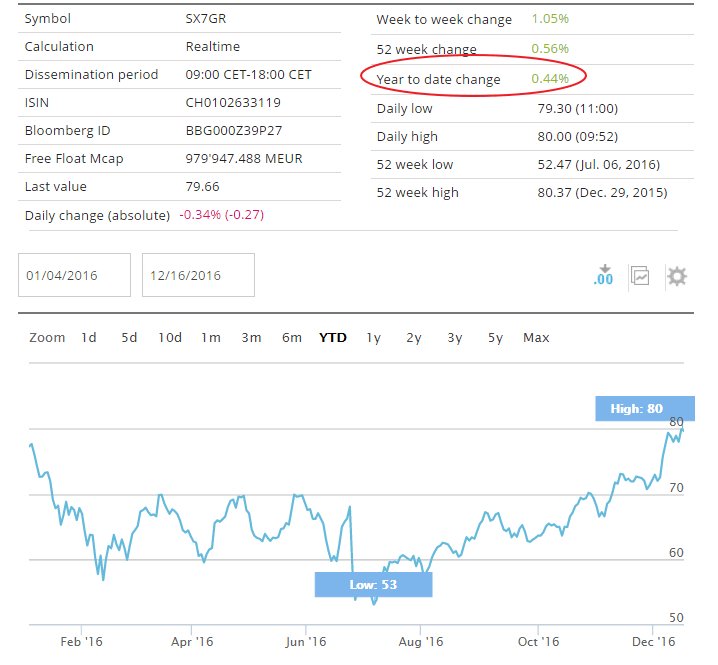
The following chart shows the year-to-date return of the benchmark STOXX Europe 600 Banks Index:

Click to enlarge

euro-stoxx-banks-ytd-chart

Source: STOXX

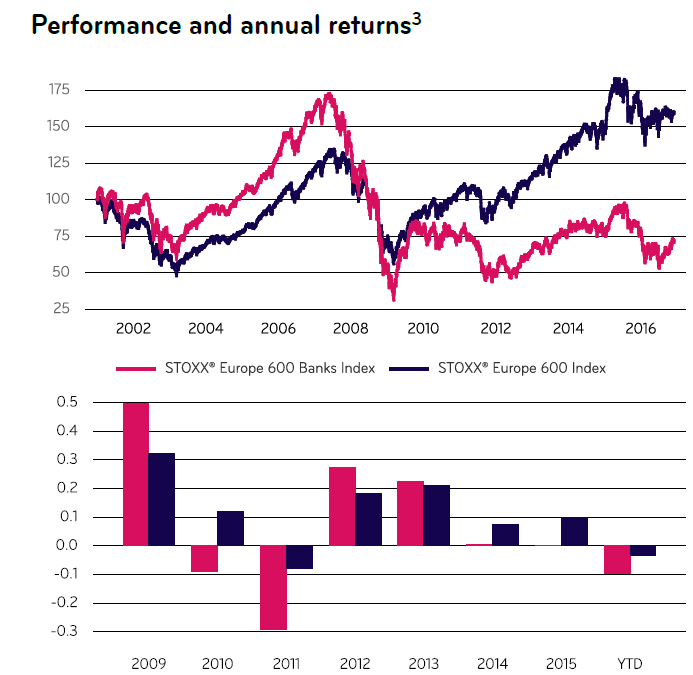
The above index holds 45 large banks from Europe including the UK. The constituents are selected based on free-float market cap.The chart below shows how European banks have lagged the overall market in the past few years:

stoxx-banks-vs-overall-market

Source: STOXX

Currently the index has a trailing dividend yield of 4.1%.

From an investment perspective, though banks from Europe are showing signs of recovery investors may want to wait and see how they perform early next year. European banks still face many headwinds like the Brexit, political crisis in crisis, populist upheavals in other countries, etc.

Investors willing to add European banks can consider Scandinavian banks such as Swedbank AB (SWDBY), Svenska Handelsbanken AB (SVNLY) and Nordea Bank AB (NRBAY). ING Groep NV (ING) is a good pick among the other major banks. However US investors may want to buy it under $10 a share. The bank has recovered from around $9 a few months ago to over $14 now. British, French and German banks are best to avoid now.

Related articles on European banks you can checkout:

Disclosure: Long SWDBY and ING

7 British Stocks To Consider For Dividend Investors

uk-flag

The UK offers an excellent hunting ground for income investors. Britain has traditionally been a market with a strong dividend culture and accordingly many large-cap firms have high dividend yields relative to their US peers. In addition, for US-based investors British dividend stocks are a good choice among foreign stocks since the UK charges no dividend withholding taxes on dividends paid out to US investors. However this rule does not apply to dividends paid out by UK REITs.

According to an article in the Money Observer half of the FTSE 100 dividends are projected to come from just seven firms. From the article:

Dividend research forecasts £39 billion will be paid out by just seven firms in 2017, while dividend cover looks ‘worryingly thin’.

The latest ‘dividend dashboard’ from AJ Bell, which looks at analysts’ forecasts for the FTSE 100 companies, suggests that the blue chip dividend environment looks bleak in 2017.

Although £78.4 billion is forecast to be paid out in 2017 – an increase of 6.25 per cent on 2016 forecasts amounting to a yield of 4.2 per cent – more than half of that (51 per cent) is still expected to come from only seven businesses.

These include oil companies Royal Dutch Shell and BP and pharmaceuticals GSK and AstraZeneca, as well as HSBC, British American Tobacco and Vodafone.

Source: Half of FTSE 100 dividends to come from just seven companies in 2017, Money Observer

The above seven stocks are listed below with their dividend yield on the US market:

1.Company: Royal Dutch Shell PLC (RDS.A)
Current Dividend Yield: 7.05%

2.Company: BP PLC (BP)
Current Dividend Yield: 6.66%

3.Company: GlaxoSmithKline (GSK)
Current Dividend Yield: 5.50%

4.Company: AstraZeneca PLC (AZN)
Current Dividend Yield: 5.13%

5.Company: Vodafone Group PLC (VOD)
Current Dividend Yield:  6.08%

6.Company: British American Tobacco PLC (BTI)
Current Dividend Yield: 3.90%

7.Company: HSBC Holdings PLC  (HSBC)
Current Dividend Yield: 6.14%

Note: Dividend yields noted above are as of Dec 14, 2016. Data is known to be accurate from sources used.Please use your own due diligence before making any investment decisions.

Disclosure: No Positions

How Did U.S. Small-Caps Perform Over Large-Caps In The Long-Term?

U.S. small cap stocks have had a great run since the election ended. Investors have bid up prices of these stocks on the hope that many policy changes such as lower taxes will benefit them more than large companies.As a result, large cap stocks have lagged small caps so far this year. For example, while the S&P is up about 10% the small cap benchmark Russell 2000 is up about double that amount year-to-date.

But did small caps really outperform large caps over the long-term? 

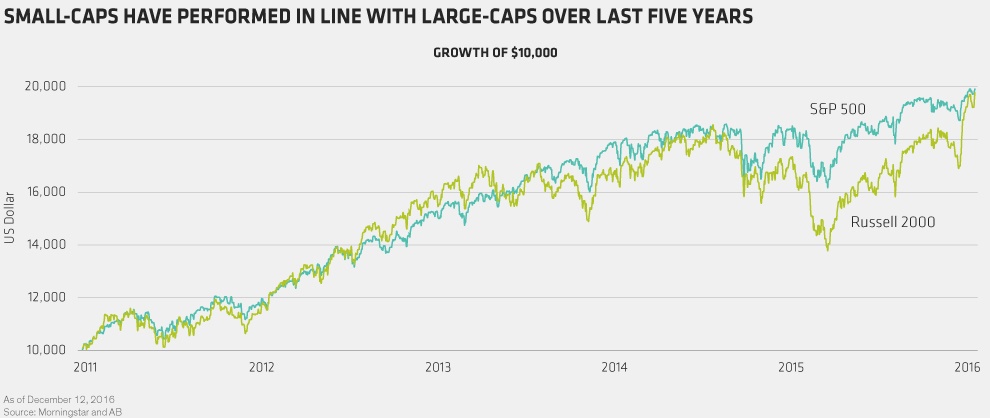
According to an article by James MacGregor, Bruce Aronow at Alliance Bernstein blog, small caps have performed inline with large caps in the past five years as shown in the chart below. So they have not outperformed large-caps.

Click to enlarge

small-vs-large-caps

Source: Trump and Small-Caps: A Perfect Match?, Ab Blog

The key point to remember is that while in the short-term small caps beat large caps, over the long-term especially in the past five years they have simply followed the performance of large caps.So over excitement on small cap stocks is unnecessary.

  • Related ETFs:
  • SPDR S&P 500 ETF (SPY)
  • iShares Russell 2000 ETF (IWM)
  • Vanguard Russell 2000 ETF (VTWO)

Disclosure: No positions

Dow 20,000 Is Just An Arbitrary Round Number

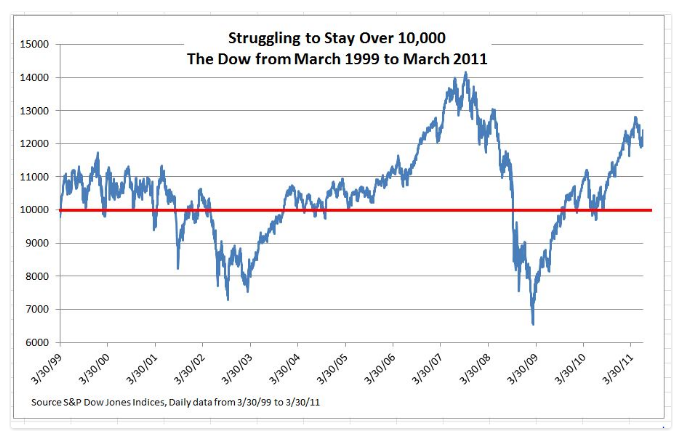
The Dow closed 19,792 today. The media has been highly publicizing the Dow 20,000 story in the past few days as if reaching that figure means some great thing. In reality 20,000 is just another round number. The percentage increase or decrease over a period is more important than 20,000 or any other number.

The last time Dow reached 10,000 it crashed twice over the next 10 years according to an article by David Blitzer at S&P Indexology. The chart below shows the two big bear markets since the Dow reached 10,000:

Click to enlarge

dow-10000-struggle

Source: Round Numbers and the Dow, S&P Indexology