China vs. USA and World: Select Metrics 2013-2016

China is one of the major emerging countries in the world. As the country is a major consumer of many global commodities and is a top exporter of cheap goods to most developed countries, China plays an important role in the global economy. Since China is also a major holder US debt chnages in the Chinese economy and economic reforms have an impact on the US economy. From a poor and undeveloped country for a long time, China has turned into a fast-growing country in a fairly short period of time. Today though the political system followed is Communism, the Chinese economic model is market socialism that has helped unleash its China’s full potential in terms of economic growth. As a result, in some aspects China is far ahead of democratic developed countries.

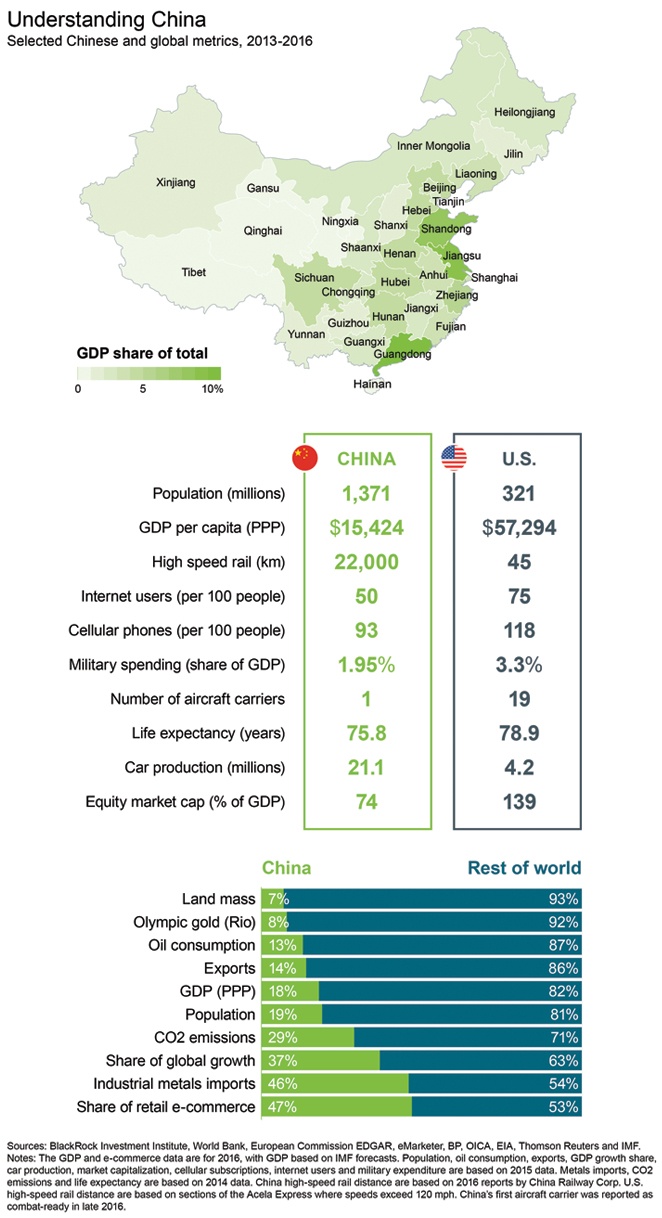
I came across the following graphic from Blackrok showing some stats comparing China with the US and world:

Click to emerge
Source: Why all investors should care about China, Isabelle Mateos y Lago, Blackrock Blog

One of the examples where China beats other countries is the high-speed rail network. China has 22,000 kms of high-speed rail network while the U.S. has just 45. In this form of transportation the U.S. is far behind China. Lack of political will and vision, lack of strong leadership, corruption, politics, special interests and other ills prevent the U.S. from buidling a nice and decent high-speed network like other developed countries and China have done.

In the areas of high-technology such as cellphone and internet usage, aircraft carriers, etc. the U.S. is well ahead of China.As the GDP per capita figures above show, China has still a long way to go before reaching the U.S. economy’s size and standard of living.

it is suprising that the retail e-commerce market in China accounts for 47% of the global market.

Ten FTSE 100 Stocks with the Highest Dividend Yield

The Dogs of the Dow is an investment strategy that involves picking annually the ten highest dividend-paying Dow Jones Industrial Average stocks. Applying this theory to the British equity market, the Dogs of the FTSE 100 strategy selects the 10 FTSE 100 stocks with the highest dividend yields. This strategy has worked out well in the past in terms of returns. From a 2016 article in Money Observer:

Over the past 15 years the Dogs strategy has produced spectacular performance. For example, the 10 Dogs of 2009 made an average return of 86.5 per cent after one year compared with 31.9 per cent for the FTSE 100 index (dividends reinvested).

The Dogs are also well ahead over the past 15 years, growing by an average annual 12.2 per cent in total return terms, two-and-a-half times the 4.8 per cent total return figure for the FTSE 100 index.

However, 2015 proved a more challenging year, and for only the fourth time in their 15-year history, last year’s Dogs underperformed the FTSE 100 index. They suffered total return losses of almost 13 per cent, twice those of the Footsie.

SourceDogs of The Footsie 2016 portfolio, Money Observer

Note: All returns shown above are in the domestic currency (i.e. British Pounds)

The Dogs of the FTSE 100 list for 2017 includes some of the top UK firms. US investors looking to gain exposure to the UK market can use this list as a starting point for additional research.

Two key points to remember about investing in British ADRs are:

  1. The UK does not charge dividend withholding taxes for US investors (except ones paid out by REITs)
  2. British companies traditionally have had one of the highest dividend yirlds in the developed world. Currently the dividend yield on the FTSE 100 is 3.76% compared to around 2% for the S&P 500.

The current Dogs of the Footsie 100 are listed below with their ADR tickers and dividend yield:

1.Company: Royal Dutch Shell PLC (RDS.A)
Current Dividend Yield: 7.17%

2.Company: BP PLC (BP)
Current Dividend Yield: 7.04%

3.Company: Capita Plc
Does not trade on the US markets

4.Company: HSBC Holdings PLC (HBC)
Current Dividend Yield: 8.78%

5.Company:SSE PLC (SSEZY)
Current Dividend Yield: 8.06%

6.Company: Vodafone Group PLC (VOD)
Current Dividend Yield: 6.06%

7.Company: Persimmon PLC (PSMMY)
Current Dividend Yield: 6.43%

8.Company: Legal & General PLC (LGGNY)
Current Dividend Yield: 6.25%

9.Company: Marks & Spencer Plc(MAKSY)
Current Dividend Yield: 7.38%

10.Company: Royal Mail Plc (ROYMY)
Current Dividend Yield: 7.80%

Note: Dividend yields noted above are as of Mar 3, 2017. Data is known to be accurate from sources used.Please use your own due diligence before making any investment decisions.

Source: Dogs of the Footsie 2017: 10 shares yielding 5 per cent plus, Money Observer, Mar 1, 2017′

Disclosure: No Positions

Knowledge is Power: International Stocks, Market Correction, Retirement Tips Edition

Fact of the Week: About 75% of mining companies global are headquatered in Toronto, Canada

Click to enlarge

When in DC, don’t forget to visit the US Postal Museum, Washington DC

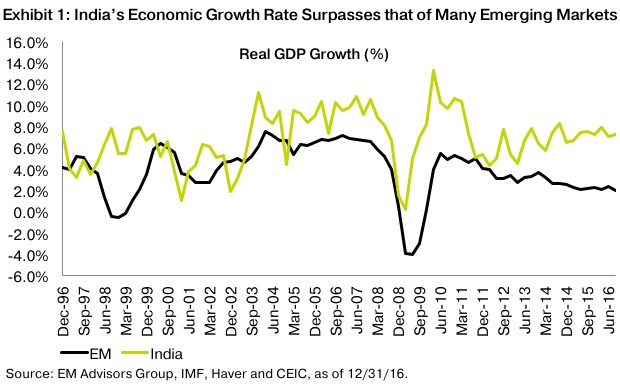
Real GDP Growth Rate: India vs. Emerging Markets

India is one of the major economies among the emerging countries. Recently the Indian government announced that the economy grew at  7 % in the quarter when a demonitization program was launched to unearth untaxed and illegal money held by wealthy Indians.This figure has surprised many economists and investors. From a Bloomberg article Mihir Sharma:

Being the fastest-growing large economy in the world is India’s destiny, and even the most poorly conceived economic policy imaginable can’t stop destiny. At least, that is, if you believe the government’s statisticians, who said on Tuesday that India’s GDP grew at 7 percent in the very quarter that the government withdrew high-value currency notes from circulation.

Is India becoming another China, with incredible growth momentum and statistics nobody quite believes? One hopes not. But the government should be careful to see the new numbers for what they are — and aren’t.

To say the data is startling is an understatement. The IMF had predicted that India would grow at around 6 percent in the half-year after “demonetization,” as it’s called. Most independent economists forecast GDP growth would come in somewhere between 6 and 7 percent. Those economists naturally assumed that withdrawing 86 percent of the country’s currency and reducing access to bank accounts would dampen private consumption.

Yet if one believes the government’s numbers, taking away most of India’s cash overnight didn’t hurt private spending at all. In fact, private consumption rose by 10.1 percent over the quarter. That’s the highest growth in spending in over five years, and it came at a time when consumer confidence was falling sharply.

Source: Is Indian Data Turning Chinese?, Bloomberg , Mar 1, 2017

But despite the current doubts over stats published by the state, over the past many years India’s GDP growth is an envy of the emerging world. While India’s average annual growth rate is around 5.8% in recent years, over the long run India’s growth has outpaced the growth rate of other emerging markets.

Click to enlarge

Source: India: A Bright Star Among Emerging Markets, Oppenheimer Funds

Citing positive economic reforms undertaken by the state, Meral Karasulu of Oppenheimer Funds is bullish on Indian equities especially over the long run.

Are Investors Overestimating Europe’s Political Risks?

European equities continue to trade at a discount compared to their developed world peers. For many years, when Europe suffered from one crisis after another including the soverign debt crisis, may rounds of Greek debt crisis, etc. investors fled European equities fearing total meltdown of the political and economic order. More recently, last year the usually traditional and conservative British shook the continent and the world with their suprisee vote for Brexit. Fears of crash in the British equity amrket were proven wrong when stocks soared after the decision.

This year Europe is back in focus on investors’ minds as another set of elecctions are scheduled to take place in Germany, France, The Netherlands and Italy. With populist surge sweeping the US and UK, investorrs are rightfully worried about the outcome of eletions in these countries. As France and Germany are two of the major economies in Europe, any major shakeup in the political system there will have reverberations across the EU.

Though political risk is an important factor to consider when investing in foreign countries, it should be noted that Western European countries are highly devleoped with strong democratic instiutions and so political stability will prevail despite short-term uncertainity. The past European crisis have shown that fears of collpase of the Euro and the EU are overblown.

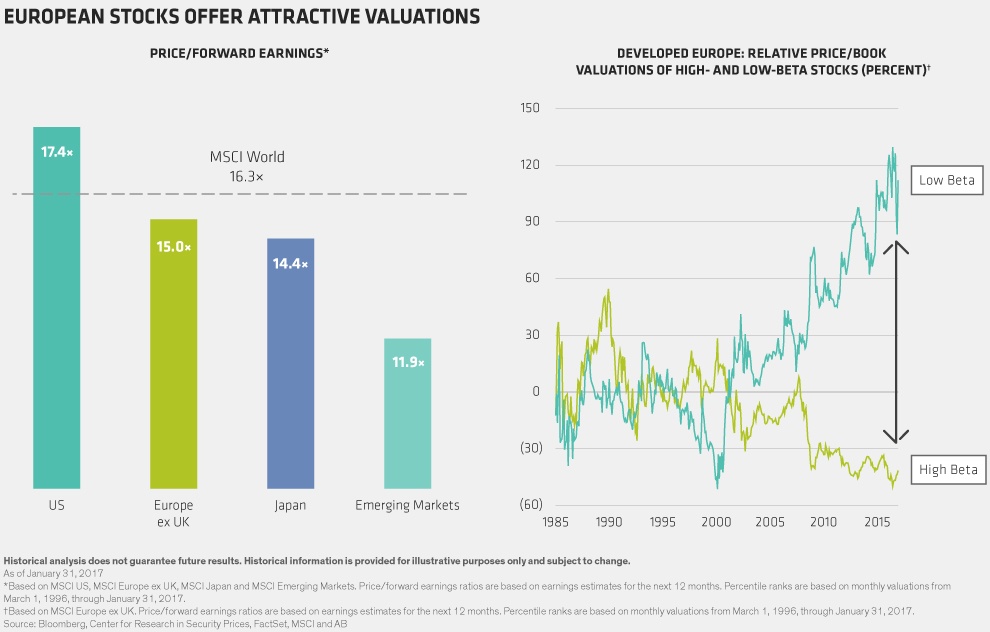
According to an article at Alliance Bernstein blog, European stocks valuations are attractive relative to other markets. And political risks need not justify high discounts compared to other developed markets. From the article:

Today, European stock markets offer abundant opportunities. European equities are attractively valued, in our view, at a price/forward earnings ratio of about 15x—an 8% discount to global developed stocks and a 17% discount to US stocks (Display, left). High-beta stocks, which are generally considered riskier, trade at very deep price/book discounts versus low-beta stocks. In other words, many investors are still overpaying for perceived safety, creating plentiful mispricing for stock pickers to exploit.


Source: Does Political Risk Matter for European Stocks?By Tawhid Ali, Andrew Birse, AB Blog

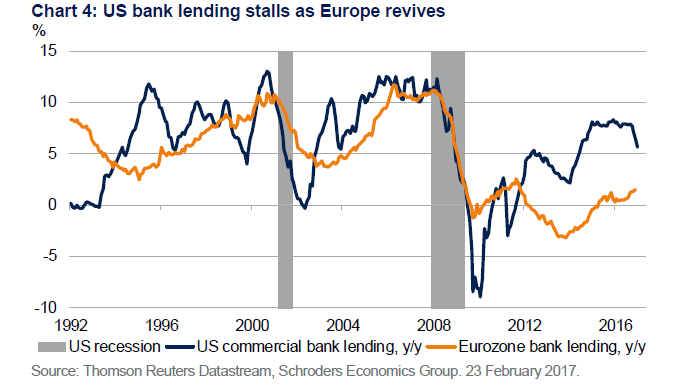
Many European economic indicators are showing signs of growth. For example,commercial lending is picking up compared to US.

Click to enlarge

Source: Schroders Economic and Strategy Viewpoint, Schroders, March 2017

So investors with a long-term horizon of five years or more can consider European stocks. Though political risks have to be considered, one need not overweight them to the point of completely avoiding European companies.

Some of the European stocks that investors can consider for long-term investment include: Nestle SA (NSRGY), Reckitt Benckiser Group plc (RBGLY), Henkel AG & Co KGaA (HENKY), Diageo PLC (DEO), Syngenta AG (SYT), Total SA (TOT) and Autoliv Inc (ALV).

Disclosure: Long RBGLY and ALV

Also see: European shares are cheap: time to get greedy?, Money Observer, Feb 27. 2017