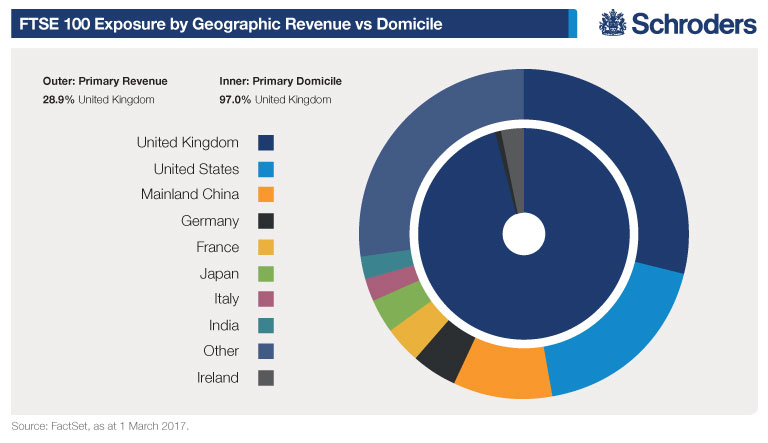
FTSE 100 Exposure by Geographic Revenue vs. Domicile

The British equity market has recovered strongly since the Brexit decision early last year. One of the main reason for the resilence of British stocks is that most of the revenues of the FTSE 100 firms come from abroad. As a result, the FTSE 100 firms are dependent on the economies of foreign countries than the domestic market. Due to its former colonial roots many of UK’s top multinational firms have strong presence in other countries especially in emerging countries which used to be ruled by the British. Some of these multinational firms such as Unilever(UL) and BP(BP) have had operations in emerging markets since the 19th century.

In general, investing in FTSE 100 companies is more of a bet on other countries than the UK.  According to an article at Schroder’s only 29% of the revenues of FTSE 100 firms come from the UK.

The following graphic shows the revenue source for FTSE 100 firms by country/region:

Click to enlarge
Source: The road to Brexit: what’s next for investors?, Schroder’s

The US is a top market for Footsie firms than France and Germany.

Related ETF:

  • iShares MSCI United Kingdom Index (EWU)

Disclosure: No Positions
 

Potential Winners and Losers from Trump’s Policies

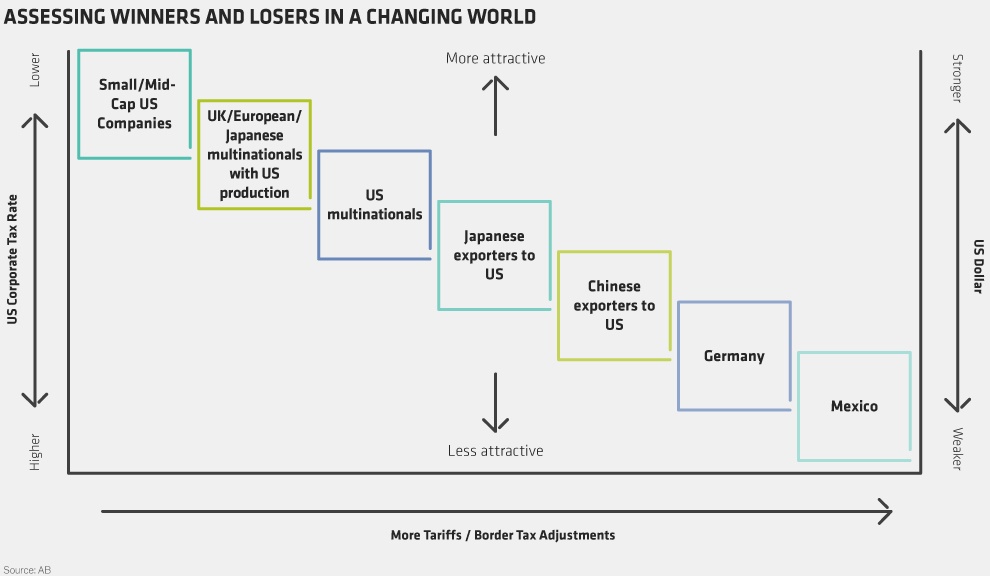
The following is a simple chart showing potential winners and loser’s from Trump’s policies:


Source: Evaluating the Trump Effect on Global Equities by Mark Phelps, Dev Chakrabarti, AB Blog, Mar 2, 2017

According to the authors of the above article, US small and mid-caps appear attractive based on three major variables—tax cuts, tariffs and the US dollar, as they focus on the domestic market.

Also see: RBC: 20 Canadian Stocks To Gain From Trump’s Policies

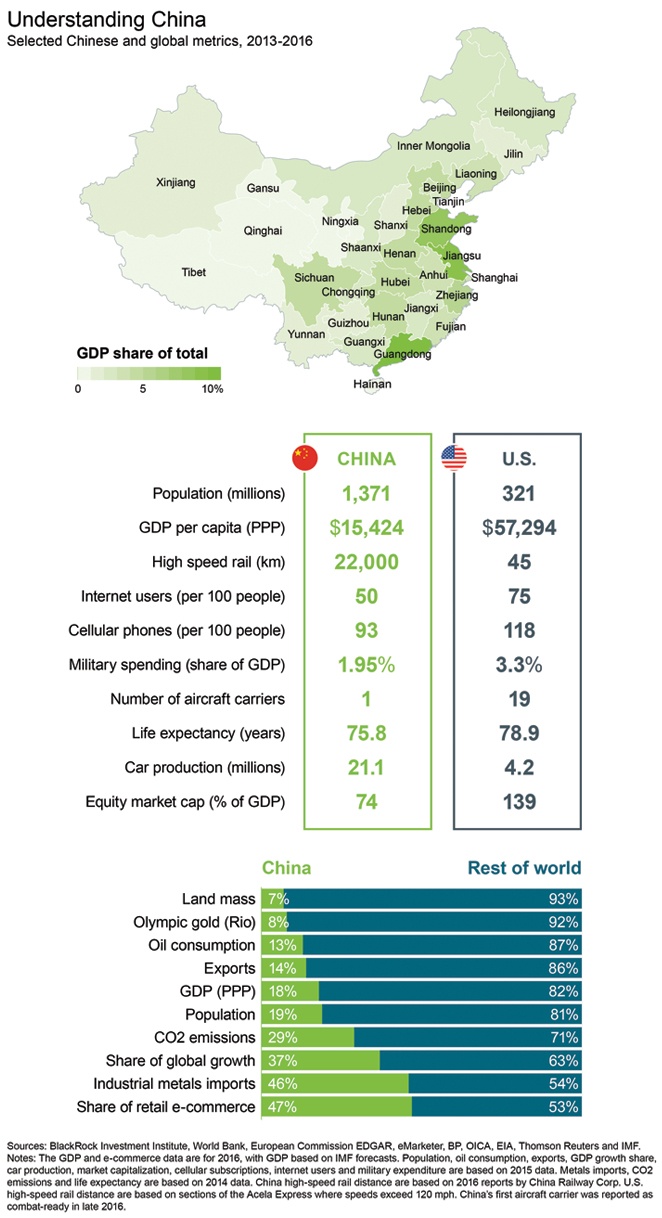
China vs. USA and World: Select Metrics 2013-2016

China is one of the major emerging countries in the world. As the country is a major consumer of many global commodities and is a top exporter of cheap goods to most developed countries, China plays an important role in the global economy. Since China is also a major holder US debt chnages in the Chinese economy and economic reforms have an impact on the US economy. From a poor and undeveloped country for a long time, China has turned into a fast-growing country in a fairly short period of time. Today though the political system followed is Communism, the Chinese economic model is market socialism that has helped unleash its China’s full potential in terms of economic growth. As a result, in some aspects China is far ahead of democratic developed countries.

I came across the following graphic from Blackrok showing some stats comparing China with the US and world:

Click to emerge

Source: Why all investors should care about China, Isabelle Mateos y Lago, Blackrock Blog

One of the examples where China beats other countries is the high-speed rail network. China has 22,000 kms of high-speed rail network while the U.S. has just 45. In this form of transportation the U.S. is far behind China. Lack of political will and vision, lack of strong leadership, corruption, politics, special interests and other ills prevent the U.S. from buidling a nice and decent high-speed network like other developed countries and China have done.

In the areas of high-technology such as cellphone and internet usage, aircraft carriers, etc. the U.S. is well ahead of China.As the GDP per capita figures above show, China has still a long way to go before reaching the U.S. economy’s size and standard of living.

it is suprising that the retail e-commerce market in China accounts for 47% of the global market.

Ten FTSE 100 Stocks with the Highest Dividend Yield

The Dogs of the Dow is an investment strategy that involves picking annually the ten highest dividend-paying Dow Jones Industrial Average stocks. Applying this theory to the British equity market, the Dogs of the FTSE 100 strategy selects the 10 FTSE 100 stocks with the highest dividend yields. This strategy has worked out well in the past in terms of returns. From a 2016 article in Money Observer:

Over the past 15 years the Dogs strategy has produced spectacular performance. For example, the 10 Dogs of 2009 made an average return of 86.5 per cent after one year compared with 31.9 per cent for the FTSE 100 index (dividends reinvested).

The Dogs are also well ahead over the past 15 years, growing by an average annual 12.2 per cent in total return terms, two-and-a-half times the 4.8 per cent total return figure for the FTSE 100 index.

However, 2015 proved a more challenging year, and for only the fourth time in their 15-year history, last year’s Dogs underperformed the FTSE 100 index. They suffered total return losses of almost 13 per cent, twice those of the Footsie.

Source: Dogs of The Footsie 2016 portfolio, Money Observer

Note: All returns shown above are in the domestic currency (i.e. British Pounds)

The Dogs of the FTSE 100 list for 2017 includes some of the top UK firms. US investors looking to gain exposure to the UK market can use this list as a starting point for additional research.

Two key points to remember about investing in British ADRs are:

  1. The UK does not charge dividend withholding taxes for US investors (except ones paid out by REITs)
  2. British companies traditionally have had one of the highest dividend yirlds in the developed world. Currently the dividend yield on the FTSE 100 is 3.76% compared to around 2% for the S&P 500.

The current Dogs of the Footsie 100 are listed below with their ADR tickers and dividend yield:

1.Company: Royal Dutch Shell PLC (RDS.A)
Current Dividend Yield: 7.17%

2.Company: BP PLC (BP)
Current Dividend Yield: 7.04%

3.Company: Capita Plc
Does not trade on the US markets

4.Company: HSBC Holdings PLC (HBC)
Current Dividend Yield: 8.78%

5.Company:SSE PLC (SSEZY)
Current Dividend Yield: 8.06%

6.Company: Vodafone Group PLC (VOD)
Current Dividend Yield: 6.06%

7.Company: Persimmon PLC (PSMMY)
Current Dividend Yield: 6.43%

8.Company: Legal & General PLC (LGGNY)
Current Dividend Yield: 6.25%

9.Company: Marks & Spencer Plc(MAKSY)
Current Dividend Yield: 7.38%

10.Company: Royal Mail Plc (ROYMY)
Current Dividend Yield: 7.80%

Note: Dividend yields noted above are as of Mar 3, 2017. Data is known to be accurate from sources used.Please use your own due diligence before making any investment decisions.

Source: Dogs of the Footsie 2017: 10 shares yielding 5 per cent plus, Money Observer, Mar 1, 2017′

Disclosure: No Positions

Knowledge is Power: International Stocks, Market Correction, Retirement Tips Edition

Fact of the Week: About 75% of mining companies global are headquatered in Toronto, Canada

Click to enlarge

When in DC, don’t forget to visit the US Postal Museum, Washington DC