Ideal Placement Location for Investments: Taxable vs. Non-Taxable Accounts

One of the annual rituals that American taxpayers go through around this time of the year is the filing of taxes. So now is a good time to consider investment assets and their tax implications. For equity investors, it is very important to understand the tax consequences of investments since various asset classes are taxed differently based on where the assets are held.

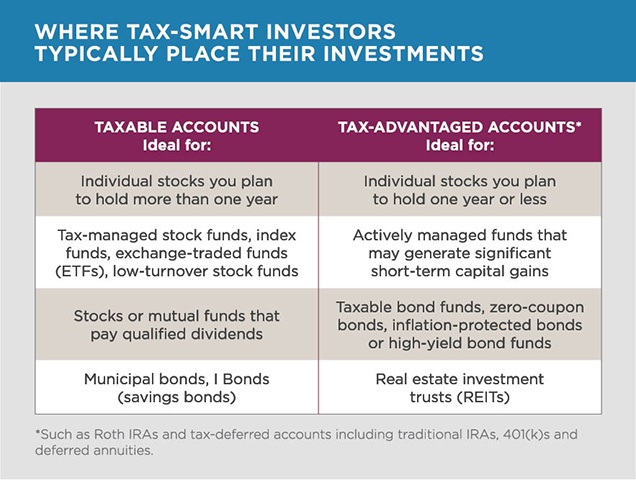
For instance, taxable accounts such as regular brokerage accounts are best suited for some type of investments like foreign stocks(excluding some), stocks to be held for the long-term, ETFs, etc. Non-taxable accounts such as retirement accounts are ideal for holding instruments like REITs, short-term stock investments, etc. Since most REITs pay high dividends holding them in non-taxable accounts avoid taxes.If they are held in taxable accounts, then dividends will be taxed especially at the rate of ordinary income taxes and not the favorable qualified or non-qualified dividend tax rates.

Owners of foreign stocks have to pay careful attention to foreign dividend taxes and their impacts. Stocks from high tax countries such as Switzerland should not be held in non-taxable accounts since the taxes paid cannot be recovered. So a big chunk of dividends will be lost of taxes. Canada does not deduct this tax for stocks (excluding REITs) held in qualified US retirement accounts. So Canadian stocks are good candidates to hold for the long-term in non-taxable accounts like an IRA or 401-K account.

The table below shows the best placement location for various asset types:


Click to enlarge
Source:  The Importance of Tax-Efficient Investing by By Rande Spiegelman, April 3, 2017, Charles Schwab
Indian Stock Market Is Expensive Based On Valuation

The Indian equity market is one of the top performing emerging markets so far this year. The benchmark S&P BSE Sensex crossed the 30,000 mark for the first time in many months. The index closed yesterday at 29575 for a gain of over 11% this year.

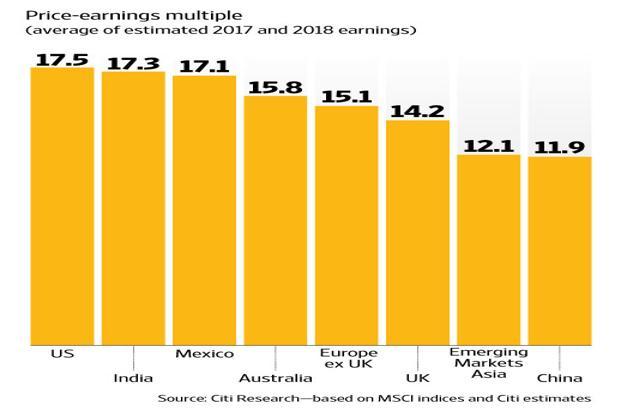
Though Indian stocks have the potential for further growth, on a valuation basis they are second most expensive in the world according to a report by Citi. The current forward P/E ratio of 17.3 is well above its mean. Incidentally the US is the most expensive market based on this ratio.

Click to enlarge

Source:India is one of world’s most expensive stock markets, Live Mint, Apr 10, 2017

Also see:

Discretionary Federal Spending 2016: Chart

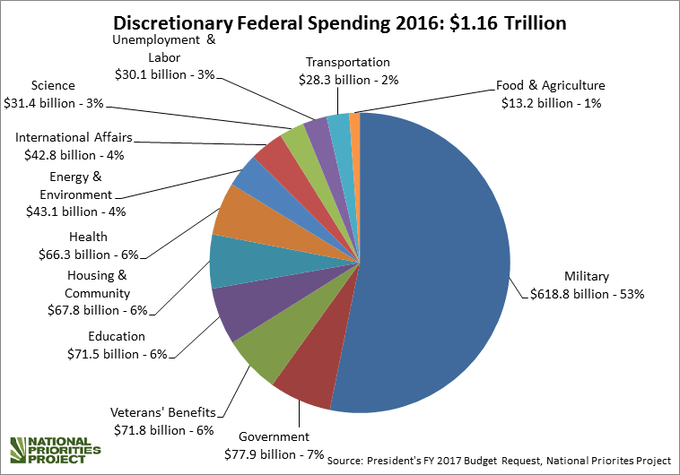
The US is the top country in terms of defense spending. None of the other countries in the world spend as much on military as the US does. According to a report by National Priorities Project, in 2016 more than half of the discretionary federal spending was spent on military. To put it another way, 53% or over $618.0 billion of the discretionary budget of $1.16 Trillion went to defense.

Click to enlarge

Source: The Militarized Budget 2017, National Priorities Project

Because more than of the spending is diverted to building weapons and other military stuff, other parts of the economy get smaller funding. For example, food and agriculture got 1%, health got 6% and transportation received 2%. High defense spending gives the country the world’s most powerful military. But lack of adequate spending in other areas leads to poor quality infrastructure, health, education, housing, etc. For example, transportation industry is a mess from roads to railroads to airports with some airports looking like third-world countries.