Number of US Stocks vs. Indices: Chart

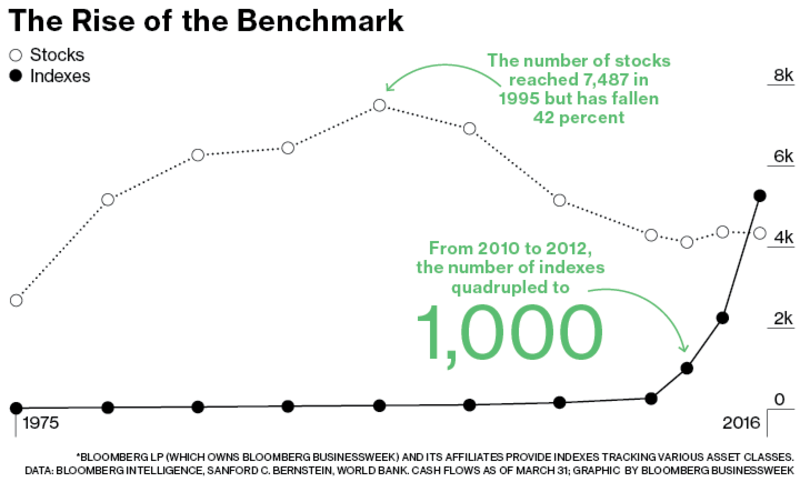
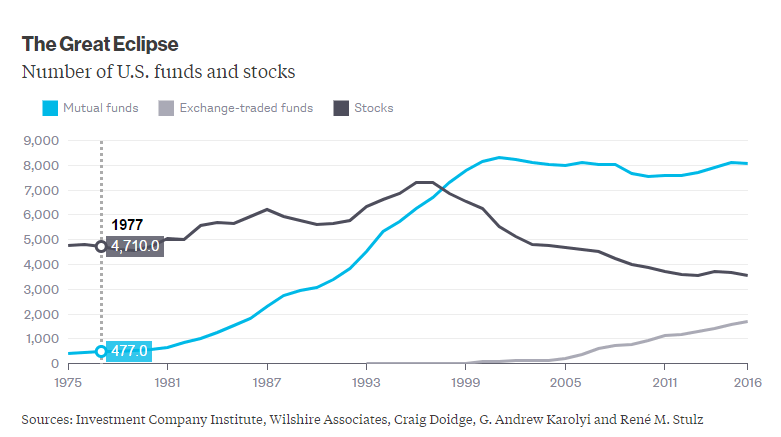
The number of stocks listed on US markets continue to decline. However the number of indices created based on US stocks has soared and now excess the number of stocks according to an article at Bloomberg.

Click to enlarge
Source:

This situation is similar to the one related to the number of US stocks and mutual funds. A few years ago I wrote that the number of mutual funds has exploded while the number of companies listed has declined. In fact, back in 2010 there were over 7,500 mutual funds compared to around 5,00o stocks.

Today there are over 5,000 indices. But the total number of listed US stocks stood at just 4,331 at the end of 2016 according to World Federation of Exchanges.

From an investment point of view, rising number of indices and mutual funds relative to the number of listed companies is not good.

Updated:
 

Source: Bloomberg

Related:
Which Canadian Banks Have High Exposure To The US Market?

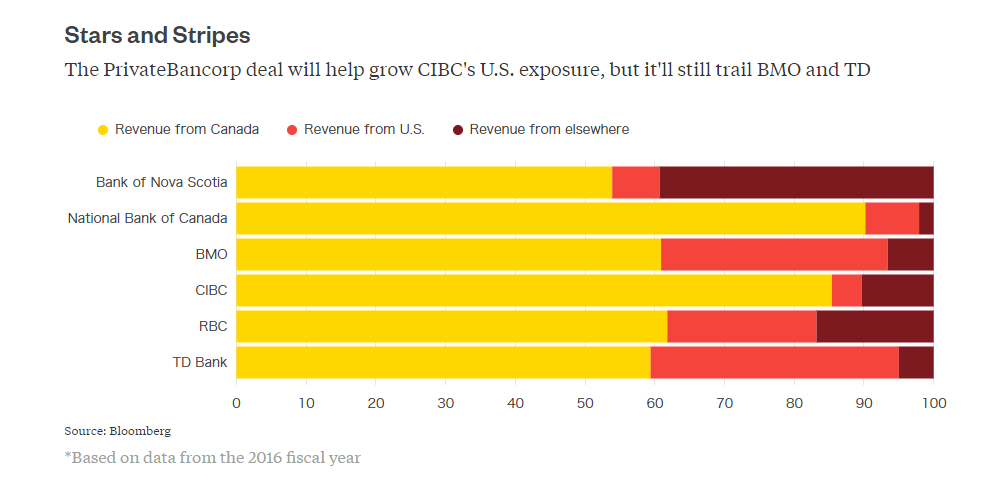
The Canadian banking industry is saturated as the market is small. So large domestic tend to diversify among other markets The US is one of the obvious choices for these banks due to close proximity and the size of the market. Among the six major Canadian banks, TD has the most exposure to the US followed by BMO. National Bank of Canada depends on the domestic market for most its revenues. Of the other large five banks CIBC is most exposed to the local market. Hence CIBC is acquiring Illinois-based PrivateBancorp(PVTB) in order to expand in the US.

Click to enlarge

Source: CIBC’s Close Call Is Cold Comfort for Canadian Banks, Bloomberg

Outside of Canada, Bank of Nova Scotia generates more of its revenues from regions other than the US. Much of this revenues comes from the Caribbean and Latin American countries where the bank has a large presence.

The five major Canadian banks listed on the US exchanges are shown below with their current dividend yields:

1.Company: Bank of Nova Scotia (BNS)
Current Dividend Yield: 4.16%

2.Company: Bank of Montreal (BMO)
Current Dividend Yield: 3.76%

3.Company: Canadian Imperial Bank of Commerce (CM)
Current Dividend Yield: 4.86%

4.Company: Royal Bank of Canada (RY)
Current Dividend Yield: 3.82%

5.Company: Toronto-Dominion Bank (TD)
Current Dividend Yield: 3.89%

Note: Dividend yields noted above are as of May 12, 2017. Data is known to be accurate from sources used.Please use your own due diligence before making any investment decisions.

Disclosure: Long all five banks listed above.

On The Impact of Political Events on Stocks

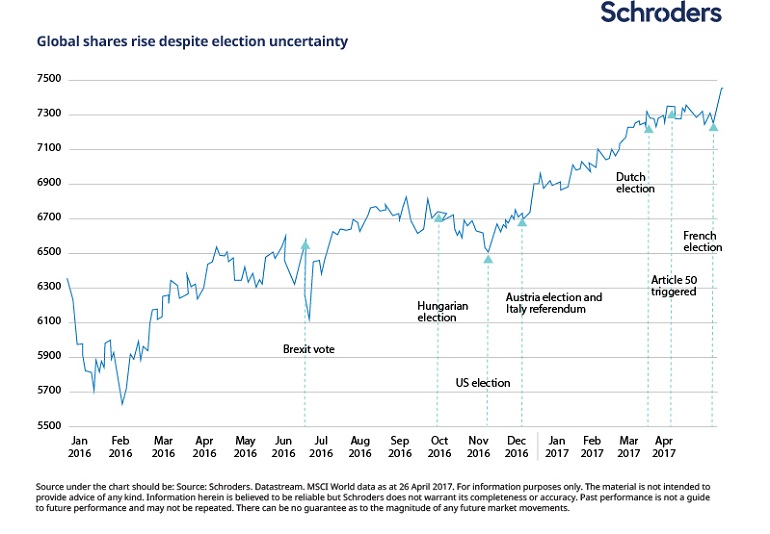
Politics generally does not have a strong impact on the stock market especially in the long-run. Major political events such as the unexpected outcome on election may have a short-term impact but over the years politics does not determine the performance of stocks.

Since 2016 major political events have had negligible impact on stocks. The MSCI World Index has continued to move higher despite negative events such as the Brexit as shown in the chart below:

Click to enlarge

Source: A political checklist for stockmarket investors, Schroders

From the above article:

Since a post-Brexit low of 6,105.5 on 27 June, the MSCI World index – a broad measure of global stockmarkets – has risen by nearly 20%.

$1,000 invested in global shares on a total return basis, if we include dividends, on 27 June 2016 would now be worth $1,200. This is with inflation taken into account.

The key takeaway for investors from the above chart is that politics does not drive the performance of stocks. When political shocks such as the Brexit or the outcome of the recent US elections do occur, investors should not get carried away. Instead they should focus on their long-term goals and try to take advantage of any short-term dislocation in equity prices.

Related ETFs:

  • iShares MSCI Emerging Markets ETF (EEM)
  • Vanguard MSCI Emerging Markets ETF (VWO)
  • SPDR S&P 500 ETF (SPY)
  • Vanguard Dividend Appreciation ETF (VIG)
  • SPDR S&P Dividend ETF (SDY)
  • iShares Dow Jones U.S. Select Dividend ETF (DVY)

Disclosure: No Positions

Auto Workers in Mexico Earn Less Than Those in China

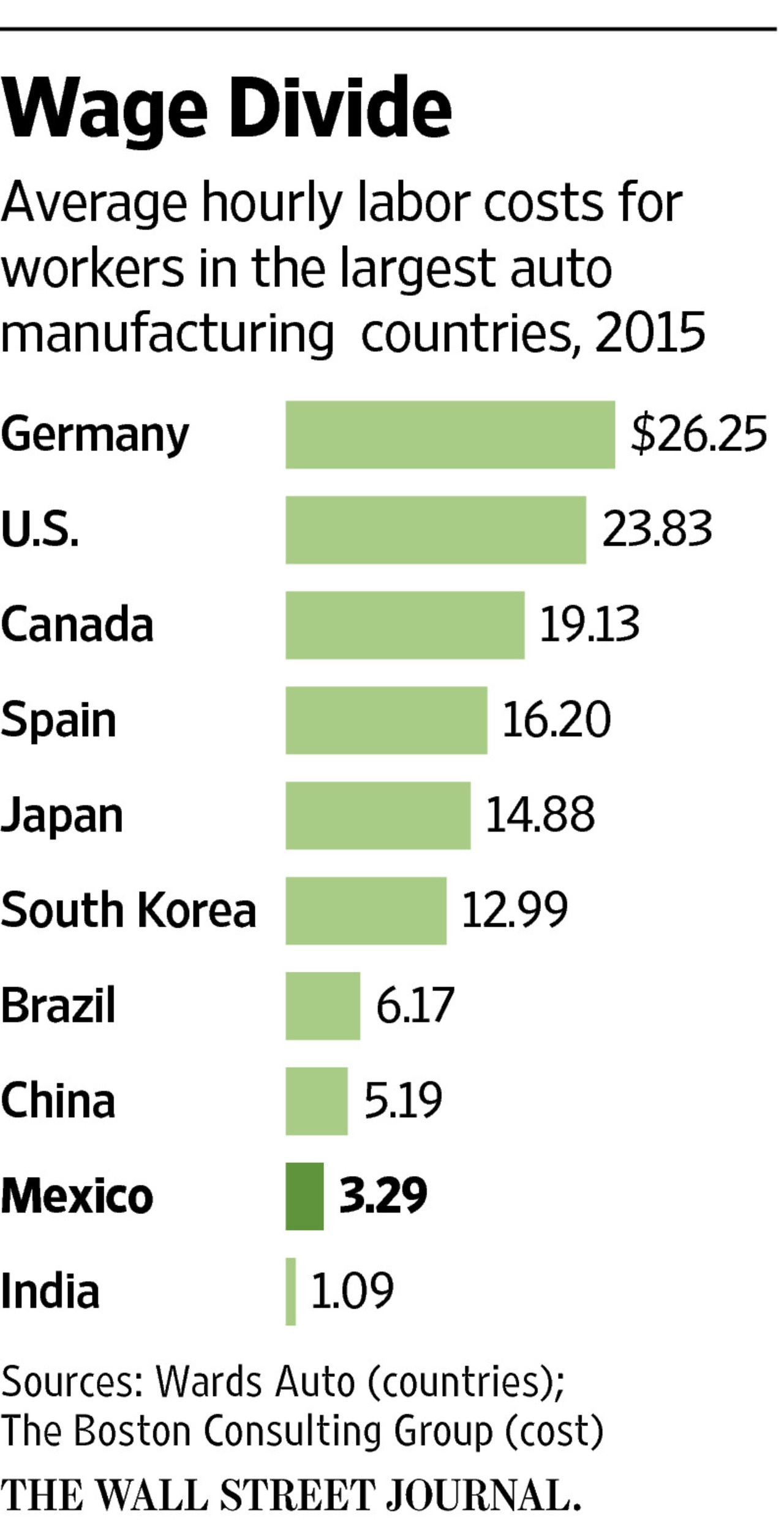
In an article last last year I discussed the average hourly wage rate for auto workers in select countries. I wrote “Mexicans working at the auto factories get between $1 an hour to $ 3 an hour. Mexico’s minimum wage is 73 pesos or $4 a day. Hence auto workers earn much more than the prevailing minimum wage. Despite this Mexican workers are far cheaper since in all the developed countries hourly wages run into double digits. Mexico has many advantages for auto manufacturing due to many factors including the cheap labor, railroad and road transportation links and close proximity to the US.”

Source: It’s Getting Harder and More Expensive to Make Cars in Mexico, WSJ, Aug 14, 2016

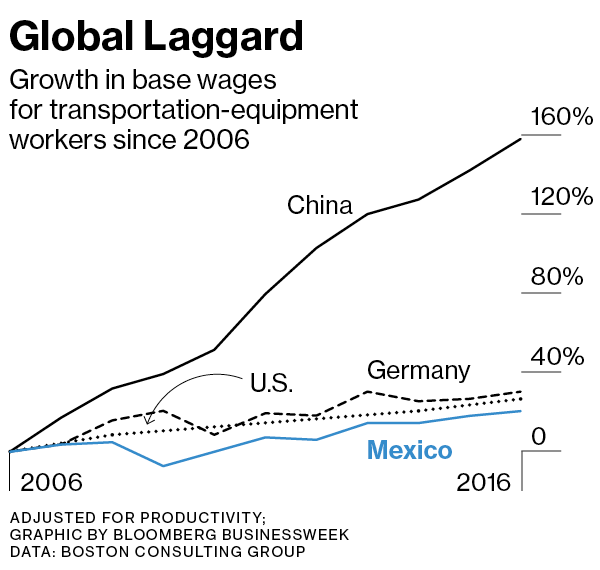
Bloomberg published an interesting piece last week discussed why Mexican auto workers’ age is very low and why it is not increasing. It seems like powerful unions and politicians that run the country basically sell out auto workers behind their backs. From the article:

At a ceremony at Mexico’s Los Pinos presidential residence in July 2014, BMW Chief Executive Officer Harald Krüger pledged to spend $1 billion to build a factory in the northern state of San Luis Potosí that will employ 1,500 workers. To mark the occasion, he presented President Enrique Peña Nieto with a model of a silver BMW race car.

The German automaker had unwrapped its own gift two days earlier, a labor contract signed by a representative from the state chapter of the Confederación de Trabajadores de México (CTM), the country’s largest union confederation, and notarized by a Labor Ministry official. The document, which Bloomberg reviewed, sets a starting wage of about $1.10 per hour and a top wage of $2.53 for assembly-line workers. The starting rate is only a bit more than half the $2.04 an hour that is the average at Mexican auto plants, says Alex Covarrubias, a lecturer at the University of Sonora in Hermosillo.

The paperwork was filed two years before BMW broke ground on the new plant, which will turn out $45,000 3 Series sedans. When workers begin to stream into the factory sometime next year, there’s a good chance most won’t know they belong to a union.

So-called protection contracts— agreements negotiated between a company and a union that doesn’t legitimately represent workers—are illegal in the U.S. and Germany. But Lance Compa, a senior lecturer at Cornell’s School of Industrial and Labor Relations, says they’re standard operating procedure in Mexico, where deals are cut factory by factory rather than collectively across a company or industry. Experts say this is a primary reason that wages in the auto sector have stagnated in recent years, despite a fresh wave of investments by foreign carmakers, most recently by German and Japanese manufacturers. Mexico’s union bosses and politicians are more interested in keeping corporations happy than in raising the living standards of workers, Covarrubias argues. “Protection contracts are a way to keep wages artificially low,” he says.


SourceHow Mexico’s Unions Sell Out Autoworkers, Bloomberg, May 5, 2017

The entire Bloomberg article is worth a read.

Related: