The List of 10 Priciest US Stocks

Some of the companies trading in the US markets have stock prices that are in the hundreds or even thousands of dollars. As the prices are so high they may not suitable for retail investors especially those that can afford only small funds to invest. For instance, it may not be feasible to easily buy 100 stocks when the price per share is too high. High-flying tech stocks such as Amazon and Google are two such examples.

The 10 Priciest Stocks in the US market are shown in the table below:

S.No.CompanyTickerClosing Price on June 16, 2017
1Berkshire Hathaway Inc. Class ABRK-A $256,450.00
2Seaboard Corp.SEB $4,103.80
3NVR Inc.NVR $2,444.68
4Priceline Group Inc.PCLN $1,802.61
5Amazon.com Inc.AMZN$987.71
6Alphabet Inc. Class AGOOGL$958.62
7Markel Corp.MKL$982.66
8Alphabet Inc. Class CGOOG$939.78
9Intuitive Surgical Inc.ISRG$914.84
10White Mountains Insurance Group Ltd.WTM$874.20

Source: Amazon’s Brush With $1,000 Signals the Death of the Stock Split, WSJ

Warren Buffet’s Berkshire Hathaway’s Class A (BRK-A) shares closed at over $256,000 per share on Friday. There are not many retail investors who can buy 1 share let alone 100 of this stock. Even companies such as Amazon(AMZN) and Google(GOOG) trade at such high levels since they haven’t split their shares after a strong run up. Since most investors invest via mutual funds or ETFs high share prices do not adversely affect investors according to these firms and other experts.

Priceline(PCLN) used to be a fad during the dot com era. But since then it has re-emerged as a leader in the online hotel and flight booking space. Others in the list such as White Mountains Insurance Group Ltd., Markel, SEB, etc. may not be familiar to some investors including myself.

Disclosure: No Positions
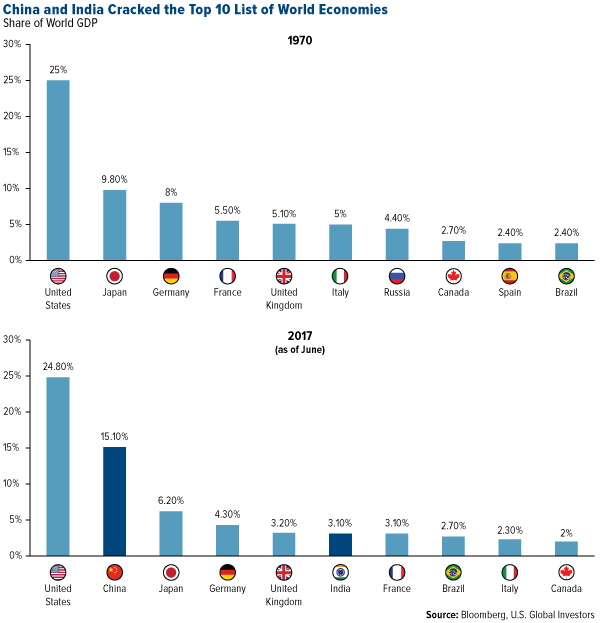
The Top 10 Economies of the World in 1970 vs. 2017: Chart

The 20th century belonged to the US and is known as the “American Century”. The 21st century is projected to be the “Asian Century” as countries such as China and India rise as world’s leading powers although economically and not militarily. Already these two countries have joined the list of the world’s top 10 economies as shown in the chart below. In 1970, neither of them were in the list. Spain which used to be the world’s wealthiest country in the 16th century and Russia were replaced by China and India.

Click to enlarge


Source: One Easy Way to Invest in the “Asian Century” by Frank Holmes, US Funds

Total Returns During US Equity Secular Bull and Bear Markets Since 1877

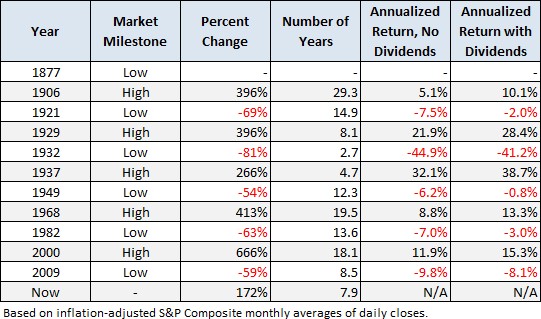
The US equity market is currently in a secular bull market. In a secular bull market stocks keep going up and up until the party ends. Secular bull markets are of course followed by secular bear markets where stocks go nowhere for years. For instance, the first decade of the 21st century was “The Lost Decade” for US stocks when stocks ended up earning nothing excluding dividends.

The difference in total returns between bull and bear markets can be quite dramatic according to an article by Niels Clemen Jensen at Absolute Return Partners, UK. From the article:

Another example is the wider performance of equity markets. At the very highest level, I divide equity markets into secular bull and secular bear markets. Over the last 150 years or so, the US has enjoyed six secular bull markets and only five secular bear markets (exhibit 2).

A secular bull market is characterised by rising earnings multiples, whereas earnings multiples decline in secular bear markets. Falling earnings multiples lead to the sharply lower returns that characterise secular bear markets. As you can see, the difference in total returns between secular bull and bear markets is quite dramatic.

Exhibit 2: Secular US equity bull and bear markets since 1877
Source: Jill Mislinski, Advisor Perspectives, March 2017, www.advisorperspectives.com

Source: May 2017- Investment Rules, The Absolute Return Letter, Absolute Return Partners

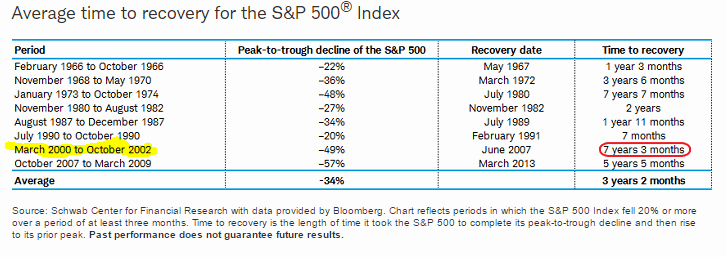
The average time for the S&P 500 since the 1960s from peak to trough and then to recover to its peak has been around four years according to article by Rob Williams at Schwab. So investors have to have the patience to wait it out in case they get caught in bear markets.

Click to enlarge

Source: Market Volatility: What If You Don’t Have Time to Recover?, Schwab

Related ETFs:

  • SPDR S&P 500 ETF (SPY)

Disclosure: No Positions

Also checkout: Length of Bear Markets Since 1920s, TFS