U.S. Utility Sector Has The Lowest Exposure To Foreign Revenues

Utility stocks have long been the favorites of income seeking investors. As monopolies in the markets they operate utilities offer stable growth and excellent dividends. In terms of adverse market conditions these stocks can offer stability and downward protection to a well-diversified portfolio.

Another advantage of holding utilities is that they have the lowest foreign revenue exposure. Hence this sector will not be too much impacted by volatility in emerging and other developed markets. The chart below shows the foreign-revenue exposure of S&P 500 sectors:

Click to enlarge

Source: GLOBAL EQUITY OUTLOOK – Spring 2017, Janus Henderson

As shown above, the tech sector is the most exposed to foreign markets while utilities have the lowest foreign revenue exposure.

The Dow Jones Utility Index is up by 7.17% year-to-date excluding dividends. This is slightly lower than the 8.24% price return for the S&P 500. Investors looking to gain exposure to the utility sector have plenty of options on the US market. Ten utilities are listed below with their current dividend yield for further research:

1.Company: Duke Energy Corporation (DUK)
Current Dividend Yield: 4.09%

2.Company: NextEra Energy Inc (NEE)
Current Dividend Yield: 2.80%

3.Company: Dominion Resources, Inc. (D)
Current Dividend Yield: 3.94%

4.Company: Southern Company (SO)
Current Dividend Yield: 4.85%

5.Company: Exelon Corporation (EXC)
Current Dividend Yield: 3.63%

6.Company: American Electric Power Co. (AEP)
Current Dividend Yield: 3.40%

7.Company: PG&E Corporation (PCG)
Current Dividend Yield: 3.19%

8.Company: PPL Corporation (PPL)
Current Dividend Yield: 4.09%

9.Company: Public Service Enterprise Group Inc. (PEG)
Current Dividend Yield: 4.00%

10.Company: Edison International (EIX)
Current Dividend Yield: 2.78%

Note: Dividend yields noted above are as of June 30, 2017. Data is known to be accurate from sources used.Please use your own due diligence before making any investment decisions.

Disclosure: Long NEE
On the Impact of the Declining Average Tenure of a Company in the S&P 500 Index

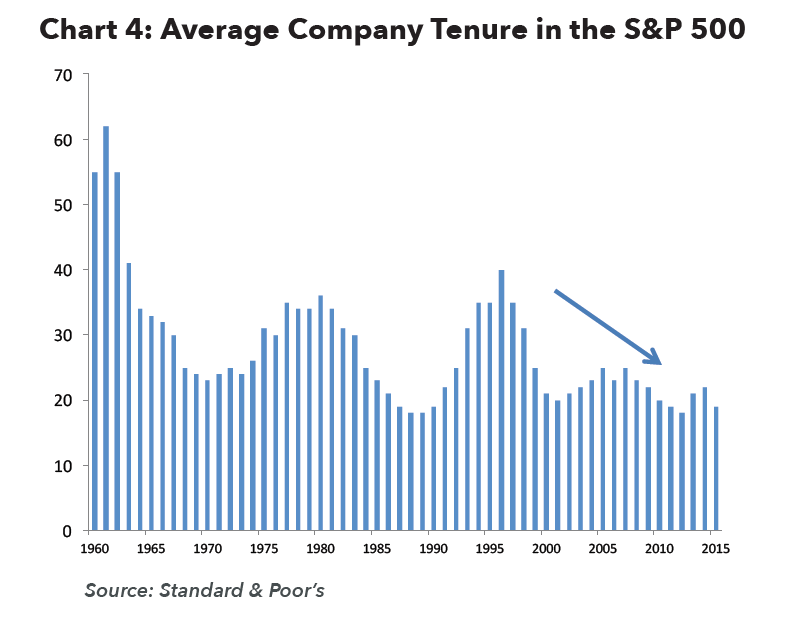
The average tenure of a company in the S&P 500 index has been on a decline for many years now. According to one research report, the average tenure is under 20 years now. So a S&P 500 company today may not exist in the index or even disappear completely within the next 20 years.

Click to enlarge

Source: Navigating Macro Choppiness, The Fiduciary Group

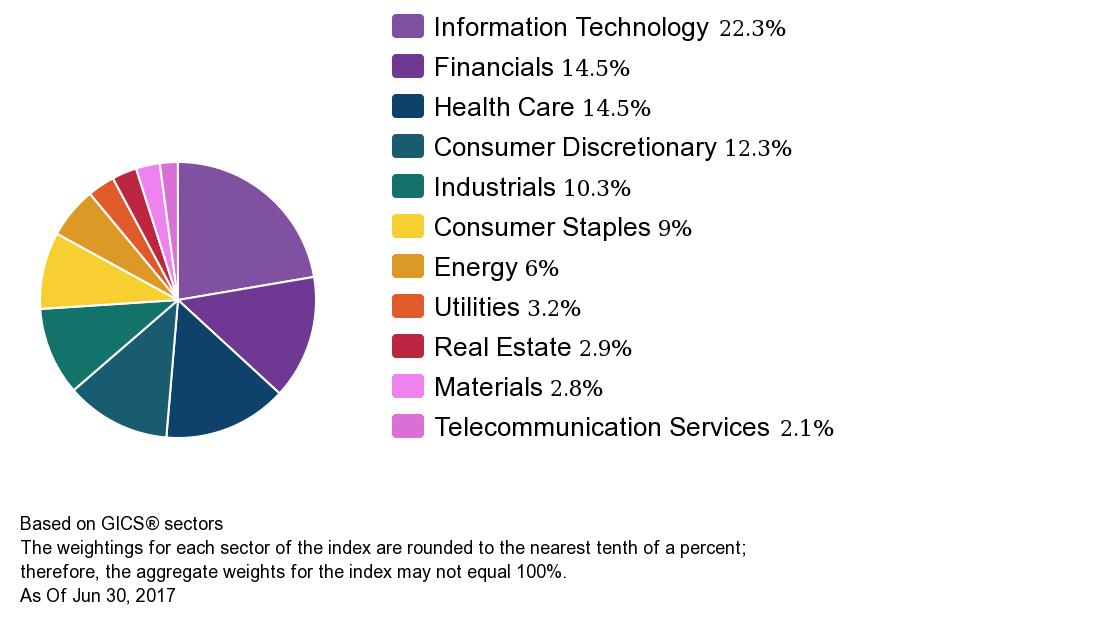
Currently the sector composition of the S&P 500 looks like below:

Click to enlarge

Source: S&P 500

At over 22% the tech sector accounts for about one-fourth of the index and is the largest sector in the index followed by financials and health care. Among the top 10 constituents by index are weight are tech companies like Apple Inc (AAPL), Microsoft Corp(MSFT), Amazon.com Inc (AMZN) , Facebook Inc A(FB) and Alphabet Inc C (GOOG). These and other tech companies in the index will endure higher competition and technological disruption in the next 20 years. As a results a few of them may disappear. While this may not be the case with larger companies like Apple or Amazon, they will still have to fight off competition and the nature of the industry is such that some other new technology can appear and uproot their dominance.

A recent article at CityWire quoted Anton Eser, chief investment officer at Legal & General Investment Management (LGIM) as saying that companies currently in the S&P 500 will change in the next 10 years and predicts 50% of the companies in the index will disappear by 2027.From the article:

Half of the companies in the S&P 500 could become obsolete by 2027, according to Legal & General Investment Management (LGIM) chief investment officer Anton Eser.

Eser expects the blue chip index, made up of the 500 largest stocks listed on the New York stock exchange and Nasdaq, will see a radical shake-upover the next decade.

‘Companies that we own over the next 10 years will change and the average lifespan of a company on the S&P 500 is declining,’ he said.

‘Fifty per cent of the companies will no longer be there by 2027.’

He expects many companies will face major disruption as a result of technological change, not least retailers as they adapt to the growth of online shopping.

The automotive sector also faces new competition from driverless and electric cars. James Carrick, LGIM global economist, points out that this poses a challenge for traditional car manufacturers.

While the UK and US are major players in the world of internal combustion engines, there is no guarantee that their car manufacturers will stay ahead of the game forever.

‘China is looking at electric cars. It may not compete when it comes to internal combustion engines, but we do not know who will make autonomous cars in the future. What happens to Ford, Toyota and the others?’ Carrick asked.

Elsewhere, technology has led to advances in energy production, with significant repercussions for economic growth.

‘The cost of solar is down to the equivalent of fossil fuel and that will have an impact on economic growth in 10 to 20 years,’ Eser said.

‘Energy costs are declining dramatically in the US…the money people have to spend on energy is declining and it is leaving [that money] available for consumption elsewhere,’ he added.

Source: LGIM: tech could wipe out half of the S&P 500, CityWire

The key takeaway for investors is that they should be prepared for big changes in the composition of the S&P 500 over the next decade or so. This is especially important for investors in the tech sector as the industry is the most vulnerable to major changes quickly.

Disclosure: No Positions

High-Speed Rail Lines Under Construction by Country 2017

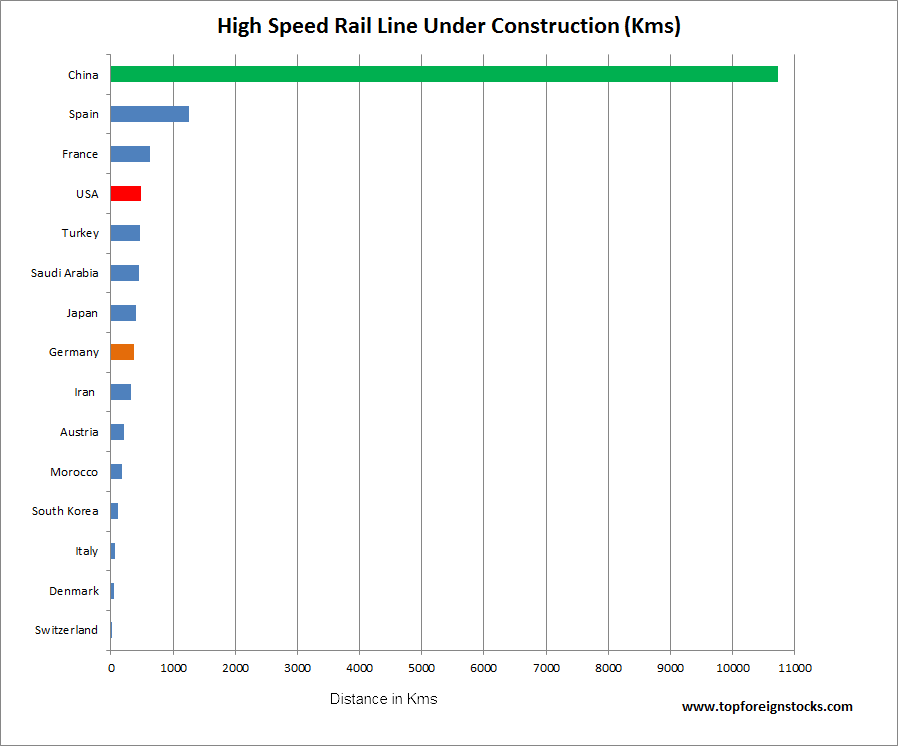
I posted an article last discussing high-speed rail lines currently in operation around the world. In this post let us review high-speed rail lines that are under construction. A total of 15 countries are currently building high-speed rail lines. Many others have lines under long-term planning. More details can be found in the attached pdf at the end of this post.

High-Speed Rail Lines in The World Under Construction by Country 2017:

Click to enlarge

The table shows the data related to the chart above:

CountryHigh Speed Rail Line Under Construction (Kms)
Switzerland15
Denmark56
Italy67
South Korea120
Morocco183
Austria218
Iran325
Germany368
Japan402
Saudi Arabia453
Turkey469
USA483
France634
Spain1262
China10730

Data Source:High Speed lines in the World – UIC Passenger Department, Union Internationale Des Chemins (UIC)

China is the top country for high-speed train network. As shown above 10,70 kms of lines are under construction in addition to the 23,914 kms of lines in operation now. In Africa, Morocco will become the first time to have high-speed rails when its 183 kms line is opened.

Download: High Speed lines in the World 2017 (pdf report)

The Economy of Australia: Infographic

Some of the important facts of the economy of Australia is shown in the infographic below. The top three destinations for Australian exports are China, Japan and the US. The top three exports are Iron Ore, Coal and Education. The presence of the education sector as one of the largest exports is surprising. Though Australian universities are attracting a growing number of foreign students especially from Asian countries like China.

Click to enlarge


Source: Trade, investment and economic statistics, Australia DFAT