Schwab Asset Class Quilt 2018

The performance of various asset classes vary in any given year. For example, bonds earned higher returns than stocks during the dark periods of Global Financial Crisis(GFC) in 2008 and 2009. Similar to the diversification benefits across countries, it is also important to diversify across many asset classes such as small caps, mid caps, large caps, bonds, treasuries, etc. The following chart from Schwab shows how different assets have performed over the years since 2008 and how a diversified portfolio can help smooth out a portfolio returns:

Click to enlarge
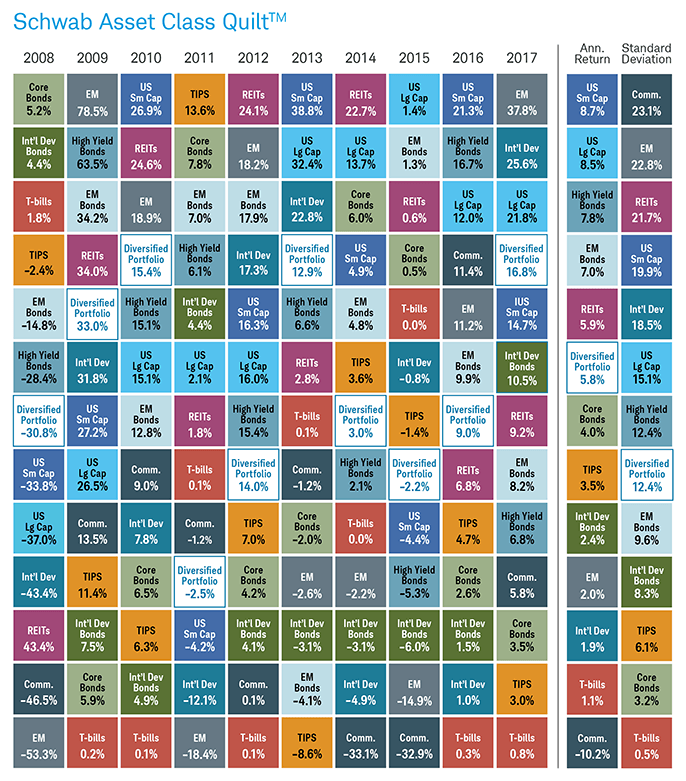
Source: Morningstar Direct and the Schwab Center for Financial Research. Data is from January 1, 2008, to December 31, 2017. Asset class performance represented by annual total returns for the following indexes: S&P 500® Index (U.S. Lg Cap), Russell 2000® Index (U.S. Sm Cap), MSCI EAFE® net of taxes (Int’l Dev), MSCI Emerging Markets IndexSM (EM), S&P United States REIT Index and S&P Global Ex-U.S. REIT Index (REITs), S&P GSCI® (Commodities), Bloomberg Barclays U.S. Treasury Inflation-Protection Securities (TIPS) Index, Bloomberg Barclays U.S. Aggregate Bond Index (Core Bonds), Bloomberg Barclays U.S. VLI High Yield TR Index (High Yld Bonds), Bloomberg Barclays Global Aggregate Ex-USD TR Index (Int’l Dev Bonds), Bloomberg Barclays Emerging Markets USD Bond TR Index (EM Bonds), Bloomberg Barclays Short Treasury 1–3 Month Index (T-Bills).

The diversified portfolio is a hypothetical portfolio consisting of 18% S&P 500, 10% Russell 2000, 3% S&P U.S. REIT, 12% MSCI EAFE, 8%, MSCI EAFE Small Cap, 8% MSCI EM, 2% S&P Global Ex-U.S. REIT, 1% Bloomberg Barclays U.S. Treasury, 1% Bloomberg Barclays Agency, 6% Bloomberg Barclays Securitized, 2% Bloomberg Barclays U.S. Credit, 4% Bloomberg Barclays Global Agg Ex-USD, 9% Bloomberg Barclays VLI High Yield, 6% Bloomberg Barclays EM, 2% S&P GCSI Precious Metals, 1% S&P GSCI Energy, 1% S&P GSCI Industrial Metals, 1% S&P GSCI Agricultural, 5% Bloomberg Barclays U.S. Treasury 3¬–7 Yr. Including fees and expenses in the diversified portfolio would lower returns. The portfolio is rebalanced annually. Returns include reinvestment of dividends, interest and capital gains. Indexes are unmanaged, do not incur fees or expenses, and cannot be invested in directly. Past performance is no indication of future results Diversification strategies do not ensure a profit and do not protect against losses in declining markets.

Source: Why Global Diversification Matters by Anthony Davidow, Charles Schwab
Why Diversify Internationally?

One of the easiest and simplest diversification strategies is to diversify across borders.Since the performance of equity markets varies across countries in any given year, an investor can boost their returns by spreading their assets across many countries. For example, emerging markets that are highly dependent on commodity exports perform well when commodity markets boom. By diversifying between developed markets and these emerging markets, investors can earn higher returns.

In addition, no one country’s equity market is the top performing market year after year. For example, Canada was the best performer in 2016 but ended up being the worst in 2017 due to decline in energy prices.

The following quilt from Schwab shows the importance of allocating assets across countries:

Click to enlarge

Source: Why Global Diversification Matters by Anthony Davidow, Charles Schwab

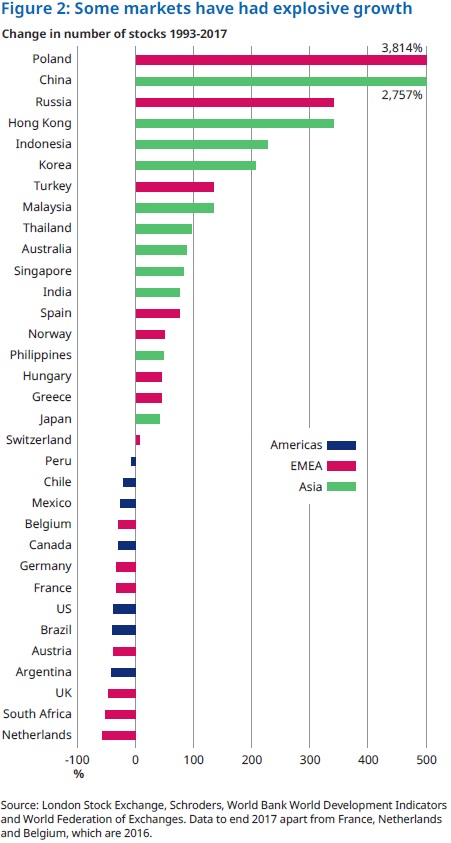
Change in Number of Listed Stocks by Country 1993-2017

The number of public listed companies has declined for many years now in the US. I have written many articles before on this topic. More recently last weekend I posted a blog quoting Vanguard.

While the number of public firms has decreased in the US, some markets abroad have seen strong growth in the number of public companies. According to an article by Duncan Lamont at Schroders, some markets have seen explosive growth since 1993.

The chart below shows the Change in Number of Listed Stocks by Country 1993-2017: 

Click to enlarge

Source: What is the point of the equity market?, Schroders

Emerging markets such as Poland, Russia, Indonesia, China, India, etc. have seen more companies going public in recent years.

The decline in the number of public firms is not limited to the US. Other developed countries such as the UK, Canada and Germany also have lower number of public companies now than in 1993.

Implications for investors:

I have discussed before that going abroad gives American investors more investing options. The above chart shows that foreign markets especially those in emerging countries offer many investing opportunities.

On Big Oil’s Profit Gusher: Chart

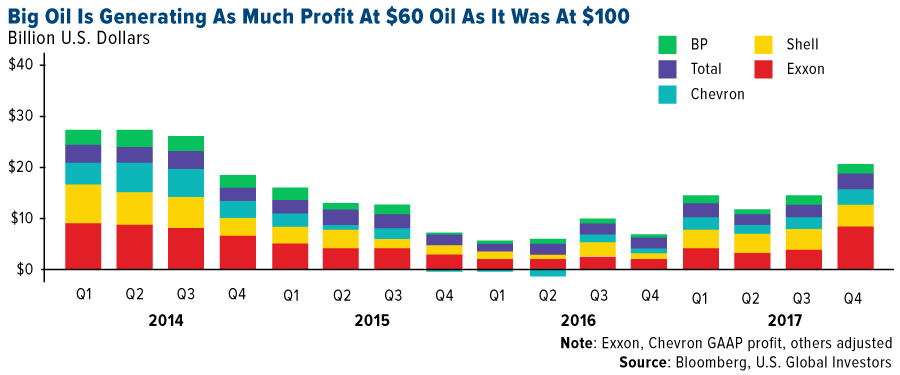
Crude oil prices closed at over $69 for June delivery (Brent). Oil prices have shot up more than 150% since the lows of $26 reached in early 2016.Rising oil prices is helping oil majors earn higher profits. According to an article at U.S. funds, big oil is generating as much profits at $60 as when the price was $100. From the article:

Some resource investors might worry that all this extra supply could depress prices and hurt profits. That’s a valid concern, but it’s worth pointing out that since its recent low of $26 a barrel in February 2016, the oil price has surged nearly 150 percent—all while the number of active wells in North America has risen.

It doesn’t hurt, of course, that demand for petroleum products is just as strong as it’s ever been right now. According to the latest monthly report from the American Petroleum Institute (API), U.S. demand in February reached its highest level since 2007. This was only the third February ever, in fact, that gasoline demand exceeded 9 million barrels a day, reflecting strenthening consumer sentiment and economic growth.

And as I shared with you last month, major explorers and producers’s profits are now in line with what they were when oil was trading for $100 a barrel and more.

According to Bloomberg, the majors are now “prioritizing investors over investments, channeling the extra cash that comes from $60 crude into share buybacks and higher dividends.”

I should add that, besides offering better opportunities for investors, energy independence helps make the U.S., its allies and, indeed, the whole world more secure.

Source: U.S. Energy Is Breaking All Kinds of Records — Are You Participating?, U.S. Funds

Oil majors are rewarding shareholders as earnings rise. For example, French major Total (TOT) announced a 28% increase in profits and a 10% increase in dividends. In addition the firm announced share buybacks as well.

You may also like:

Disclosure: No Positions