Auto Penetration Rate in China, India vs. Developed Countries: Chart

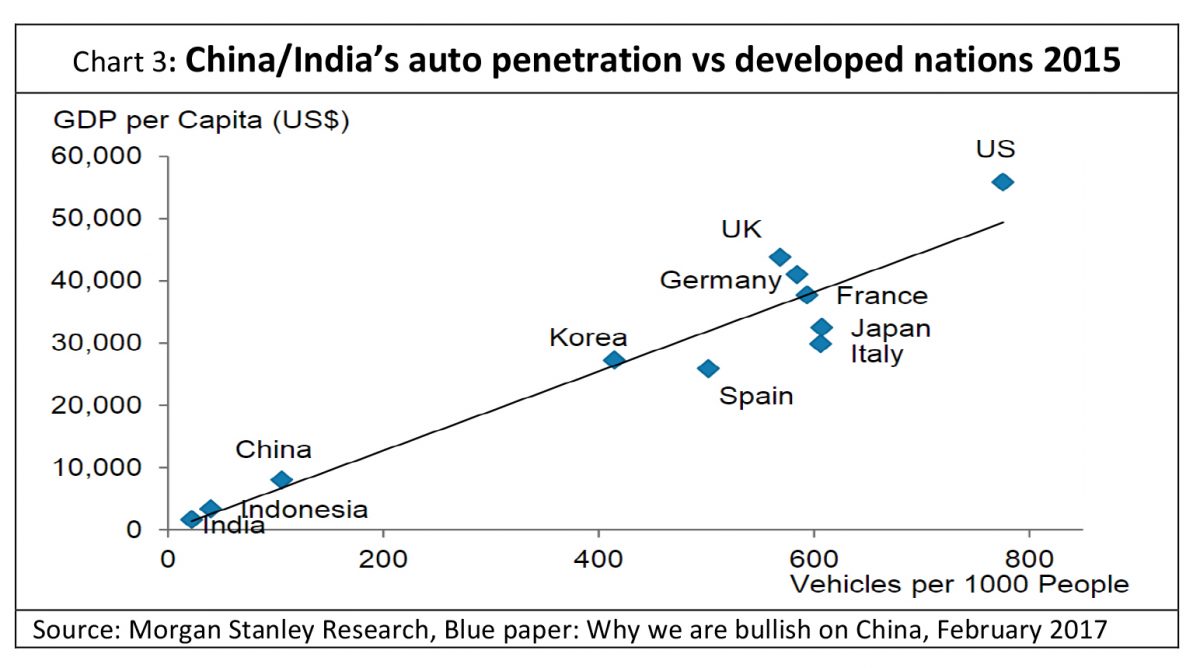
One of the main luxuries of emerging middle class in developing countries is the ownership of an automobile. Auto penetration rate is very low in emerging countries of China and India relative to the developed world as shown in the chart below:

Click to enlarge
Source: CPD: All aboard the new Silk Road, Adviser Voice

The US has the highest auto penetration rate in the developed world since public transportation is virtually non-existent in most parts of the country. Relative to the US and other developed countries India has the lowest auto penetration rates. Though China is ahead of India in terms of economic development, the auto penetration rate in China is still far below than the rate in developed countries. While China will never have cars as the primary means of transport for majority of the people, opportunity exists for car ownership rates to go higher as rising incomes will lead to higher car sales.

Monthly Salary in Manufacturing Sector of Select Asian Countries

China used to be known as the “factory floor” of the world a few years ago as the country’s manufacturing industry was attractive to companies from the developed world due to cheap labor costs. However that is no longer the case. Wages in China have been steadily increasing making some manufacturers look for alternative cheaper locations. For example, in 2016 I wrote an article on the comparative wages in the automotive industry for select countries. At that time, the average hourly wage was $5.19 in China compared to $3.29 in Mexico and nearly $24 in the US.

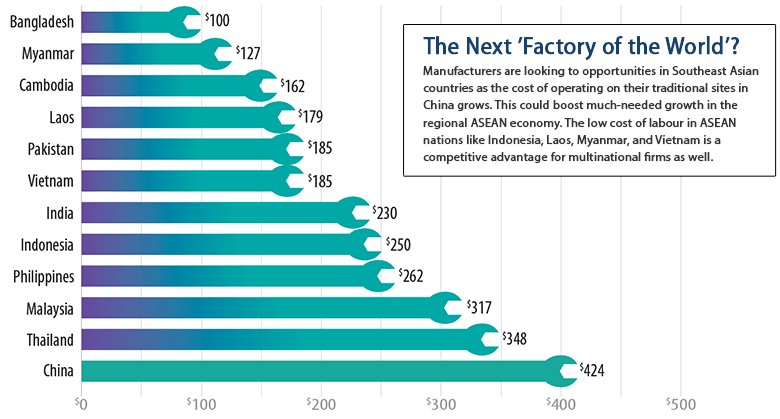
According to research by CLSA, the average monthly salary in the manufacturing industry in China is $424. Many Asian countries have lower monthly salaries than in China as shown in the chart below:

Click to enlarge

Source:How ASEAN’s 3Rs Can Overcome Trade Wars, Nikko AM

Asian economies such as Indonesia, Vietnam, etc. have competitive advantages over China in the manufacturing industry. Rising wages in China may lead some firms moving their facilities to these low wage countries to remain competitive in the global marketplace.