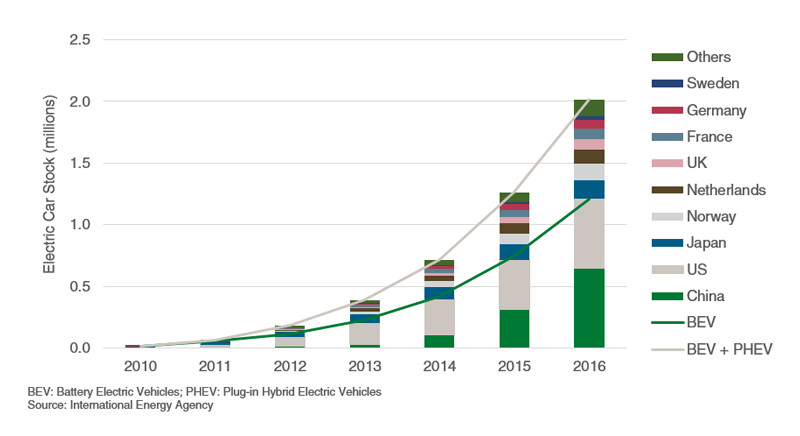
Global Penetration of Electric Vehicles by Country

Sale of Electric Vehicles(EVs) is growing globally on an annual basis. The latest data show that global sales of EVs exceeded 2 million in 2016. Though this figure is tiny when compared to the annual vehicle fleet of over 1.2 billion it is still significant since it is growing rapidly.

The top country for EV penetration is China followed by the US. The chart below shows the global penetration of EVs by country:

Click to enlarge
Source: The road ahead for electric vehicles,  Manning & Napier

From the above article:

On a broader scale, while the global penetration rate for EVs remains very low, the recent growth in EVs should not be ignored. The latest data from the International Energy Agency shows that global EV sales hit a new record in 2016, with China—the largest market for EVs—accounting for 45% of purchases. This was more than double the sales in the second largest market, the US, which accounted for 21%. After being virtually non-existent just five years ago, the number of EVs on the road surpassed 2 million in 2016 (see accompanying chart).

Related Stock:

  • Tesla, Inc. (TSLA)

Disclosure: No Positions
Shark Attack: US vs. International Stocks

Jeffrey Kleintop at Schwab has posted a fascinating article on the dangers and returns of international and US investing using the example of a shark attack.

The following is an excerpt from the article:

US and International

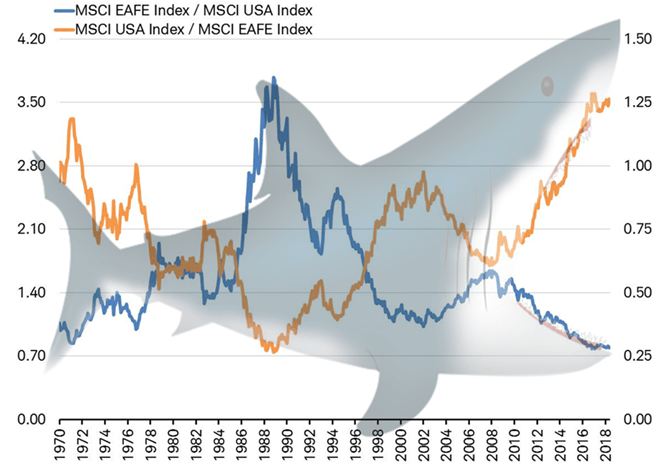
The chart below shows us what stock market shark attacks look like using the relative performance of US and international stock indexes. The lines are just one index divided by the other. When the blue line is rising international stocks are outperforming U.S. stocks. When the orange line is rising U.S. stocks are outperforming international stocks. They are mirror images of each other.

Shark attack: U.S. versus International

Source: Charles Schwab, Bloomberg data as of 5/13/2018.  Past performance is no guarantee of future performance.

In the early 1970s, the jaws were gaping wide. As international stocks began to outperform, the jaws began to close and take a big bite out of the portfolio of investors who hadn’t rebalanced. The jaws opened again in the late 1980s as the outperformance of international stocks became extreme, only to see them bite down again in the following years. Now, the shark’s jaws are open wide again after 10 years of U.S. stock market outperformance. We could again be on the cusp of a shark attack.

No one knows for sure if we have seen the peak of U.S. stock market outperformance of international stocks; the shark jaws could open wider before biting down. But the risk of a shark attack appears to us to be pretty high. Prepared investors should be thinking about being a contrarian and rebalancing their portfolios from the U.S. to international stocks after a decade of U.S. outperformance.

Source: How To Avoid A Shark Attack by Jeffrey Kleintop, Charles Schwab

The entire post is worth a read.

Dividend Yields of Largest Economies and Developed Markets

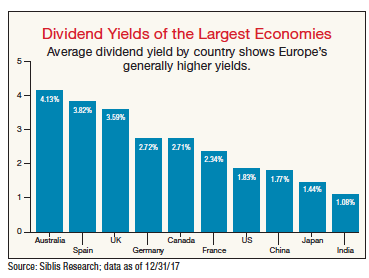
The Dividend Yields of the world’s largest economies is shown in the chart below:

Click to enlarge

Source:Dividends And Buybacks: The Last Hurrah?, Global Finance

Among the developed markets, Australia offers the highest dividend yield at 4.18% followed by Norway and the UK.

The dividend yields of the developed markets are shown in the following chart:

Click to enlarge

Note: Data shown above is as of December end, 017

Source: Singapore Loves Dividends, Australia Most Generous, Bloomberg

Are Energy Stocks A Good Buy Now?

Oil prices have soared in the past year gaining around 40%. With the summer travel season coming soon drivers in the US can be expected to drive higher demand for gasoline in coming months. Despite the dramatic and surprising boom in oil prices energy and related sector stocks have not kept up up until now. According to Brad Sorensen at Charles Schwab, investors willing to take higher risks can add positions at current levels for higher potential returns but the sector is volatile and hence investors need to be aware of the risks involved.

From the article:

The more things change …

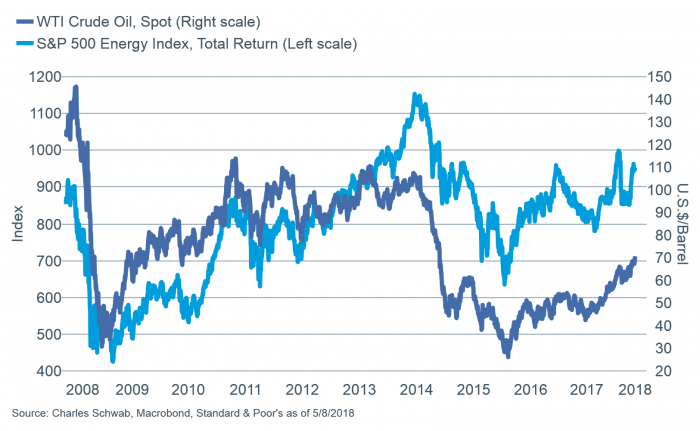
Oil prices have staged a solid rally over the past year, with WTI crude moving from around $50/barrel a year ago to close to $70/barrel currently—a roughly 40% gain. However, as you can see below, the energy sector hadn’t kept up with the commodity gains until a very recent move higher.

The energy sector hasn’t kept up with crude prices.

Past performance is no guarantee of future results

Now that the sector has started to move higher, the potential for the gap to close has excited much of Wall Street, with more bullish calls coming out for both the sector and for oil. The gap, however, could be closed by oil coming down to meet the energy sector line, a possibility that seems to be ignored by much of the current analysis, likely largely due to the bullish view on the future of oil prices. Two other charts appear to indicate that in the past, gaps in traditional relationships have been closed more by the commodity price moving to the stock-related price than the other way around. History is no guarantee of future performance, but it does leave open the possibility of a different outcome.

Source: Schwab Sector Views: Drilling Down on Energy, Schwab

From another article at AllianceBernstein on the same topic:

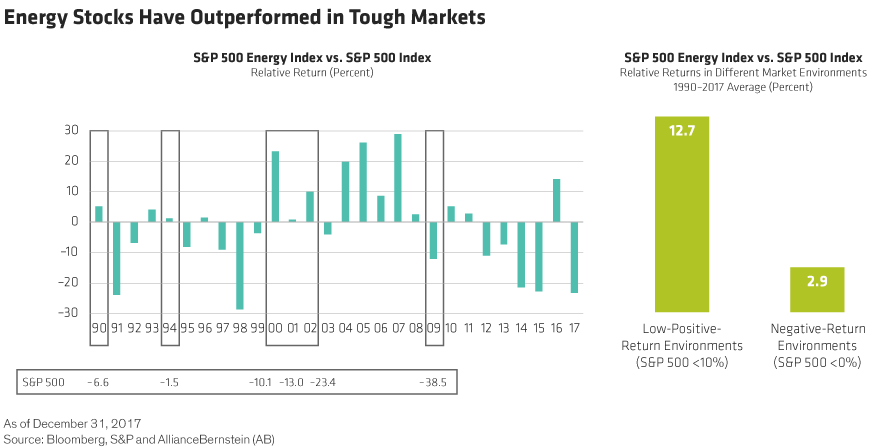
Energy Stocks Have Outperformed Challenged Markets

That might seem counterintuitive, given that energy is often seen as a volatile sector. But in fact, over the past 28 years, energy stocks outperformed challenged markets several times (Display, left): in 1990 and 1994; after the tech bubble burst from 2000 to 2002; and during the global financial crisis in 2008. On average, the energy sector outperformed the S&P 500 by 2.9% in negative-return years and by 12.7% in low-return years (with an S&P 500 price return below 10%), since 1990 (Display, right).

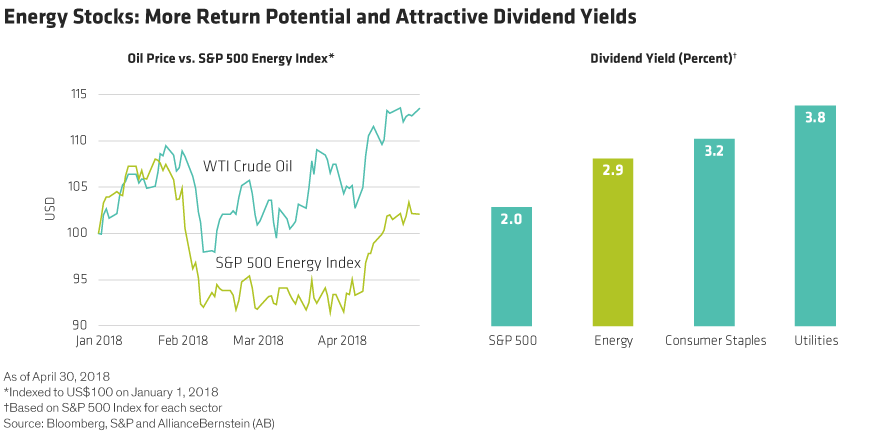
This year, energy stocks have advanced by 2%, outperforming the S&P 500. But they’ve lagged gains in West Texas Intermediate (WTI) crude oil, which has been up 13% (Display). We believe that this disconnect offers an investment opportunity, particularly among integrated oil companies. Within the sector, look for companies with attractive valuations and dividends that rival consumer staples companies, supported by improving fundamentals.

Source: Energy Stocks: A Surprising Defensive Play?, AllianceBernstein

From an investment perspective, energy stocks are not as attractive as they were a few months ago due to the recent run-up. However geo-political issues and demand can lead to higher oil prices in the coming months potentially boosting the stock prices of this sector and related sectors.

In addition to oil majors and oil exploration firms, investors may also want to consider the oil field services and equipment sector firms such as Schlumberger NV (SLB), Halliburton Company (HAL), etc.

Related ETFs:

  • SPDR S&P Oil & Gas Exploration & Production ETF (XOP)
  • SPDR Energy Select Sector ETF (XLE)

Disclosure: No Positions