U.S. Stocks Are Overvalued based on Price to Sales Ratio: Chart

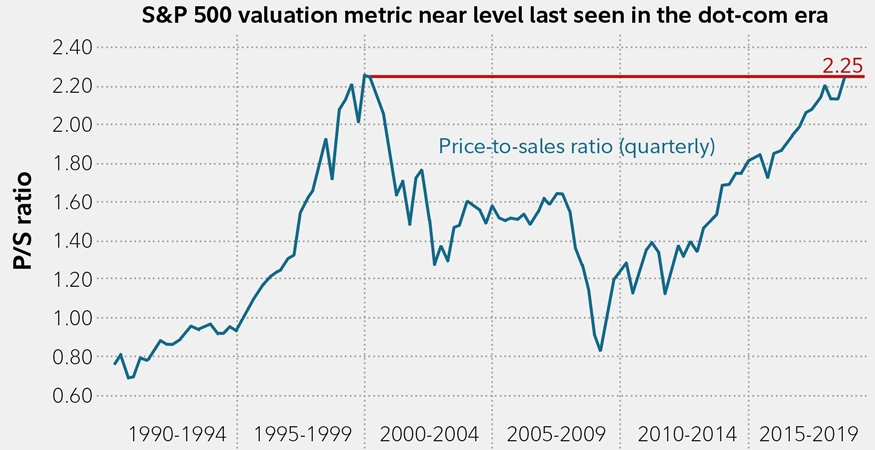
U.S. equities are reaching record highs and some investors are wondering how long the current bull market will last. The S&P 500 is up by over 9% on price basis YTD. Currently the P/E ratio of the index is 25.38. Based on the price to sales ratio stocks are reaching the levels last reached during the dot-com era as the chart below shows:

Click to enlarge

The S&P 500’s price-to-sales (P/S) multiple is approaching dot-com era highs, suggesting the market may be expensive at current levels. Its trailing 12-month price-to-sales ratio surged to 2.25 recently, the highest since early 2000. And it’s not just tech giants skewing the data: The median P/S ratio for index members is more than twice the level of the dot-com peak.
Source: Fidelity

Related ETFs:

  • SPDR S&P 500 ETF (SPY)
  • S&P MidCap 400 SPDR ETF (MDY)
  • SPDR Consumer Discretionary Select Sector SPDR Fund (XLY)
  • SPDR Consumer Staples Select Sector SPDR Fund (XLP)
  • SPDR Energy Select Sector SPDR Fund (XLE)
  • SPDR Financials Select Sector SPDR Fund (XLF)
  • iShares Dow Jones Select Dividend ETF (DVY)
  • SPDR S&P Dividend ETF (SDY)
  • Vanguard Dividend Appreciation ETF (VIG)

Disclosure: No Positions

Why Manufacturing Jobs Are Better Jobs

FT Alphaville published an interesting analysis on why manufacturing jobs in the US are better than other jobs. The article basically debunks Gary Cohn, ex-head of the President’s National Economic Council simplistic and lack of critical thinking views on why one would prefer a nice cushy office job in an air-conditioned office than working in mine or factory which involves hard physical labor.

The following is an excerpt from the piece:

Manufacturing workers, though there are only about 9 million of them, make about $21.50 an hour. There are only 550 thousand mining and logging workers, but they make more than $28 an hour. They aren’t the highest-paying jobs in America, but for someone without a college degree, a manufacturing job in front of a blast furnace pays far better than an air-conditioned job inside a Target.

People in finance are famously overworked, so we’ll forgive Mr Cohn for not knowing that for many Americans, pay isn’t the only consideration. Simply getting enough hours is a challenge. Here, standing in front of a blast furnace or risking black lung (as he puts it) both have a massive advantage: both occupations offer 40 or more hours a week.

Your weekly paycheck isn’t your wage; it’s your wage multiplied by your hours. Over the last 40 years, hours overall have drifted down, particularly in retail, where in the last decade scheduling software has allowed companies to more efficiently call employees in or dismiss them. But manufacturing jobs, which are more likely to be unionised, still offer 42 hours a week. Mining and logging, which tend to run closer to capacity, offer 47 hours.

And in America, whether an employer offers benefits can make a huge difference. Last year 81 percent of production jobs offered health insurance. Overall for private workers, 68 percent. For service jobs — the single largest group — 39 percent. So the job that Gary Cohn says Americans wouldn’t choose at the same pay turns out to have better pay, better hours, and better benefits. People are nostalgic for manufacturing jobs not just because it’s nice to make something. It’s because they’re better jobs.

Source: Manufacturing jobs are better jobs, FT Alphaville

Another important point to be noted is that building a factory to manufacture something involves millions of dollars and machinery and takes time. Hence a company that invests so much time and effort into a manufacturing facility is not going to shutdown overnight and layoff all the workers. On the other hand, a retail joint like a department store in a mall, a coffee shop, a donut shop, a hair-style shop, a shoe shop, etc. can be shutdown overnight without any major need to dismantle machinery or other issues. So in a way the lowest paying jobs are also most vulnerable to disappear any day. This is one more reason why people yearn for manufacturing jobs than a retail job.

e-Commerce Bubble Compared to Other Bubbles: Chart

FAANG stocks have soared in recent months like there is no tomorrow. In fact, Amazon, Apple, etc. have shot up nearly eight times since March 2010 according to a recent article by Frank Holmes of U.S. Global Investors. The bubble in the e-commerce sector is the second largest bubble in the past four decades as shown in the chart below:

Click to enlarge


Source: Are We Headed for a Passive Index Meltdown? by Frank Holmes, U.S. Global Investors

A dose of caution is warranted on hi-flying internet stocks.

Related stocks:

Disclosure: No Positions

South Africa: Economy by the Numbers

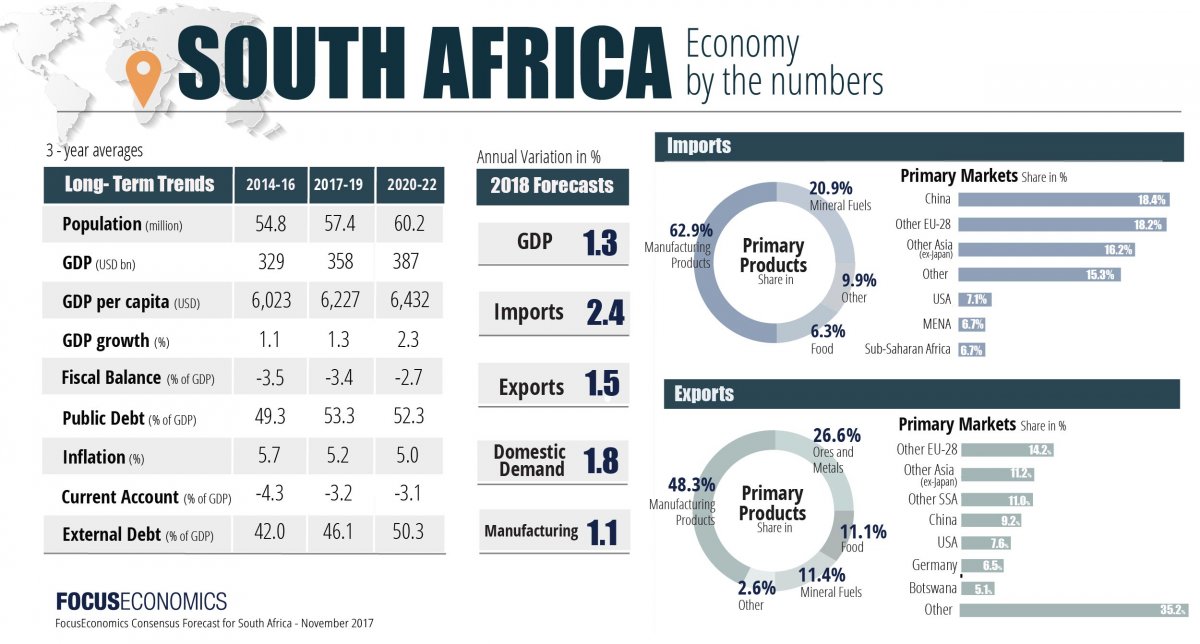
South Africa is one of the major emerging economies. Though the country is rich in natural resources and is considered as a commodity-based economy, exports of manufacturing products accounts for nearly half of the economy and ores and metals constitute only one-fourth of exports.

The following infographic shows a snapshot of the key variables of the South African economy:

Click to enlarge

Source: Focus Economics