Five Risks to Consider in Dividend Investing

Investing in dividend stocks is a popular strategy among many investors. Dividend stocks offer investors a decent dividend yield in addition to any potential gains from price appreciation. So investors tend to gain twice since not only they get paid dividends quarterly or yearly or twice yearly but also the price gains. Since dividends are paid straight out of profits and they are cash in investors’ pocket, dividend investing is a straight forward approach to investing in equities. Moreover income stocks provide a cushion during good times and bad times since the dividends keep coming. Despite all these advantages dividend investing, just like any other strategy, has many risks. Recently I came across an article at Money Observer by Robert Clough is an investment manager at Thesis Asset Management who discussed about five such risks.

1.Tax implications

Taxes are important factor to consider with dividend investing. For example, dividend yields in the US are low by global standards since dividends are taxed at a higher tax rate than capital gains. Hence this artificially forces companies to reinvest retained earnings for growth and investors are content with lower dividends since it reduces their tax hit.

Similarly US tax rates for dividends from REITs, bond ETFs, and other asset types are different. Hence investors need to be aware of them. Dividends paid out bond ETFs for instance are “Ordinary Dividends” which have higher tax rates than “Qualified Dividends” paid out by stocks that are held over 1 year.

Investing in foreign dividend stocks involves dividend withholding taxes by foreign states. These rates can be 0% to as high as over 35%. In many cases, US investors cannot recover these taxes and the withholding tax rates effectively reduce the net yield received by an investor.

2.Dividends can be erratic

Dividend payments are not guaranteed and can be cancelled or suspended or reduced at any time by a company. So investors should remember this fact and accordingly choose companies. Generally well-established companies with strong balance sheets tend to pay consistent dividends.

3.Correlation of dividends

Many companies in the same sector more or less have similar dividend yields. For instance, banks tend to have higher yields in the 2%+ range in the US. However simply investing in a bunch of banks to capture these juicy dividends is not a great idea. This is because during crises such as the Global Financial Crisis of 2008-09 banks suspended or reduced their dividends.

4.Mature companies

Mature companies may have higher dividend yields but they have lower growth for the obvious reason that they are mature. Unlike a young startup these firms may not have exponential growth. So investors loose out on capital appreciation though they earn high yields.

5.Erosion of capital

As discussed before, companies can reduce or cancel dividends. Reducing a dividend is much better than outright suspending of dividends. When a firm suspends dividend payments many institutional investors may be forced to sell the stock since the stock turns into a  non-dividend paying stock. They sell out the stock as their mandates may prohibit owing any stock that does not pay a dividend. Due to this selling prices may decline drastically in the market. A retail that sells during this time for whatever reason will sell at huge loss.

Source: Five risks to check: investing for dividends, Money Observer

Knowledge is Power: Small Habits, Emerging Market Drivers, German Energy Transition Edition

The S&P is down by 2.75% YTD. US bank stocks declined even more and are getting close to bear market territory. The crash in tech stocks especially the FAANGs is not surprising. Developed European markets are in the negative YTD as well with Germany’s DAX off by 16%. Among the Latin American markets, Mexico is down due to the election of AMLO while Brazil is up with the election of “Trump of the Tropics” Jair Bolsonaro. With this year almost looking a down year for the US markets, investors are looking forward to 2019, although that is promising to be a great year for equities either.

The following are some interesting reads that you can check out:

Sagrada Familia, Barcelona

The Upside and Downside of Global Risks in 2019: Infographics

Investors have to brace themselves for plenty of risks in the coming year. From trade wars to real wars(Russia invading Ukraine, for example) and everything in between including further oil price collapse, currency risks, geopolitical risks, never-ending political drama in Western Europe, China collapse, even political risk in the US, etc. will be closely watched by investors. The following infographic shows some of the potential upside and downside risks globally in 2019:

Click to enlarge

Source: Alliance Bernstein

Canadian Stocks Are Cheaper Than US Stocks: Gluskin Sheff

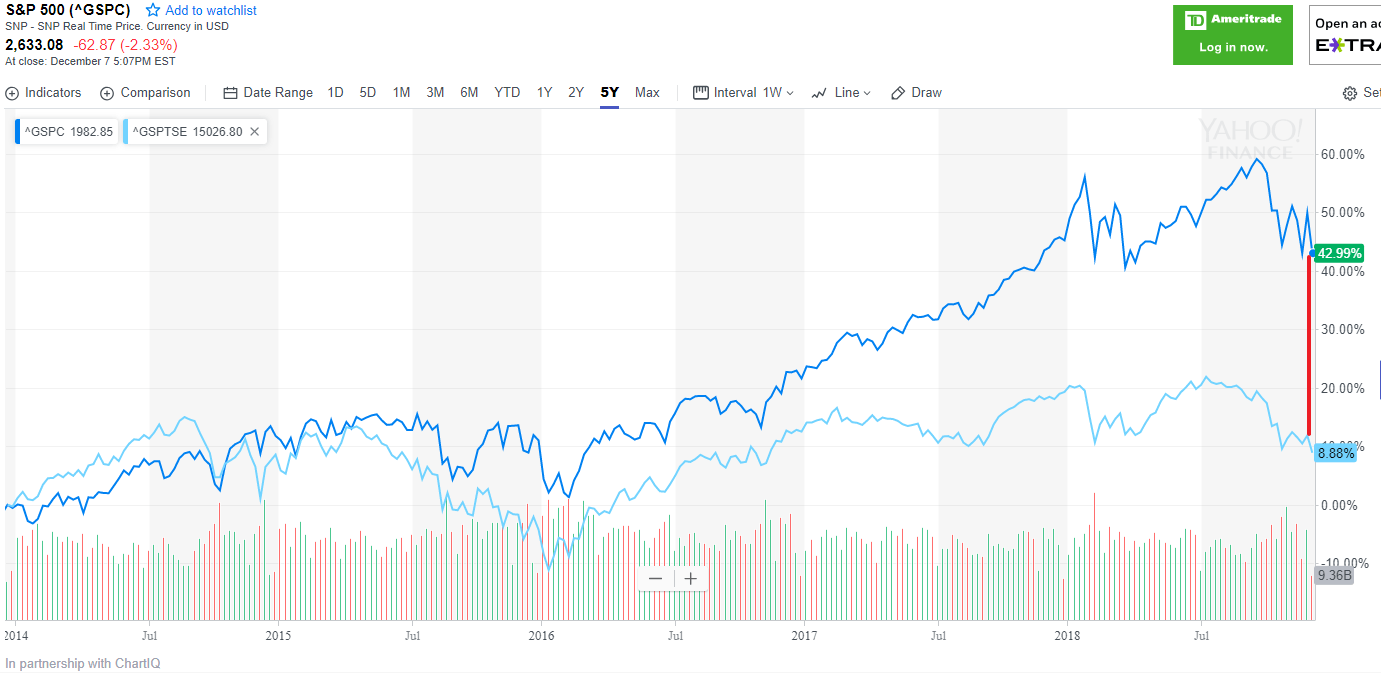
The Canadian stock market has under-performed the US market for many years now. For instance, while the S&P 500 is downy 1.52% year-to-date based on price, the S&P TSX Composite Index is off by 8.7%.

The following chart performance of the two indices in the past 5 years:

Click to enlarge

Source: Yahoo Finance

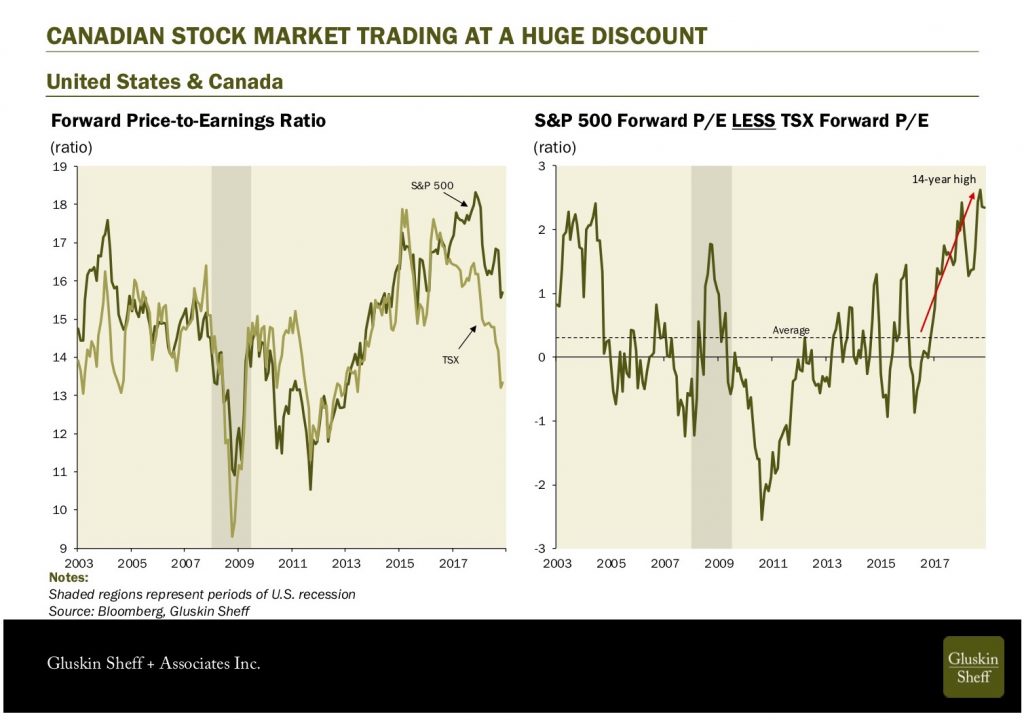
According to David Rosenberg, chief economist at Gluskin Sheff and Associates, Canadian stocks look cheap now. From an article at MaClean’s:

The macro news in Canada may indeed be bad, but that bad news is likely already in the price. Consider for a moment that there has been no bull market north of the border this cycle as there was in the United States. The Canadian stock market is no higher now than it was in the summer of 2008—ten years of nothing but a whole lot of volatility and your reinvested dividend in the blue-chip banks. Yet corporate earnings have risen more than 30 per cent over this time frame, with nothing to show for it from a market price standpoint. In other words, the Canadian stock market is cheap. Dirt cheap. The forward price-earnings multiple (p/e)  is beginning to resemble that of an emerging market, and no, despite our challenges, we are not anywhere close to being an emerging market. Not yet, anyway. That p/e multiple has compressed all the way down to a mere 13.3 times, the lowest it has been in well over five years and the two-and-a-half percentage point discount that the S&P/TSX Composite Index trades at currently vis-à-vis the S&P 500 is the widest the valuation gap has been since June 2004 (normally, both markets trade with the same multiple). Canadian bears may want to dig into the history books because in the year that followed, the TSX rallied 16 per cent versus 4.5 per cent for the S&P 500. That was as tough a sell then as it is today, but either you believe in reversion-to-the-mean, or you don’t.

Source: The most important charts to watch in 2019, MaCleans

Investors looking for opportunities in Canada can consider the following stocks for further research:

Bank of Nova Scotia (BNS), Bank of Montreal (BMO), Canadian Imperial Bank of Commerce (CM), Royal Bank of Canada (RY), Toronto-Dominion Bank (TD), Canadian National Railway Co (CNI), Canadian Natural Resources Limited (CNQ), Canadian Pacific Railway Ltd(CP), BCE Inc (BCE), TELUS Corp (TU)

Disclosure: All five banks listed above, CNI

Sector Breakdown of MCSI AC World vs. MCSI UK Index: Chart

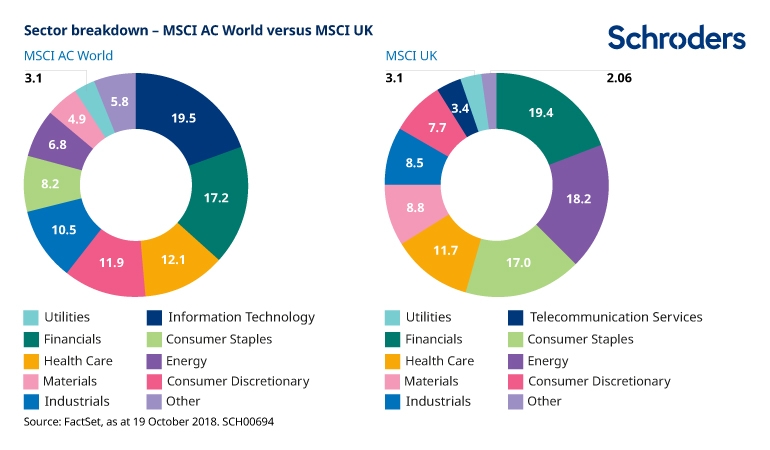
The following chart shows the sector breakdown of MCSI All-Country Index and MCSI UK indices:

Click to enlarge

Source:Three reasons to diversify in the hunt for equity income, Schroders

The biggest difference between the indices is that the IT sector accounts for 19.5% in the MSCI World Index while in the UK the sector is so tiny it is grouped with the ‘Other’category. Consumer staples is another sector which varies widely between the two indices. In the MSCI World Index it accounts for just over 8% whereas in the UK index it is more than double at 17%.

From an investment perspective, UK investors have to careful focusing too much on a domestic-companies based portfolio mimicking an index since the equity market is heavily concentrated in just three sectors – financials, energy and consumer staples.