Interesting Article on Manchurian Plague, 1910-11

Many of the epidemics and pandemics in modern times originated in China. For example, the Asian Flu (1956-1958), SARS (Severe Acute Respiratory Syndrome) in 2002, H7N9 in 2012, etc. all started in China. Of course, the country is also the source for the current coronavirus pandemic (Covid-19). The reasons for why China is the originator of many deadly diseases are many. The following excerpt from an article early this years offers a few:

All of these outbreaks originated in China, but why? Why is China such a hotspot for novel diseases?

“It’s not a big mystery why this is happening… lots of concentrated population, with intimate contact with lots of species of animals that are potential reservoirs, and they don’t have great hygiene required. It’s a recipe for spitting out these kinds of viruses,” Dr. Steven Novella recently opined on an episode of the Skeptics’ Guide to the Universe.

South Central China is a noted “mixing vessel” for viruses, Dr. Peter Daszak, President of EcoHealth Alliance, told PBS in 2016. There’s lots of livestock farming, particularly poultry and pigs, with limited sanitation and lax oversight. Farmers often bring their livestock to “wet markets” where they can come into contact with all sorts of exotic animals. The various birds, mammals, and reptiles host viruses that can jump species and rapidly mutate, even potentially infecting humans. Experts are pretty sure this is precisely what happened with the current COVID-19 coronavirus, which is why, on January 30th, China issued a temporary ban on the trade of wild animals.

There are also cultural reasons why China plays host to large outbreaks.

“Many Chinese people, even city dwellers, insist that freshly slaughtered poultry is tastier and more healthful than refrigerated or frozen meat,” journalist Melinda Liu wrote for Smithsonian in 2017. “The public’s taste for freshly killed meat, and the conditions at live markets, create ample opportunity for humans to come in contact with these new mutations.”

Source: Why Do New Disease Outbreaks Always Seem to Start in China?, Real Clear Science

While doing some research online I came to know about the Manchurian plague of 1910-11 which also started in China. From an article on this plague:

In the autumn of 1910, the press in China began to report that a rare and deadly pneumonic plague had reached Harbin in the extreme Northeast of China, then known as Manchuria.[1] Though confined largely to China’s Northeastern provinces, cases were reported sporadically throughout the empire, in Tianjin, Beijing and along the Beijing-Hankou railway line stretching down into central China, reflecting the scale of the epidemic.[2] It is difficult to attain precise statistics about the death toll of the plague; however reports suggest that between 50,000 and 60,000 people died, with an unprecedented mortality rate of 100 per cent.[3] As a point of comparison, this places the death toll of the Manchurian plague in the same region as that of the more familiar Great Plague of London (1665-66).[4]

CAUSATION

The plague is likely to have originated amongst tarbagan marmot hunted for their fur in Manchuria.[5] As the German chemical industry developed new dyes, cheap marmot fur could be manufactured into imitation sable, mink and otter fur.[6]Consequently, the value of marmot fur rose from a ‘few kopecks a skin to a rouble’, causing migrant hunters to flock to Manchuria. These migrants, however, were inexperienced. Whereas local hunters, many of whom were from the region’s Buryat ethnicity, could identify and avoid diseased marmots, the migrant hunters collected unhealthy marmots, infecting themselves with the plague bacilli the diseased animals carried.[7]

The spread of the plague was exacerbated by the bitter cold of the northern winter, which caused the hunters to huddle together in huts, quickly spreading the airborne pneumonic plague. Manchuria’s extensive railway network further aided the rapid transmission of the disease by facilitating the movement of large numbers of migrant workers returning home for the New Year Festival.[8]

From Khailar in October the plague spread to Harbin, where thirteen cases had been reported to be ‘fatal’[9] and by November 8th the city had a death toll of 5,272 deaths. Quarantine and control had been put in place in order to prevent the spread, however by January, Mukden (today’s Shenyang) had over 2,571 deaths,[10] soon spreading south to the capital city, Peking where an additional five cases were found.[11] Thus, the plague quickly spread throughout towns and cities along the railway lines in Manchuria, thriving in areas defined by ‘dense population, high human mobility and poor hygiene conditions’.[12]Subsequently, cities throughout Manchuria experienced high death rates, such as Kuancheng, near Jilin, which reported over 200 deaths per day.[13]

Due to the popularity of the relatively cheap, third-class tickets offered by the South Manchurian Railway most cases of plague infected cities along the rail line first, then spread further to small villages, with some being reported as far as Tientsin.[14]There were fears it would spread further, especially to Peking, as workers travelled home and shopped for Chinese New Year (30th Jan). The worst hit areas were the crowded provincial capitals Changchun, Harbin, and Mukden, with deaths of up to 150, 130, and 60 daily respectively.[15] The majority of infections fell on poor, middle-aged Chinese who lived in crowded conditions with poor sanitation; very few foreigners contracted the plague, if so, they were medical staff.[16],[17] Through carrying out recommended procedures (isolation) infection in most cities and villages died out within two weeks; by the middle of March, Manchuria had resumed normality with plague existing only in hospitals. Schools, factories, and businesses including the whole of the South Manchurian Railway were open, working harder to recover lost ground.[18]

Note: All the references noted above are in the linked site.

Source: Manchurian plague, 1910-11, Investment Office

The entire article is worth a read. History does indeed repeat itself even with respect to pandemics, epidemics and plagues.
War on Covid-19: Vietnam vs. US

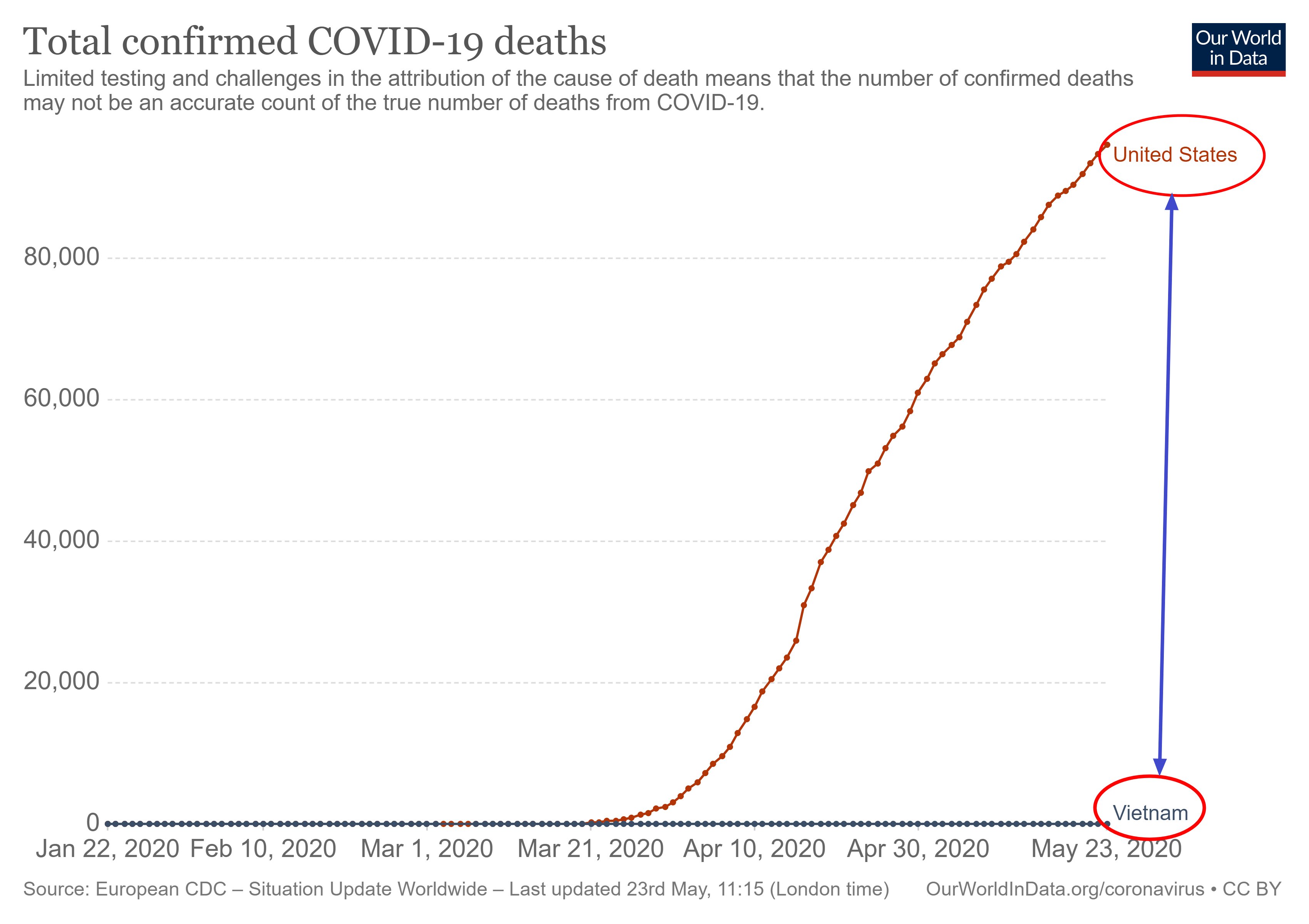
The total Covid-19 cases in the U.S. exceeds 1.6 million and the number of deaths 96,610 as of May 23, 2020 according to NY Times. Vietnam on the other hand has had just 324 cases so far with no deaths according to published data. The sharp contrast in these figures between the countries will be studied by scientists and academic experts once the pandemic is over.

Below is chart comparing the death toll of US and Vietnam:

Click to enlarge

Source: Our World In Data

The following is an excerpt from a piece on this subject published in April in Asia Times:

“Our team up in Hanoi is working very, very closely with their Ministry of Health counterparts,” said the US Centers for Disease Control and Prevention’s representative in Thailand, John MacArthur.

“The communications I’ve had with my Vietnam team is that at this point in time, [they] don’t have any indication that those numbers are false,” MacArthur said, according to US National Public Radio.

The US also did not coordinate the information in their health and safety messages to the public, or blanket the country with broadcasts, print media, street posters and other ubiquitous warnings and reminders which Hanoi did on a scale reflecting its mass mobilization efforts during the war.

Hanoi’s impressive twin successes – both against America during the war and now in containing the spread of Covid-19 – have been achieved by commanding citizens to act, manipulating media and controlling public and private enterprises.

The Communist Party’s tight hold on then-North Vietnam, and on today’s united Vietnam, have enabled Hanoi to respond with comparatively limited resources.

Source: Why Vietnam won and US lost their Covid-19 wars, Asia Times

From a piece in The Guardian on the success of Vietnam:

Vietnam didn’t just flatten its coronavirus curve, it crushed it. No deaths have been reported, official case numbers have plateaued at just 271, and no community transmissions of the virus have been reported in the last two weeks. On 23 April, the nation eased lockdowns in its major cities and life is gradually returning to normal. It is a stark contrast to many other nations including the US, where more Americans have died from Covid-19 than during the entire Vietnam war.

Kidong Park, the World Health Organisation’s representative to Vietnam, has praised the country’s response to the crisis.

Quarantining tens of thousands in military-style camps and vigorous contact tracing procedures have helped Vietnam to avoid the disasters unfolding in Europe and the US. After testing over 213,000 people, the nation has the highest test-per-confirmed-case ratio of any country in the world. A creative public information campaign featuring viral handwashing songs and propaganda-style art helped, but it was decisive early action – hastened by a government praised for its response to Sars in 2003 – that proved most effective.

Source: Vietnam crushed the coronavirus outbreak, but now faces severe economic test, The Guardian, May 5, 2020

Related:

Comparing Covid-19 to Other Pandemics of the Past: Chart

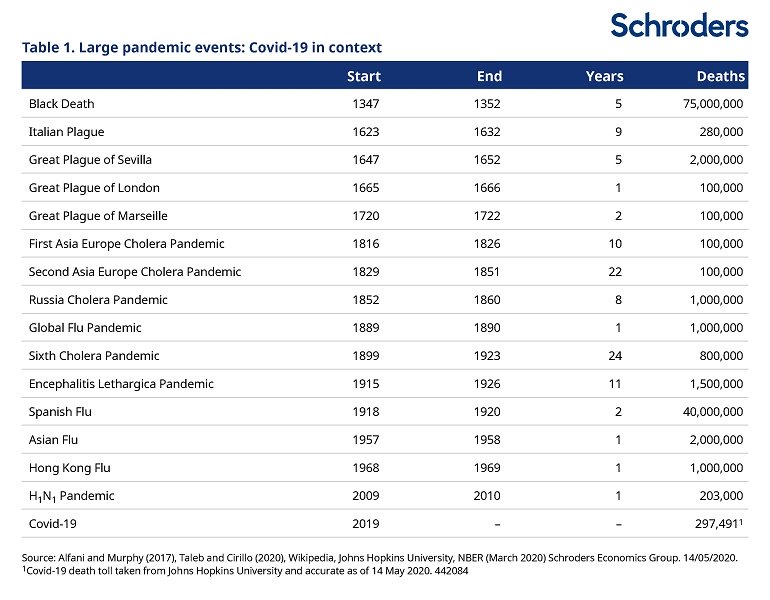
Pandemics are rare events. However when a pandemic hits the world, the impact on the global economy last a long time according to a research study by Keith Wade at Schroders. He notes that adverse effects can last up to 40 years. However in the current scenario, the impacts may not last that long but still the recovery won’t be V-shaped. It is rather likely to be a U or L shaped recovery. Keith also makes the following insight:

Covid-19 is most frequently compared with the Spanish flu of 1918-19, an outbreak that claimed 40 million lives, or 2% of the world population implying 150 million deaths when applied to today’s population.

Fortunately, better health systems and government action to suppress the virus mean that the current outbreak should not be anywhere near as fatal. Nonetheless, although governments may ultimately succeed in curtailing the health impact, the economic effects and debt costs are significant. (emphasis mine)

With that brief excerpt the following graph shows the large pandemics the world experienced since the Black Death of the 14th century that led to the death of some 75 million people.

Click to enlarge

Source: Covid-19: the inescapable truths faced by investors, Keith Wade, Schroders

How Did The Stock Market Perform During The Spanish Flu of 1919 ?

Millions of Americans have lost their jobs as Covid-19 decimated the US economy almost overnight. The tiny invisible virus did more damage to the economy than even 9/11. The number of unemployed Americans is about 43 million. As the adverse effects of the Pandemic continues to impact every corner of the world’s largest and dynamic economy, the stock market seems to have recovered from the lows reached during the panic in March.

The S&P 500 down by just 8.57% on price basis year-to-date. Today the market soared on a positive new on the vaccine front. Sometimes it makes you wonder if the market is brushing aside the Pandemic itself like a minor flu or fever, While the talking heads and others tell us that the market is soaring because it can’t get any worse, vaccine tests are showing potential, US states and other countries are opening up and that is a huge positive, etc. In reality, markets are rising on thin volumes and vaccine for this disease is still one year or more away.

With that brief introduction, let’s turn our attention to how market may perform in a pandemic situation such as the current one. The last pandemic that devastated the globe is The Spanish Flu of 1919. Millions of people around the world were infected and millions died. While Covid-19 is unlikely to reach that levels, it is still important to study the Pandemic of 1919 and its impacts on the market.So far most of the countries have been hit by the first wave of Covid-19. However there are fears of a second wave if economies are opened up prematurely or people go back to living like normal.

An interesting article by Dr. Brian Taylor, in Investment Office analyzes the Spanish Flu and its impact on the US equity market. From the article:

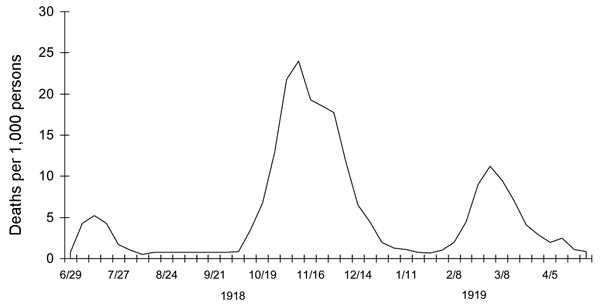
The Spanish flu came in three waves as is illustrated in Figure 1.  The first wave, which made people notice the flu, occurred in July 1918.  The second and most deadly wave occurred in October 1918 and resulted in millions of deaths.  A final wave of the flu occurred in February 1919, and after that, the flu disappeared.  Either the virus mutated to a less lethal form or doctors got better at treating or preventing it.  Just as no one knows for sure exactly where the virus came from, no one knows why it disappeared.

Spanish flu

It is indeed scary that The Spanish Flu had not just one but three waves. Without the internet and other modern conveniences in those days life during the pandemic must have been miserable.

How did the US equity market perform during The Pandemic of 1919? The author provided the following explanation to this question:

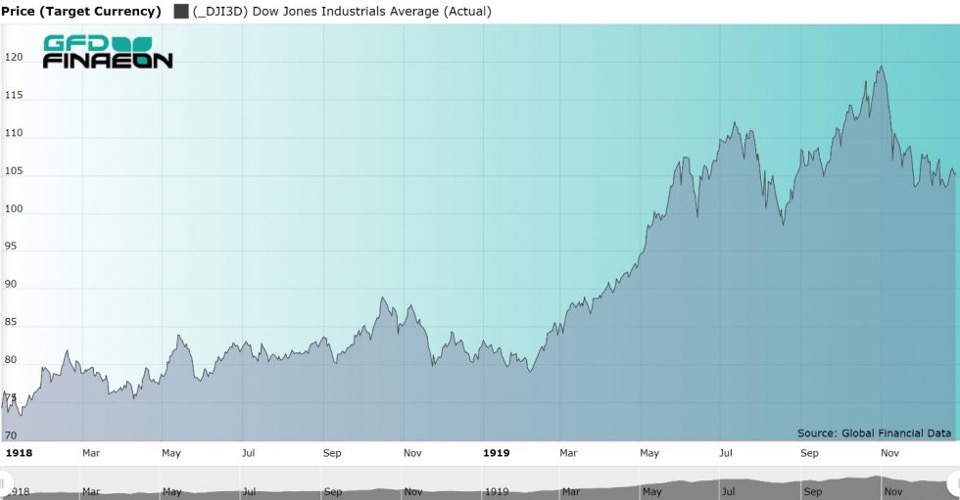
However, the impact of the Spanish Flu on the stock market was minimal. If you look at the Dow Jones Industrial Average in 1918 and 1919, you can see that the stock market was relatively unaffected by any of the three waves of the Spanish flu. Of course, the Spanish flu occurred in 1918 while World War I was raging in Europe so the war had a larger impact on the stock market than the flu.  There were few if any global supply chains that the Spanish Flu could disrupt because the war made supply chains nonexistent. The second and worst wave of flu occurred at the end of World War I when peace was finally achieved after four years of devastating destruction. It is interesting that there was little impact on the stock market of World War I ending on November 11, 1918.  Perhaps euphoria about the conclusion of the war was offset by concerns about the Spanish flu.

It is comforting to see that when the final wave of the Spanish flu subsided in February 1919, the market began an increase of 50% which lasted until November of 1919.  Whether this increase occurred because of the end of World War I or the end of the flu or both is impossible to say, but it does provide encouragement that once the coronavirus begins to subside, the market will bounce back once again. (emphasis mine)


DJIA 1918-1919

Figure 2.  Dow Jones Industrial Average, January 1918 to December 1919


Source: The Spanish Flu and the Stock Market: The Pandemic of 1919, Investment Office

We do not know how long it will take for the Coronavirus Covid-19 to disappear. However it is wise to learn from history and be prepared for any eventuality. Hopefully we will not have any 2nd or 3rd wave with this nasty virus as everyone has already suffered enough.

From an investment perspective, the above details about the Spanish Flu and the equity market offers us valuable lessons.