Economic Snapshot of China from an Australian Perspective

China is one of the major economies in the world with a GDP of over $14.0 Trillion in 2019. Many of the developed countries depend on China for manufacturing goods cheaply and for selling high-value goods including luxury products. For instance, European luxury goods purveyors like LVMH Moet Hennessy Louis Vuitton SA(LVMUY), Kering (PPRUY), Compagnie Financière Richemont (CFRUY), etc. increasingly depend on Chinese consumers than American or European consumers for growing sales. Hence it is wise for global investors keep an eye on the economy of China.

The following is a neat snapshot of the Chinese economy from an Australian perspective. China is an important trade partner for Australia. The main exports to China are coal, iron ore and natural and the major imports from China are manufactured goods like computers.

Click to enlarge

Source: DFAT

Disclosure: No Positions
Quick Post: Three Industrial Gas Producers

The world leaders in Industrial gases specifically hydrogen are Linde(LIN), Air Liquide(AIQUY) and Air Products and Chemicals(APD). In addition to hydrogen and other gases, they also produce oxygen which is in high demand during this pandemic. For instance, Linde is major supplier of oxygen in many emerging countries. With millions of Coronavirus patients requiring oxygen the demand is exceeding supply in some countries.

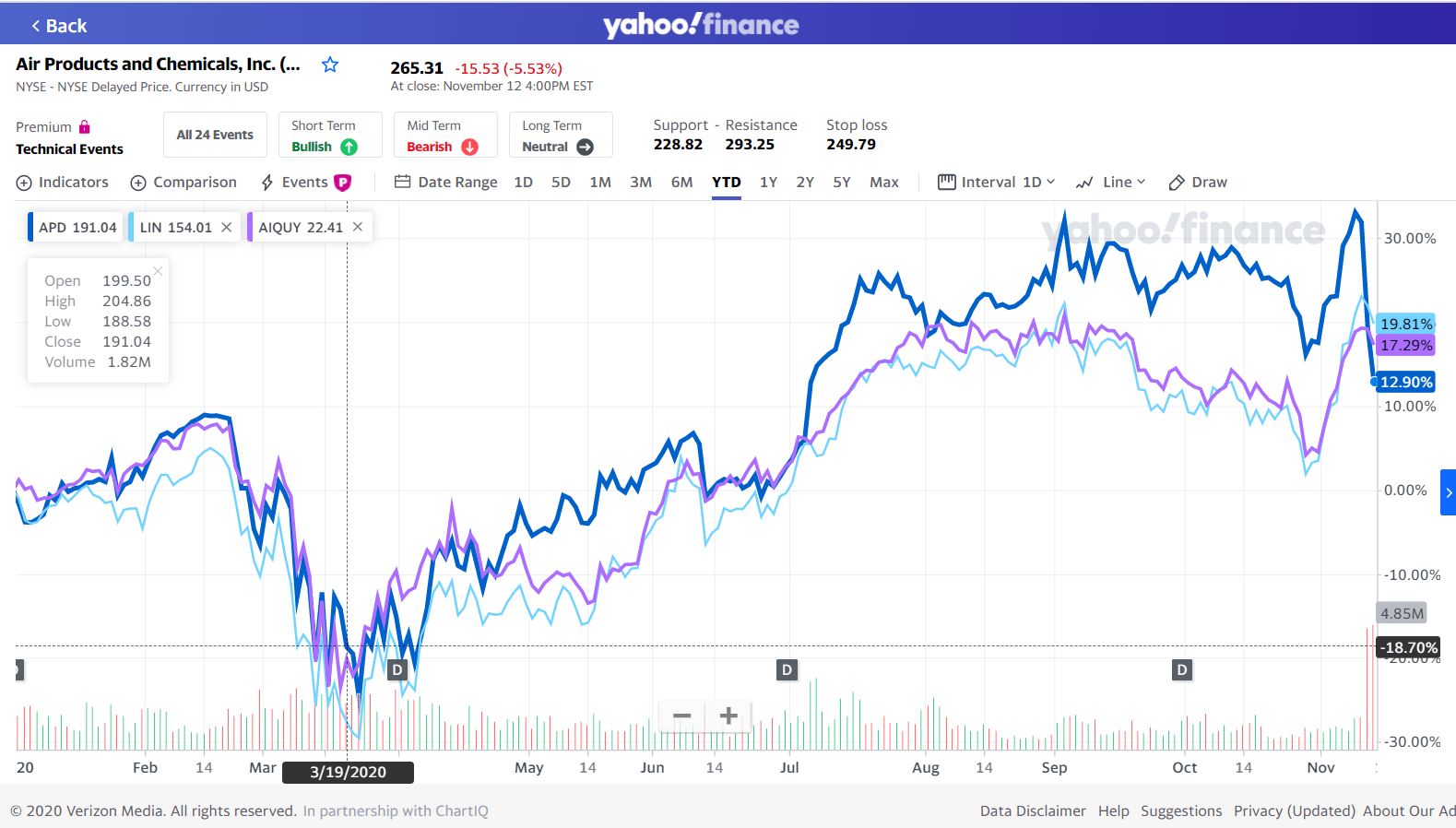
With that said, all three stocks had great run this year until recently when they fell some after reporting earnings. The following chart shows the year-to-date returns of the three stocks:

Click to enlarge


Source: Yahoo Finance

Below is a brief excerpt from a journal article:

Linde, Air Liquide and Air Products have advantages over newcomers. Hydrogen is very volatile, and they already know how to safely produce, store and transport it. Their current industrial customers are also likely to be hydrogen buyers in the future and they have been investing in clean hydrogen pilot projects and new technologies.

Linde is the global leader after the German company merged with U.S. rival Praxair in 2018. It only funds hydrogen projects that provide double-digit internal rates of return, just like its other investments. Its joint venture with ITM Power also provides a link to promising electrolyzer technology used to make carbon-free, or green, hydrogen.

Air Liquide also takes a relatively conservative approach to hydrogen investment, focusing on the production and distribution of the gas, though it also dabbles in refueling stations. The Paris-headquartered company has a stake in electrolyzer company Hydrogenics, which has fuel-cell technology too.

Based in Allentown, Pa., Air Products and Chemicals has a bolder approach, investing in larger hydrogen projects with more experimental technologies. In July, the company announced it will contribute $3.7 billion to the $7 billion project to build a green-hydrogen facility in Neom, a futuristic megacity to be built in Saudi Arabia. Its stock has outperformed its peers this year, perhaps because it has absorbed more of the hydrogen hype. The gas accounts for roughly 25% of its revenue, compared with around 10% for the larger European companies.

Source: The Industrial Giants That Could Get a Lift From Hydrogen. WSJ

Disclosure: No Positions

Know Your Risk During COVID-19: Infographic

Coronavirus cases are exploding in the U.S. For the first time since the pandemic began, new cases exceeded 160,000 yesterday according to NY Times. For more than a week now average daily cases have crossed the 100,000 mark.

Covid-19 has killed 242,787 Americans so far and the total case count is over 10.6 million.

The situation is so bad in the country that the French aid organization Doctors Without Borders is now opening in the U.S. According to CNN’s Dr.Sanjay Gupta:

 “Doctors Without Borders have come to the United States to do their work. They go to the hottest spots in the world, they look at the Earth and say where are we needed? Well, they’re needed here in the United States right now.”‘

Usually DWB provides medical relief in some of the poorest and third world countries of the world. People in the US and other developed countries donate funds to this charity in order to help people in the worst spots of the world. So DWB operating in the richest country in the world is indeed shocking ! The even bigger sad thing is that scare resources that are desperately needed in other countries are now being spent by the DWB in the US because the country failed to take care of itself in spite of all the wealth.

Here is Dr.Gupta from another piece at CNN:

“This is a humanitarian disaster — probably one of the worst stories I’ve covered in my career here at CNN,” the network’s Chief Medical Correspondent Dr. Sanjay Gupta said Thursday.

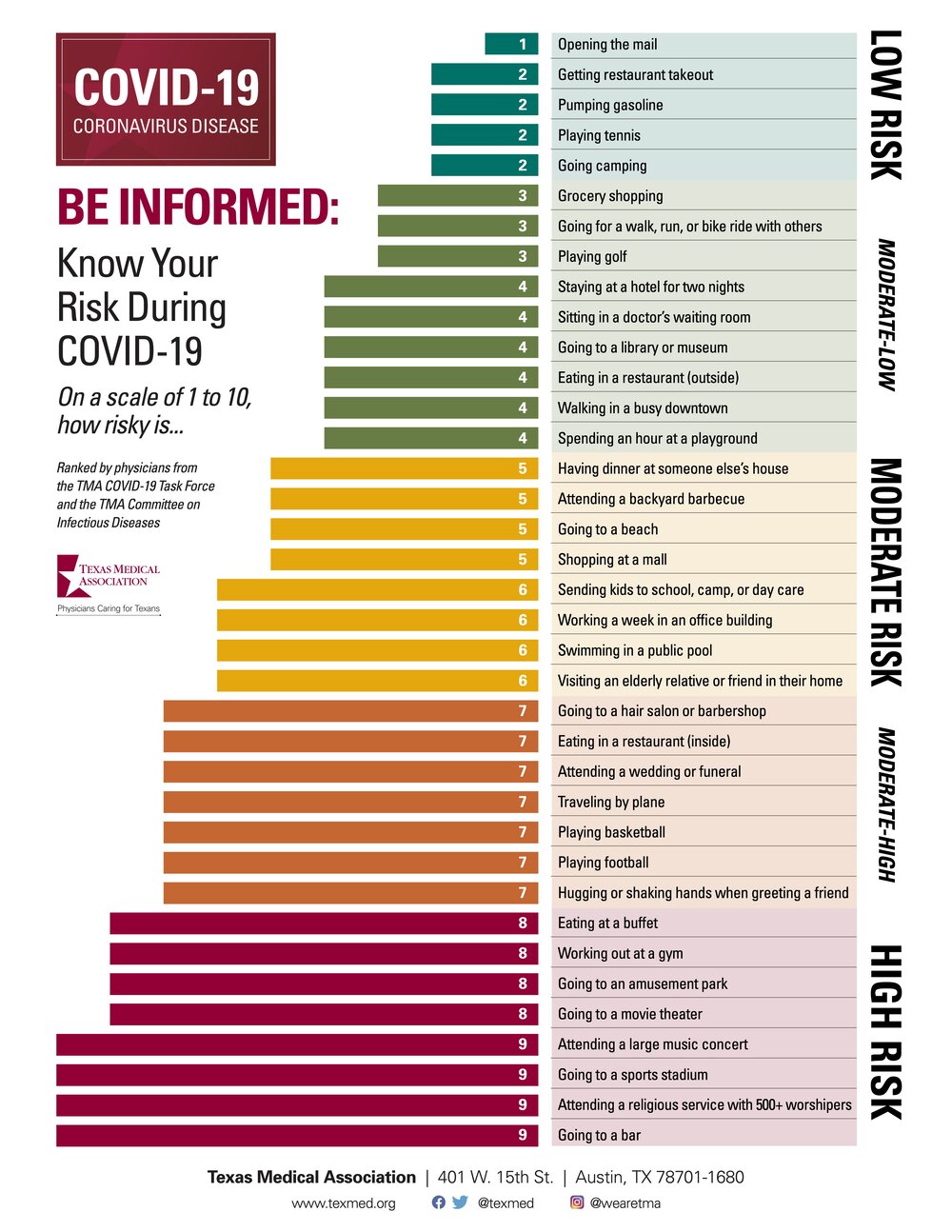
With that brief update on the Coronavirus pandemic, below is an informative chart I recently came across. This chart shows the type of various day to-day activities that are low risk to high risk. Some of the high risk activities are going to a bar, working out at a gym, going to an amusement park, etc.

Click to enlarge

Source: Texas Medical Association (TMA)

China’s Per Capita GDP Growth From 1949 To 2019: Infographic

The economy of China has grown significantly in the past few decades especially after the country entered the WTO in 2001. From 1949 thru 1980 the GDP per capita was mostly flat. To put it another way, China’s economy took off under the leadership of Deng Xiaoping. The following infographics shows some of the key events since 1949 under each president and the per capital GDP growth until 2019:

Click to enlarge

Source: Unknown (Will update once identified)