Foreign Equity Markets: Less Concentrated and More Opportunities

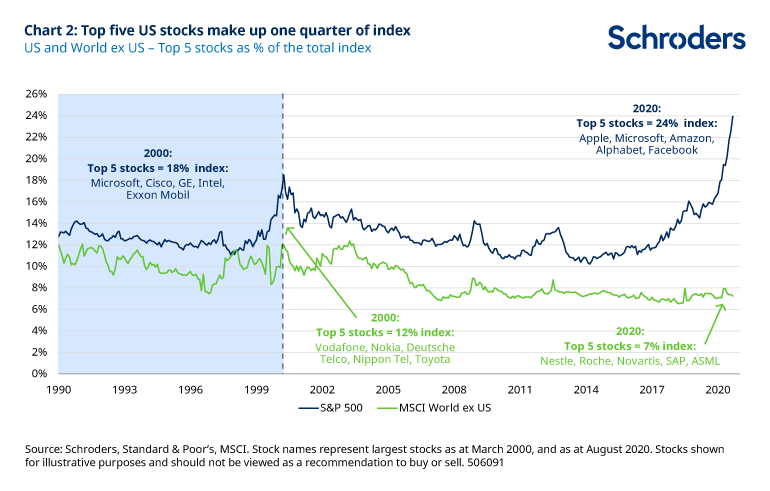
In a recent post I mentioned that US stocks beat foreign stocks hands down over the long term. However that does mean one should simply avoid foreign stocks. In addition to diversification benefits, currently international equity markets are less concentrated than US markets and also they offer plenty of choices relative to the US market. The following chart shows how concentrated the US equity market is compared to international markets:

Click to enlarge
Source: Six charts that make the case for international equities and value, Schroders

An excerpt from the above article:

Picking up point 5, the narrow breadth of the US market has been a feature of the past few years. This has been mainly due to the phenomenal success of the US tech giants.

The chart below shows how the top five US stocks alone now make up almost one quarter of the S&P 500 index. By contrast, the top five international stocks account for just 7% of the international benchmark (MSCI World ex US).

This reflects a period of extraordinary growth for those tech giants. Aside from Microsoft, most of them were barely a twinkle in their founders’ eyes at the turn of the 21st century. There’s no denying that, so far, there has been no good time to bet against their success continuing. But this does raise the question how much further this trend can go on.

As we’ve already said, it’s impossible to predict an optimal time to diversify portfolios. However, this level of concentration in US markets suggests to us that now is probably not the worst time to do so at least.

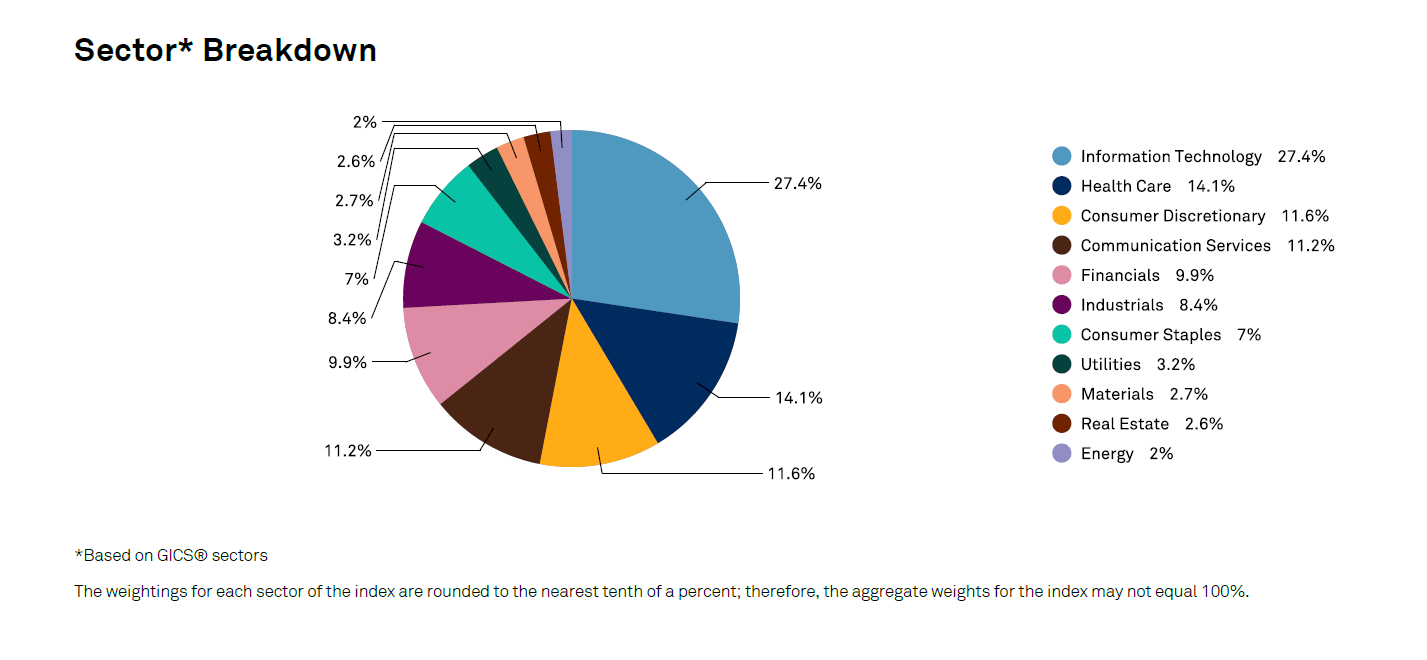
Another perspective on the concentration in the US equity market can be found in the S&P 500. As of Oct 30th, IT constitutes over 27% of the index as shown in the following chart:

Click to enlarge
Source: S&P

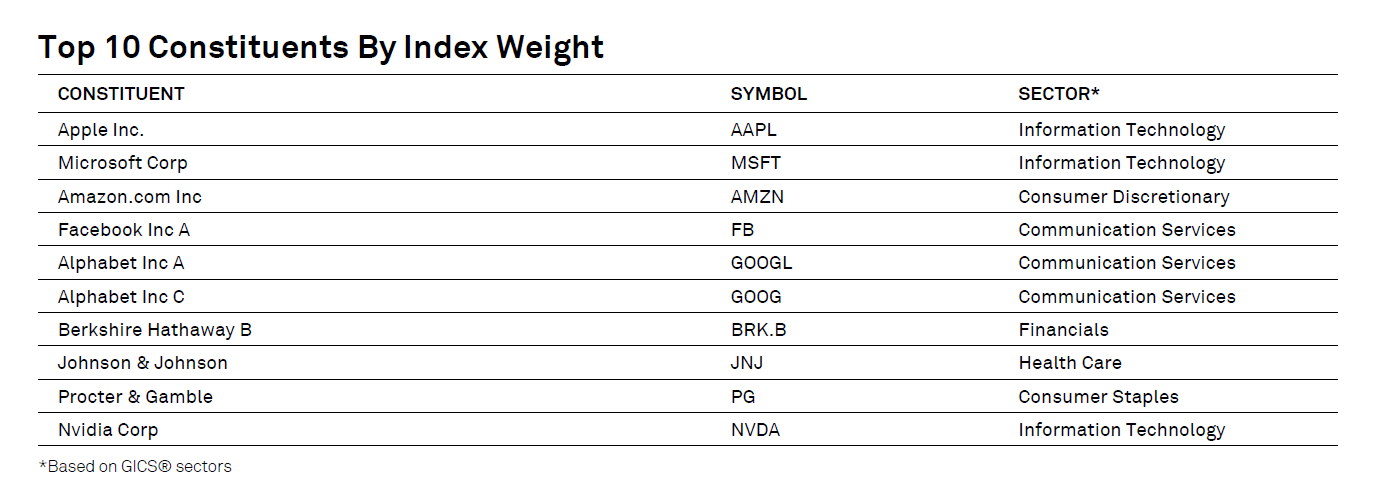
In addition, six of the top 10 companies in the index are tech companies:
Source: S&P

Related ETF:

  • SPDR S&P 500 ETF (SPY)

Disclosure: No positions
Fact of the Day: US Stocks Beat Foreign Stocks Over The Long Term

I have written many times on this blog that US investors have to diversify their holdings across assets including owing foreign equities. The convention wisdom that American multinationals derive a substantial portion of their earnings form abroad and hence foreign stocks are not necessary to own does not necessarily hold true. However in recent years US stocks have outperformed foreign stocks by a significant margin. I came across the below fascinating fact in the latest article by Jason Zweig at the WSJ.

  • The S&P 500 yielded an average of 8.7% annually higher than the MSCI World Ex-USA index over the past five years
  • Over the past 25 years the S&P 500’s annualized return over the MSCI World Ex-USA index was 4.5%

Source: Blown Election Calls, the Stock Market and You, WSJ

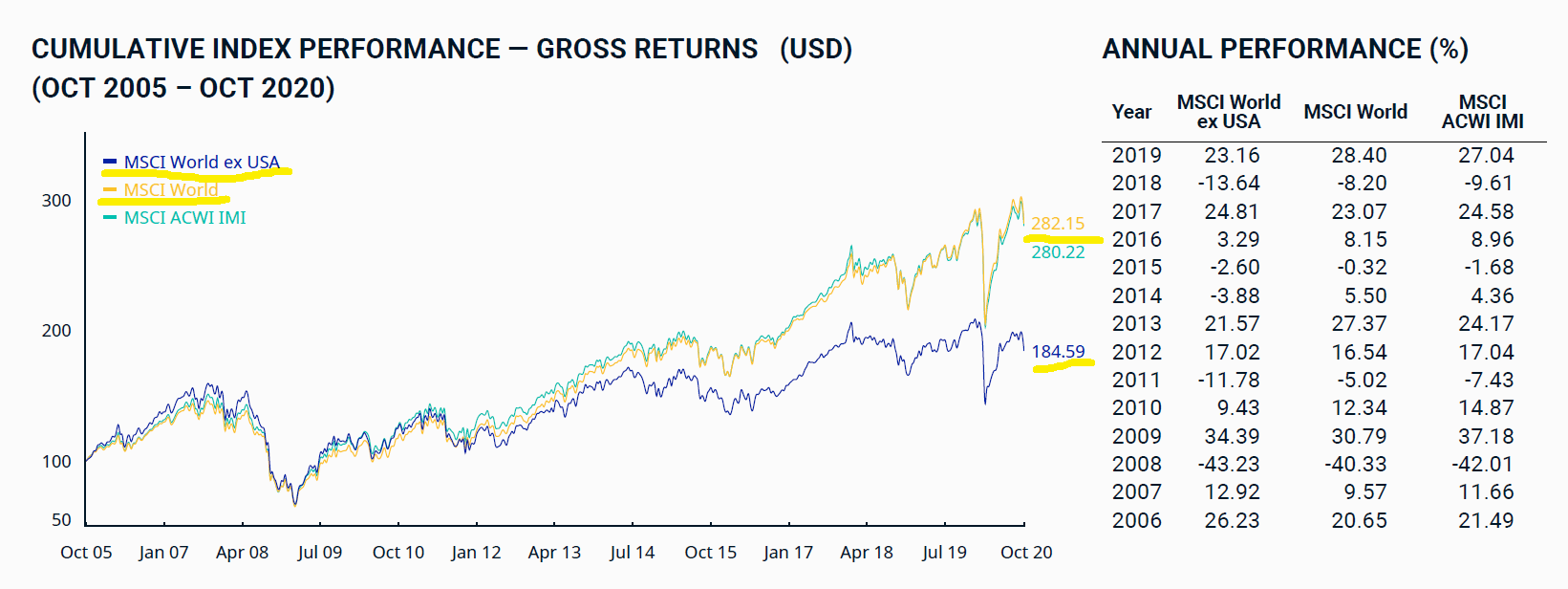
The following chart shows the wide gap in returns between the MSC World Index and MSCI World ex USA. The MSC World Index includes the US.

Click to enlarge

Source: MSCI

Related ETFs:

  • SPDR S&P 500 ETF (SPY)
  • Vanguard MSCI Emerging Markets ETF (VWO)
  • iShares MSCI Emerging Markets ETF (EEM)
  • Vanguard Developed Markets Index Fund ETF (VEA)

Disclosure: No Positions

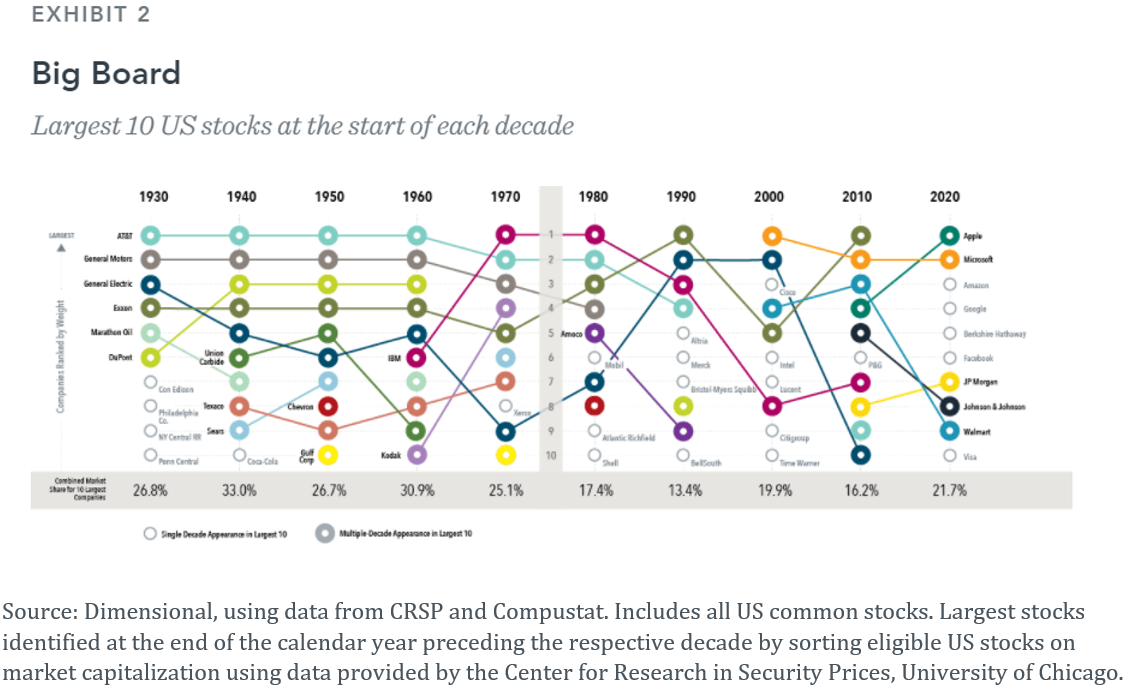
The Largest 10 US Stocks at the Start of Each Decade: Chart

Many of the top US firms stayed in the top 10 rank for decades while others did not. For example, AT&T(T) lasted in the top 10 for six straight decades from 1930. General Motors(GM) and General Electric(GE) also ranked in the top 10 for many decades. Some of the one-time wonders include Lucent Technologies and Cisco(CSCO) at start of the 21st century. In this decade, 5 new entrants are at the top 10. These are Amazon(AMZN), Facebook(FB), Alphabet(GOOG), Visa(V) and Berkshire Hathaway Inc (BRK.A).

Out of these Berkshire Hathaway can be counted as it is a conglomerate operating in multiple unrelated industries with no particular vision or mission. The three members of the FAANG gang can easily be replicated by some other startup in the future. It remains to be seen which of these top 10 companies will continue to dominate the US in the next several decades. Fifty years from now people may ask if Facebook is some kind of new book published about one’s face.

Click to enlarge


Source: Large and In Charge? Giant Firms atop Market Is Nothing New, Indexology Blog

Disclosure: No Positions

On the Year-to-Date Return of Exchange-Listed Foreign Oil Stocks

Oil prices have fallen dramatically this year as the pandemic decimated global oil consumption. Currently Brent crude is trading under $37 for January delivery. With the fall in crude oil prices oil stocks have been crushed well. Most of the foreign exchange-listed oil stocks have plunged by 50% of more as shown in the table below.

In April oil supermajor Shell cuts it dividend for the first time since World War Two. Shell slashed its quarterly dividend to 15 cents from 47 cents. Last week Shell announced it was raising dividend by 4% to 16.65%. Though the increased amount is still far below the original dividend amount, the raising of the dividend is a step in the right direction.

S.No.CompanyTickerStock price (as of Oct 30, 2020)Year-to-Date % ChangeCountry
1Transportadora de Gas del SurTGS$4.82-32.78%Argentina
2China Petroleum & ChemicalSNP$39.33-34.61%China
3EquinorEQNR$12.83-35.56%Norway
4PetroChinaPTR$28.46-43.45%China
5China National Offshore Oil-CNOOCCEO$92.12-44.73%China
6TOTALTOT$30.33-45.15%France
7EcopetrolEC$9.25-53.66%Colombia
8EniE$13.98-54.84%Italy
9Royal Dutch Shell - ARDS.A$25.55-56.68%United Kingdom
10Petroleo Brasileiro-PetrobrasPBR$6.63-58.41%Brazil
11BPBP$15.48-58.98%United Kingdom
12Royal Dutch Shell - BRDS.B$24.15-59.73%United Kingdom
13YPFYPF$3.22-72.19%Argentina
14Vista Oil & GasVIST$1.99-74.65%Argentina
15SasolSSL$5.26-75.66%South Africa

Source: BNY Mellon

Demand for oil will continue to be depressed until there is some sense of return to normal life. The new lockdowns starting in many European countries this week does not help oil companies. Despite the known uncertainties investors willing to make a bet on oil stocks can consider some of the beaten down stocks.

Disclosure: Long EC