Why Canadian Investors Should Diversify Globally

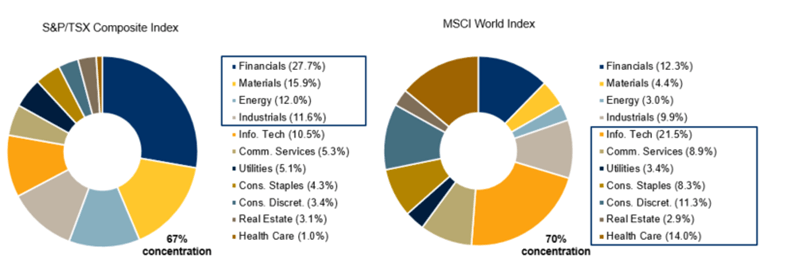
The Canadian equity market is highly concentrated. Just four sectors – financials, materials, industrial and energy account for about 70% of the market. As with investors in any other country it is wise for Canadian investors to not hold all their assets in the domestic stocks and instead diversify across other sectors in foreign countries. The latest data for the benchmark S&P/TSX Composite Index is dominated by Financials at just over 30%.

Jillian Richmond of PH&N Investment Services discussed the need for Canadian investors to diversify in an article a few months ago. From the article:

By investing globally, you can benefit from exposure to other sectors that are under-represented at home, including Information Technology and Health Care. Exposure to Health Care may be particularly timely as a number of COVID-19 vaccines are being developed in labs outside Canada.

97% of the world’s investment opportunities lie outside of Canada

Canadian market is focused in four sectors, while global markets are very well diversified.

Sources: S&P and MSCI Indices as of July 31, 2020.
Source: How to avoid home country bias, PH&N Investment Services

In the Info Tech sector Canadians can find plenty of opportunities just south of the border relative to the home market.

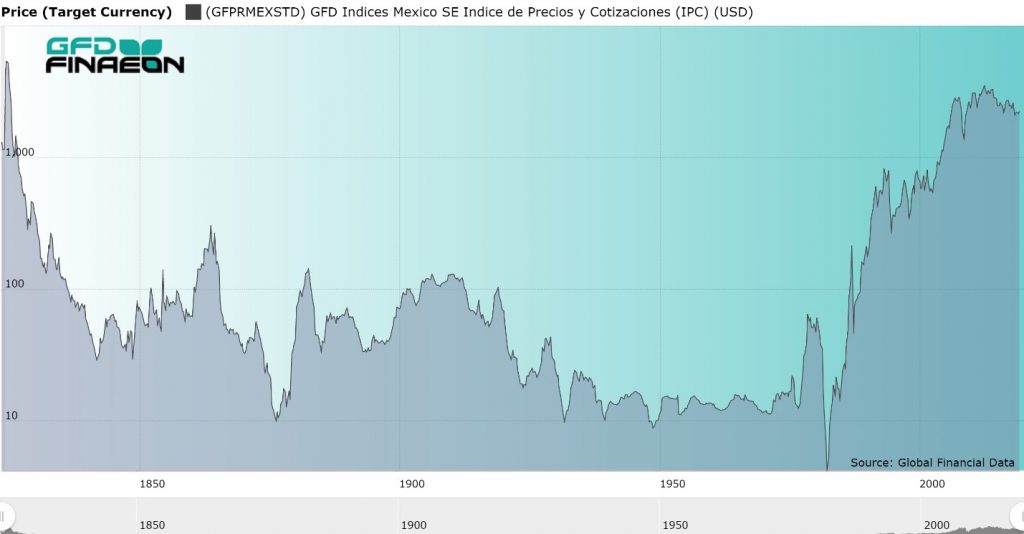
Mexico: Still An Emerging Market 200 Years Later

Mexico is currently an emerging market. According to an article by Bryan Taylor, Chief Economist at Global Financial Data published last year Mexico is still emerging 200 years later. He discusses the boom and busts and the challenges of the country since its independence. Before we get to those details, it is important to note that some countries are unable to transition to developed market status after years, decades or even centuries. For example, countries like South Korea, Singapore, Hongkong and Taiwan used to be emerging markets in the 1950s. But in the following two decades, they transitioned into developed markets with astonishing economic growth. Even the US was an emerging market in the 1800s. However these type of successful transitions are few. Brazil for instance is called the “Country of the Future” for many decades now. It is also still emerging and unable to become a developed country. So it would be foolish to invest in Brazil or Mexico thinking they will be the Latin Tigers of this century.

With that said, below is an excerpt from the article “Mexico: Still Emerging 200 Years Later“:

Mexico has been struggling to develop its economy since Spain invaded Mexico in 1521 and it gained its independence in 1821.  When Mexico was a colony, Spain relied upon exports of silver to profit from its control over the economy.  The economy stagnated after Mexico gained its independence, but General Porfirio Diaz (1876-1910) attempted to develop the economy by allowing foreigners to invest in Mexico and build railroads and mines with foreign capital.  Most of the investment in the 1910s and 1920s was spent developing Mexico’s oil, but after the nationalization of the oil industry in 1938, foreign capital stopped flowing into Mexico and the country had to rely on domestic capital.  The economy grew rapidly after World War II, but collapsed in the 1980s.  Since NAFTA was signed in 1994, Mexico has pursued market-oriented policies to expand trade with the rest of the world. The period between 1982 and 2007 was an era of high returns to both stocks and bonds, the highest in the country’s history, but during the past 12 years, returns have stagnated.

Global Financial Data has 195 years of data on Mexico stretching from 1824 until 2019.  GFD has data on 44 companies that listed in London and 30 companies that listed in New York between 1824 and 1989.  Most of the companies that listed in London were mining companies, railroads, banks or oil and gas companies.  Oil and gas, telephone and telegraph, utilities and mining companies listed in New York. Some of the companies had a long existence with the Anglo-Mexican Mint Co., Mexican Eagle Oil Co., Mexican Railway Co., and United Mexican Mine Co. all lasting over 50 years before meeting their demise. The poor performance of equities was matched by the poor performance of government bonds.

Mexico was in default during most of the 1800s, paid interest from 1887 until World War I, went into default during the Mexican Revolution, then returned to solvency after World War II.  Mexico defaulted on its bonds in 1827, made a few interest payments in the 1860s, but didn’t really start paying interest regularly until 1887.  Mexico defaulted a second time in 1914 and remained in default until 1963 when the country issued new government bonds in New York.  Mexico defaulted a third time in 1982 and remained in default until the “Brady plan” restructured Mexico’s debt in 1989. The Mexican government has been in default on its bonds in more years than it has paid interest.  Mexican government bonds are definitely not risk-free. Even with the reinvestment of interest received periodically between 1824 and 1972, investors would have just broken even on Mexican government bonds during those 150 years.  On the other hand, between 1994 and 2018, investors in Mexican bonds received an 8.73% annual return, which exceeded the 8.16% returned to equities during those years.

Click to enlarge

Source: Mexico: Still Emerging 200 Years Later, GFD

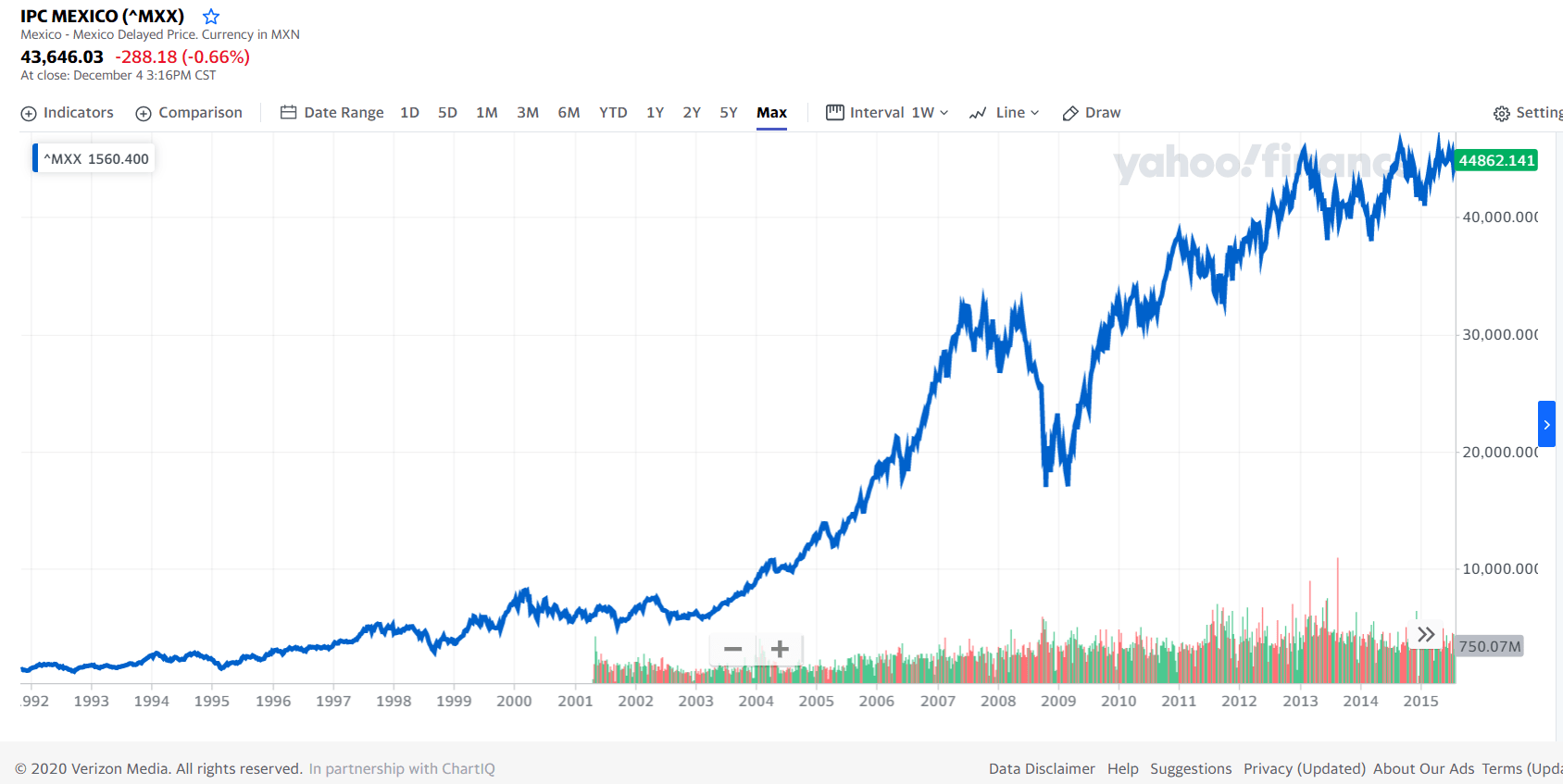
Below is the long-term chart of the benchmark IPC Index of the Mexican equity market:

Click to enlarge

Source: Yahoo Finance

It would be fascinating to watch if Mexico is able to shake off its past challenges and become the miracle economy of Latin America this century.

Related ETF:

  • iShares MSCI Mexico ETF (EWW)

Disclosure: No Positions

Covid-19 RNA Vaccines – What Are They and How Do They Work: Infographic

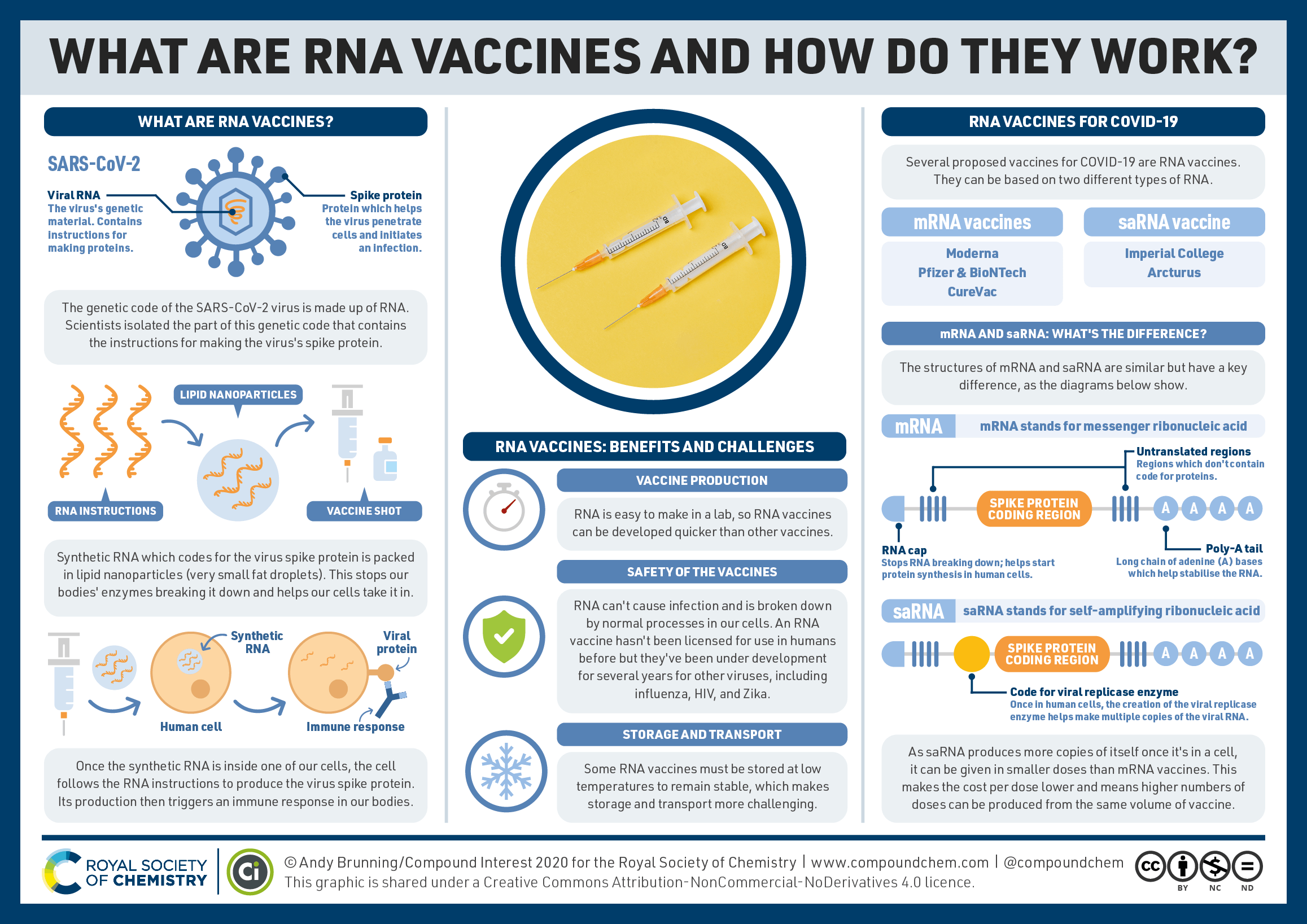
The Covid-19 vaccine created by Pfizer (PFE) and BioNTech(BNTX) uses a new technology called mRNA which stands for message RNA. But what are RNA vaccines and how do they work? The following is a fantastic infographic from Compound Interest that explain the details.

Here is how the CDC defines mRNA vaccines:

New Approach to Vaccines

mRNA vaccines are a new type of vaccine to protect against infectious diseases. To trigger an immune response, many vaccines put a weakened or inactivated germ into our bodies. Not mRNA vaccines. Instead, they teach our cells how to make a protein—or even just a piece of a protein—that triggers an immune response inside our bodies. That immune response, which produces antibodies, is what protects us from getting infected if the real virus enters our bodies.

Source: Understanding mRNA COVID-19 Vaccines, CDC

Click to enlarge

Source: CompoundChem

You can learn more details on this wonderful vaccine technology in the above link.

Related article:

Related stock lists:

  1. The Complete List of Covid Vaccine Stocks Trading on the US Markets
  2. The Complete List of Biotech Stocks Trading on NASDAQ
  3. The Complete List of Biotech Sector-Related Stocks on the NYSE 
  4. The Complete List of Major Pharmaceutical Stocks on the NYSE

Stocks Outperform Bonds Over The Long Term: Chart

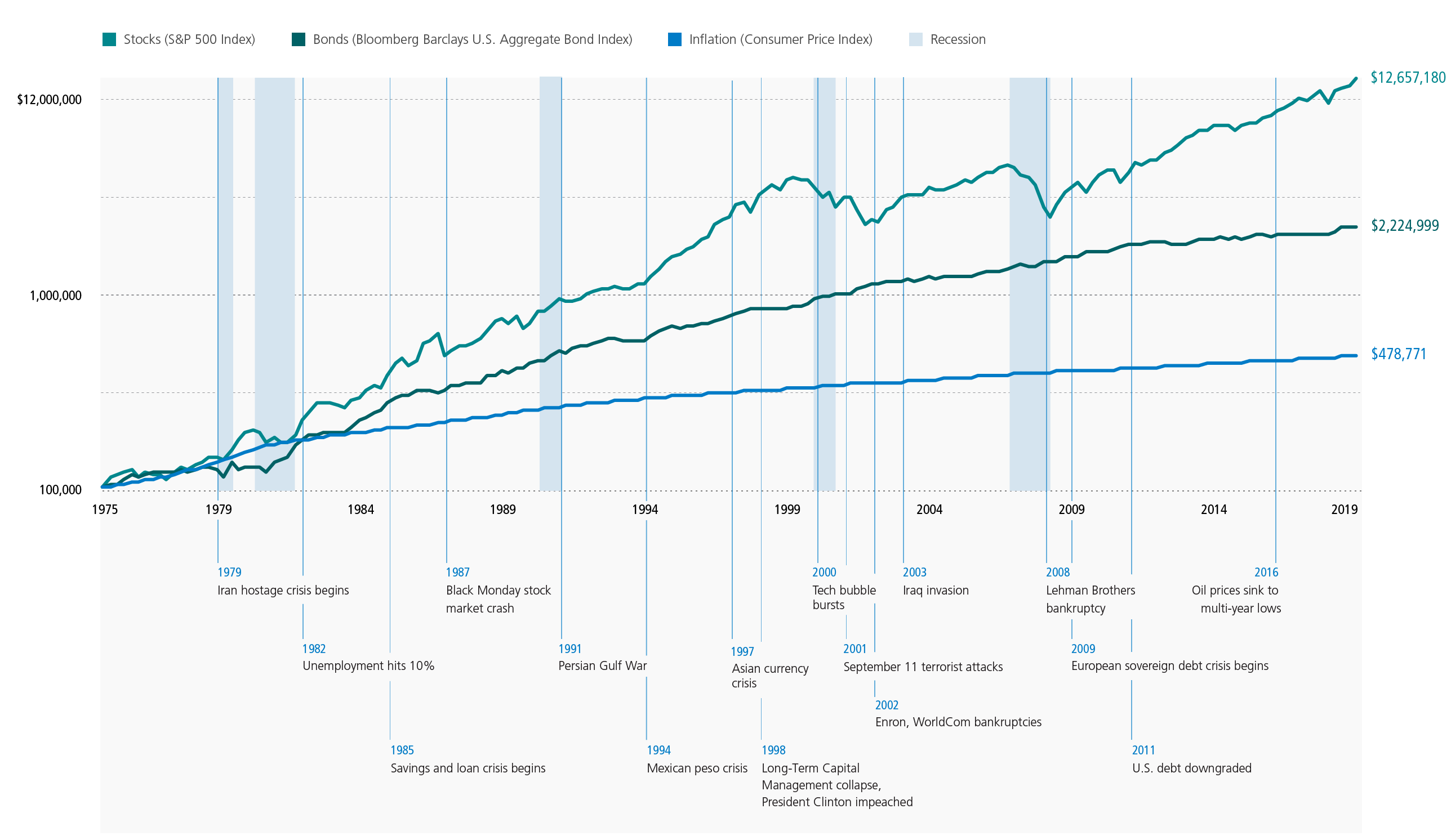
Stocks outperform bonds over the long term overcoming many obstacles along the way such as wars, recessions, inflation,  political uncertainty, natural disasters, etc. During short time periods such as a few months or a years during recessions sometimes bonds have done well relative to bonds. However stocks are the best asset type to own to build real wealth. The following chart shows the growth of $100,000 invested in stocks and bonds from 1975 thru 2019:


Click to enlarge

Source: U.S. equity investing, John Hancock Investment Management

The investment in equities would have soared to over $12 million whereas bonds would have increased to just over $2 million. The above chart also shows some of the critical events that occurred during the time period.

Related ETFs:

  • SPDR S&P 500 ETF (SPY)
  • iShares iBoxx $ Investment Grade Corporate Bond ETF (LQD)
  • iShares TIPS Bond ETF (TIP)
  • Vanguard Total Bond Market ETF (BND)
  • iShares Core Total U.S. Bond Market ETF (HYG)
  • SPDR® Barclays High Yield Bond ETF (JNK)

Disclosure: No Positions