Gold is a Great Asset To Own Especially During Periods of High Market Volatility

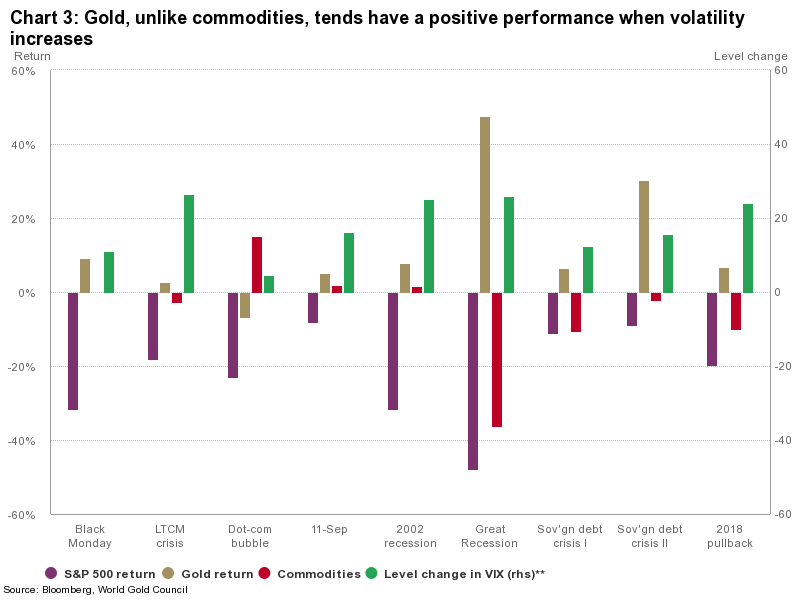
Gold is an important asset to own in a well-diversified portfolio. Gold offers portfolio protection especially during periods of high volatility in equity markets or crises. This is because when equities crash gold generally rises and hence offers stability to a portfolio. Since gold as an asset class does not produce income such as dividends it is not necessary or prudent to assign large part of a portfolio.

Gold has positive co-relation to stocks during equity market expansions according to an article at World Gold Council. During equity market downturns and other crises gold has negative co-relation to equities.

Click to enlarge
Source: Gold: the most effective commodity investment, World Gold Council

The chart shows that during the Great Recession in equity markets in 2008 when equities plunged around 50%, gold rose over 45%. In other instances such as during the sovereign debt crises in the last decade also gold performed very well relative to other assets including stocks.

Related ETF:

  • SPDR Gold Trust (GLD)
  • SPDR S&P 500 ETF Trust (SPY)

Earlier:

Disclosure: No Positions

The Periodic Table of Annual Returns For Canadians – From 2010 To 2020

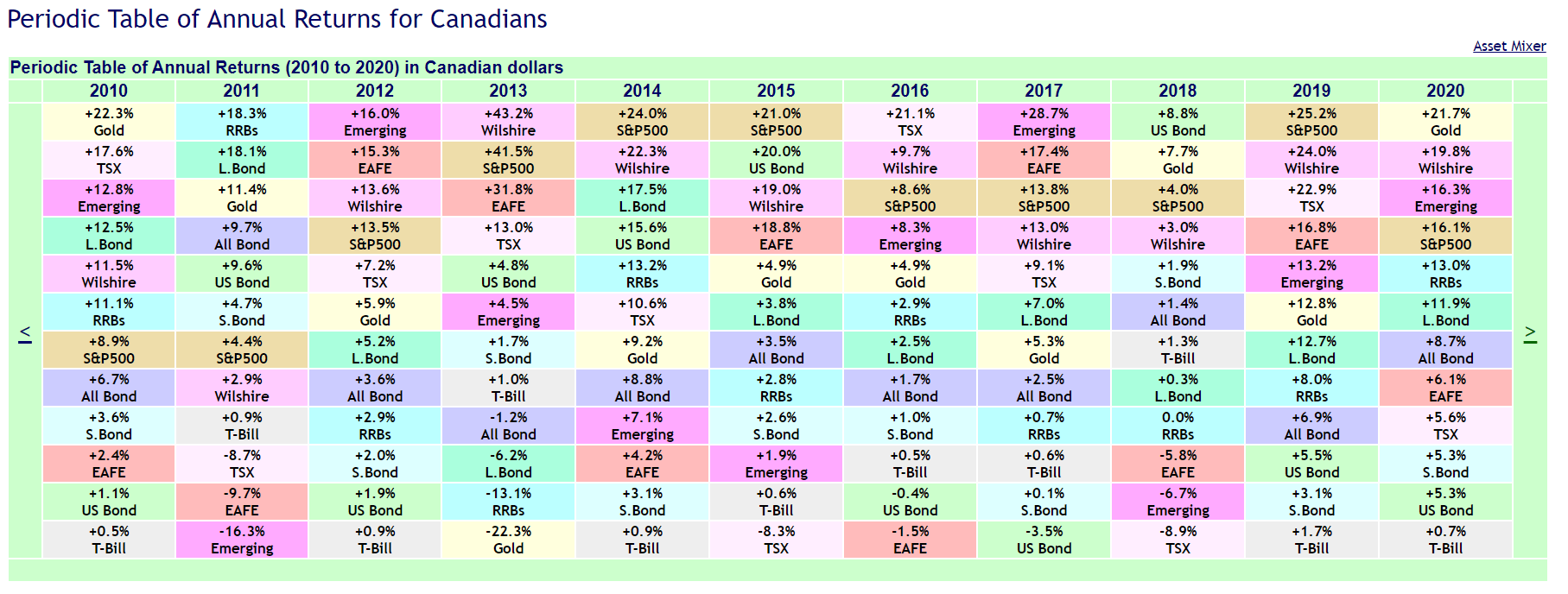
The Periodic Table of Annual Returns in Canadian Dollars from 2010 to 2020 is shown below. In 2020 the TSX index returned 5.6% compared to 16.1% for the S&P 500 in Canadian Dollar terms.

Click to enlarge

Credits: Many thanks to Norbert Schlenker at Libra Investment Management for collecting the data that this calculator uses. Original public data sources include: Bank of Canada, BC Government Statistics, Canadian Institute of Actuaries, Economagic.com, Financial Post, Globe & Mail, globefund.com, Kitco, Libra Investment Management Inc., MSCI, Prof. Werner Antweiler (UBC), Scotia Capital, BMO, Standard & Poors, Statistics Canada (Table 326-0001), DH&A, and Wilshire Associates.

Source: Stingy Investor

Research Study: Countries with Loose Rule-Breaking Cultures Have Been Hit Harder by Covid

A fascinating article  in The Guardian yesterday discussed why the Coronavirus hit some countries harder than others was published based on a research study. According to the author, Michele Gelfand of professor at the University of Maryland Covid was deadlier in countries with “loose” relaxed attitude towards rule-breakers. Most of the countries the western world fall in this category including the US, UK, Spain, Italy, etc. In these countries lockdowns that were implemented were “leaky” lockdowns meaning it was not a strict lockdown and even when violators were it was mostly a small fine or a warning. In contrast, Asian countries such as Singapore, Japan, China and even Austria fared much better as people in those countries people followed the rules more strictly. Accordingly both infections and deaths were much less relative to the developed countries.

Below is a brief excerpt from the piece:

The virus has been especially effective at turning some societies’ propensity for rule breaking against them. Americans exemplify this spirit. It’s why the United States boasts a great deal of creativity and innovation. It’s also a major liability during times of threat. Such maverick behaviour is supposed to subside in emergencies. Yet countless US citizens continue holding parties, shopping maskless and generally scoffing at the virus. When the fear reflex is triggered, it’s often in a perverse way: fearing lockdowns and mask mandates more than the virus itself.

These cultural mismatches made that threat signal harder to discern. But former President Trump’s messaging silenced it for millions. “Just stay calm. It will go away,” he said on 10 March 2020. Even in January 2021, well after more than 300,000 Americans had died, he complained of the Centers for Disease Control and Prevention’s supposed exaggerations.

Source: Why countries with ‘loose’, rule-breaking cultures have been hit harder by Covid by Michele Gelfand, The Guardian

The complete article is worth a read.

The nation’s chaotic and messy healthcare system also turned out to be less conducive in fighting a global pandemic.

How Corrupt Is Your Country? : Infographic

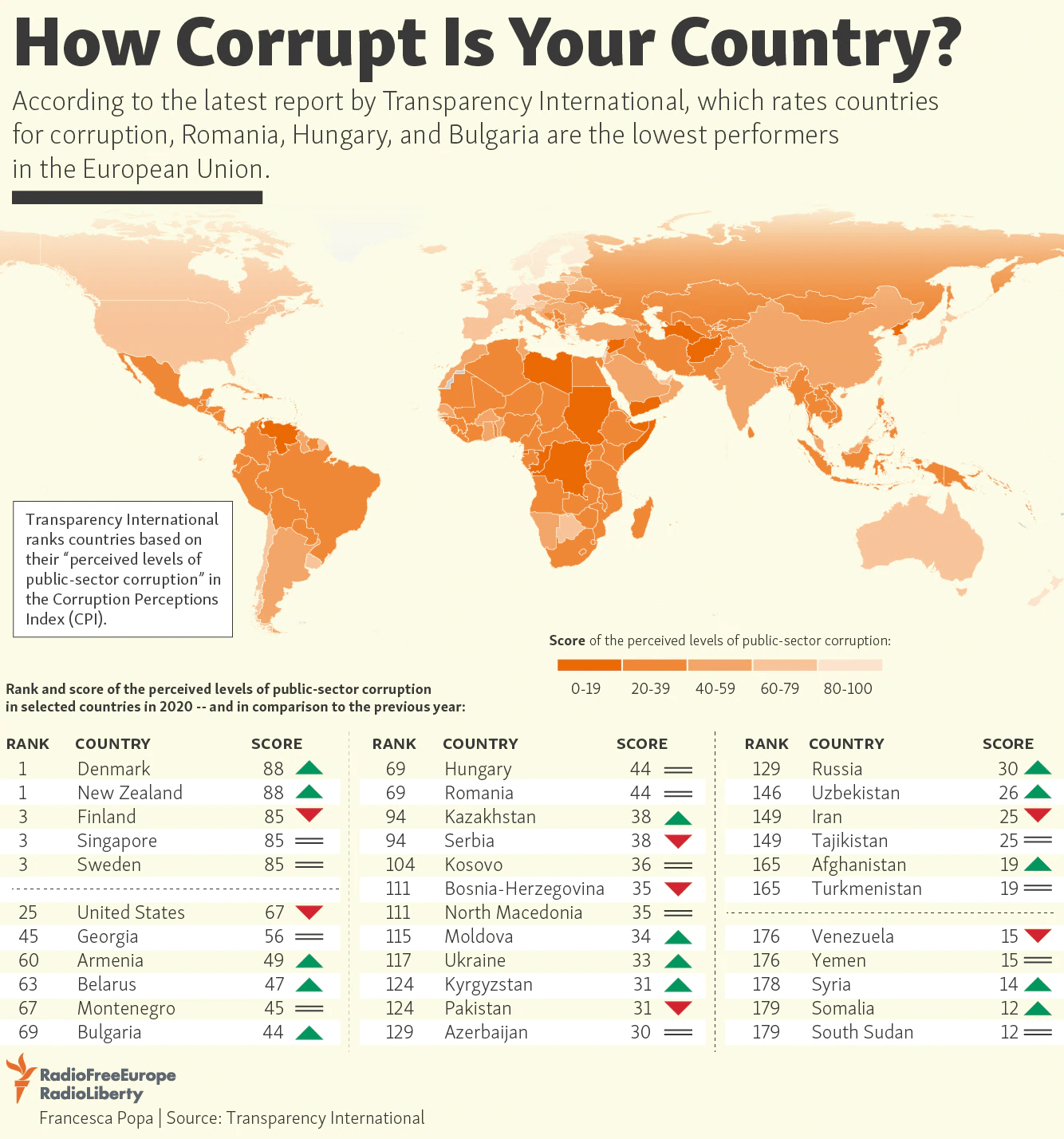
Every year Transparency International publishes a report ranking the countries of the world based on corruption. The 2020 ranking showed Denmark and New Zealand ranked number one followed by Finland, Singapore and Sweden in the third spot. The US took the 25th rank ahead of Georgia and Armenia. The US should eliminate corruption at all levels and try to attain a spot at least in the top five. If tiny Singapore can appear in the top ranks US should be able to as well.

Click to enlarge

Source: How Corrupt Is Your Country?, Radio Free Europe/Radio Liberty