How Much Have Foreign Bank Stocks Fallen ?

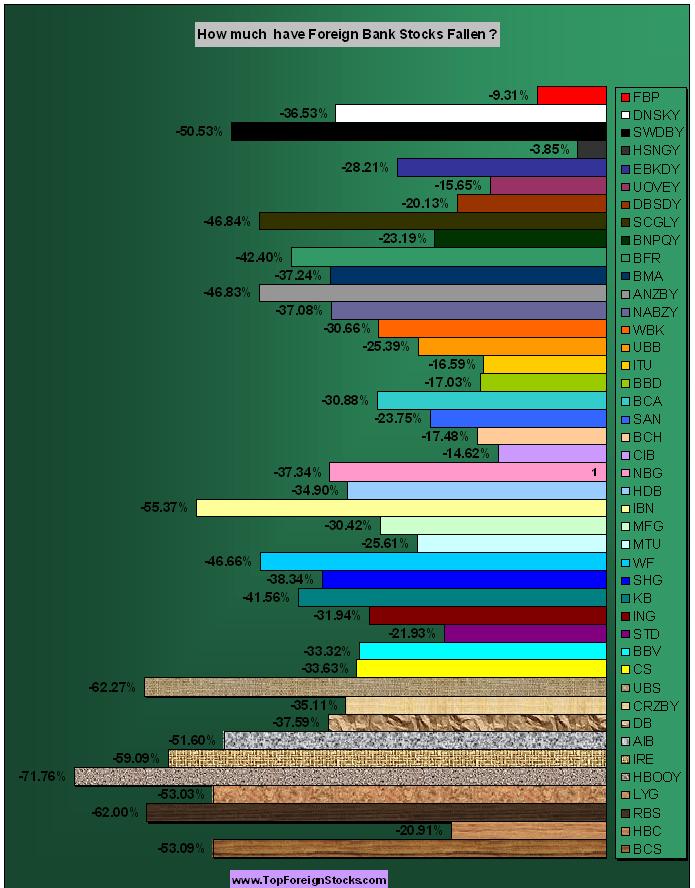
A few a days ago I read an interesting post titled “50 SPX Stocks Down > 50%” in “The Big Picture” site.That article inspired this post where I analyze the performance of 43 foreign banks since the October 2007 peak.

I followed these rules for this study:
a. Take the highest intra-day high reached in October 2007 as the peak.
b. If a stock reached higher price before or after October ignore it.
c. Include bank stocks listed in the OTC market as sponsored ADRs.

I selected October 2007 because after hitting highs both the US and foreign markets started going down due to the unfolding credit crunch.Just like some of the US bank stocks, some of the foreign banks listed in the chart below are down more than 50%.

Foreign Bank Stock Returns Chart:
All-Foreign-Bank-Stock-Returns

Please click on the above thumbnail to enlarge chart.When the chart opens in the new page, move the cursor over the chart and click once with the zoom lens to enlarge chart and view clearly.Thanks.

Table:

[TABLE=81]

Note: Please note that the data used for calculation is thought to be accurate but not guaranteed. Do your own research before making any investment decisions.

Analysis:
1.Out of the five British banks, HBOOY is the worst loser since its main
business is in mortgage.Surprising to see HSBC down only about 21%.
2.The Irish economy has cooled for many months now.So both IRE and AIB are
down over 50%.
3.Brazil,Singapore bank stocks have held up well.
4.France’s SCGLY was cut almost in half because of the losses made by a
rogue trader.
5.Only two stocks are down in the single digit range.
6.Even South Korean and Australian banks are not immune to this global slowdown. The decoupling theory does not seem to be true anymore.

The above study has confirmed my thoughts that the British banks are worst hit among the European banks. Some of the emerging market banks seem to provide shelter for investors fleeing financials in developed markets. Overall the above list can be used as a starting point to dig into some of these beaten up stocks. Or this list can be used to track these bank stocks.

Tim Hortons and Esso

Tim Hortons and Esso are two retail outlets that you will see in many parts of Canada. Tim Hortons is in the quick service food business and Esso is the band name of gas stations owned by Imperial Oil.

1. Tim Hortons

Tim Hortons sells donuts, over-sized muffins, coffee,Iced Cappucino, Timbits besides other food items. Started in 1964 in Hamilton,Ontario Tim Hortons has become a highly successful operation. As per Wikipedia “As of July 1, 2007, there were 2,733 outlets in Canada, 345 outlets in the United States and one outlet just outside Kandahar, Afghanistan.” In many small towns in Canada such as Sudbury,ON Tim Hortons seems to be the place that the entire town people visit whenever they can to grab a donut and coffee. Canadians just love Tim Hortons. They just can’t seem to get enough of them.

While the Tim Hortons model has been a success as a business, its stock has not been a hit with investors. Buying a Tim Hortons franchise is profitable than buying its stock – this is the widely held belief among Canadian investors. Getting a franchise in Canada is not easy since there is a such a high demand for those licenses.

Tim Hortons Inc. trades in the New York with the ticker THI. The stock has a dividend yield of 1.08% and a market cap. of just under $6.0 B S&P; has a 2 star rating. THI is an average stock but worth watching. Unlike Starbucks Tims is not closing hundreds of stores in this economy.

2. Esso

Imperial Oil, an integrated oil company, markets gasoline in Canada under the “Esso” brand. Esso was named to resemble the infamous Standard Oil(SO) Company of John D.Rockefeller. Some 70% of the company is owned by the US oil giant Exxon Mobil.Today Imperial owns some 700 of the 1900+ Esso gas stations in Canada.

Imperial Oil trades on the NYSE as IMO. The market cap. is about $45.0B and the dividend yield is 0.74%. The stock has a 5 year annual dividend growth rate of 4.56%. PE ratio is just 14.00.

An investor looking to gain some exposure to Canadian oil plays can add some IMO to their diversified portfolio.

Top Foreign Dividend Stocks in NYSE

Following our earlier analysis of Top Canadian Dividend Stocks,Top Banks of the World and Top 10 European Utilities in this post lets review the top dividend paying foreign stocks(ADRs) trading in the New York Stock Exchange (NYSE).

The total market cap. of all stocks listed in the NYSE is about $27.1 Trillion as of Dec 31,2007. Out of this, 421 foreign company stocks account for $11.4 Trillion market cap.(Source: NYSE). Thats about 42% of all the stocks listed in the NYSE.

Foreign stocks have usually paid higher dividend than their US peers. To figure out which foreign stocks are the top dividend yielders now, I ran my stock screen with the following criteria:

1.Stocks must trade on the NYSE
2.Market cap. >= $25B
3.Must have dividend yields of at least 5%

This search resulted in 28 stocks.Only 7 US stocks are in this list. 20 are from Europe and only 1 (Westpac Banking Corporation (WBK)) is from outside of Europe in Australia. Emerging market stocks from India,China, Brazil, etc. are not in this list.

Top Foreign Dividend Stocks in the NYSE:

[TABLE=80]

Top US Dividend Stocks in the NYSE:

[TABLE=79]

Analysis:
1. Half of the stocks in the list (14) are in the financial sector – Banking, IB and Insurance.
2.RBS with its 21.15% dividend yield is an anomaly since the stock has fallen a lot.
3.Generally many of these banking stocks have high yields due to their low stock price.
4.While oil major like Total Fina (TOT), Exxon Mobil (XOM) have been making record profits in recent times, they are not in this list because they reinvest majority of the net income for research and other growth initiatives.
5.None of the Canadian companies made it to the list.
6.Interesting to note that there are four telecom stocks.

Top Canadian Dividend Stocks available as ADRs

There are many stocks in the Canadian stock markets that have high dividend yields and/or dividend growth rates. The goal of this post is to identify those Canadian stocks that consistently raised dividends year over year and trade as interlisted stocks in the US. In order to accomplish this goal, we shall use the S&P TSX Canadian Dividend Aristocrats Index as the base.

Note: Kindly note that the title is spelled incorrectly. Canadian stocks trading in the US are not ADRs. They are called as “Interlisted” stocks.

S&P TSX Canadian Dividend Aristocrats Index:
This index has a total of 37 companies. It includes companies which have followed a managed-dividend policy of increasing dividends every year for at least 7 years.

S&P created this index because dividends have played a major role in the returns of the S&P/TSE Composite Index. Since 1956 dividends alone have accounted for 30% of the total returns of the TSE Composite Index. So dividends account for almost 1/3rd of returns. The past 5 year return of the Dividend Aristocrats is 18.31% (using Canadian dollars).

Canadian Dividend Aristocrats Index – Components as interlisted stocks in the US:

Out of the 37 stocks in the index, 11 of them trade as interlisted stocks in the NYSE. Hence an investor looking to add some Canadian dividend stocks can easily add them to their diversified portfolio. The following is a listing of those 11 stocks:

1. Bank of Montreal – BMO
Dividend Yield – 6.13%

2. Bank of Nova Scotia Halifax – BNS
Dividend Yield – 4.11%

3. Brookfield Properties Corp – BPO
Dividend Yield – 2.80%

4. Canadian National Railways – CNI
Dividend Yield – 1.75%

5.Canadian Natural Resources Limited – CNQ
Dividend Yield – 0.44%

6.Enbrdige Inc – ENB
Dividend Yield – 2.98%

7.Imperial Oil Ltd – IMO
Dividend Yield – 0.73%

8.Manulife Financial Corp – MFC
Dividend Yield – 2.83%

9.Royal Bank of Canada – RY
Dividend Yield – 4.41%

10.Sun Life Financial Serv Canada – SLF
Dividend Yield – 3.63%

11.Toronto-Dominion Bank – TD
Dividend Yield – 3.97%

Note: The above yield info. is as of Aug 29, 2008.