What Is The Future Of US Community Banks?

Created in 1933 to restore confidence in the nation’s banking system, the The Federal Deposit Insurance Corporation (FDIC) insures deposits at 8,384 banks and savings associations in this country (Source: FDIC News Release – 2/5/2009). A vast majority of these FDIC-insured banks are small and medium community banks. In this article lets review the community banking system and analyze what the future holds for them.As per the Independent Community Bankers of America (ICBA), community banks constitute 98% of all banks in the US. Some of them are small and some of them are medium sized with assets ranging from $10M to a few billion. Community banks are an important source of lending for small businesses. “According to the SBA Office of Advocacy, community banks provide 35% of the total dollar amount of loans to small businesses under $1 million dollars, despite comprising just 12% of industry assets.”

Considering the above facts it would seem that the small and medium banks must be helped during times of crisis. However that is not happening. Following “the too big to fail” theory, the Feds have been helping large banks survive with massive cash infusions while shutting down weak community banks. In 2008, of the 25 banks failed banks just two of them large institutions. They were Washington Mutual and IndyMac Bank accounting for 91 percent of the assets of all the failed banks in 2008.

This year so far the following 13 banks have failed:

Pinnacle Bank of Oregon, Beaverton, OR
Corn Belt Bank and Trust Company, Pittsfield, IL
Riverside Bank of the Gulf Coast, Cape Coral, FL
Sherman County Bank, Loup City, NE
County Bank, Merced, CA
Alliance Bank, Culver City, CA
FirstBank Financial Services, McDonough, GA
Ocala National Bank, Ocala, FL
Suburban Federal Savings Bank, Crofton, MD
MagnetBank, Salt Lake City, UT
1st Centennial Bank, Redlands, CA
Bank of Clark County, Vancouver, WA
National Bank of Commerce, Berkeley, IL

Of the over 700 community banks listed in the markets, the small ones are strong due to lower exposure to the subprime mess. A recent Banker article says that the medium-sized banks face the greatest threat. Most of the banks that failed in 2008 and in 2009 are community banks.

Medium-sized banks are face tough challenges ahead. Camden Fine, president of the Independent Community Bankers of America (ICBA), which represents the country’s almost 8000 community banks says “They are between community banks [which have assets of $1bn or less] that can fend for themselves, and the biggest banks that are considered too big to fail.”

While the large mega banks are asking and getting Uncle Sam’s help to continue operations, some small and medium sized banks are actually rejecting federal capital infusions. Small banks such as the 20-branch Burke and Herbert Bank in Virginia continue to attract more deposits. Last year during the Wachovia takeover saga, Edmund Burke of the bank commented “we had an influx of new deposits of $66m over a four-week period. That’s a year’s growth in deposits for us normally”.

Instead of just propping up the mega banks such as Citibank (C), Bank of America(BAC) and the like with tax payers’ dollars it may be time that the government supported the strong community banks. However the weak community banks must be closed down though. With more than 10 months to go, we can expect to see some more community banks fail this year.
Will US Pension Funds Suffer More Losses in 2009?

This week the Organisation for Economic Co-Operation and Development (OECD) released the OECD Private Pensions Outlook 2008 report. This report analyzes the private pension systems in various countries and compares their performance in terms of fees, risk allocation, etc.

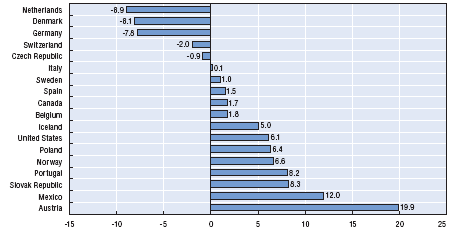
One of my key observations in this report is that the pension funds in the USA increased their equity allocations between 2001 and 2007 to over 60% of the total assets they managed. Since the markets fell heavily 2008, they were exposed to large losses. Other developed country pension funds that increased equity allocations were Ireland, Norway, Portugal, etc.

Chart – Differences in Equity Allocations between 2001 and 2007 in select OECD countries:

OECD pension

Source: OECD

As we can see from the above chart, Germany, Denmark, The Netherlands and Switzerland reduced their equity allocations in the same period. The report says: “In the case of Denmark and the Netherlands this portfolio reallocation appears to be partly driven by the introduction of stricter, risk-based funding requirements.”

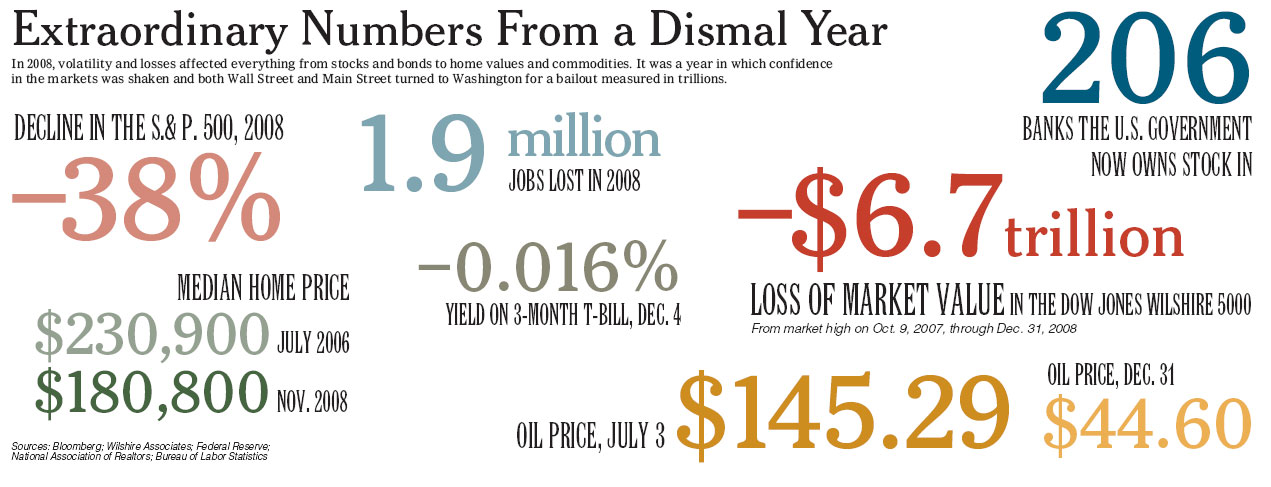
Last year by October end, total losses in private pension plans in developed countries were USD 5 Trillion. Out of that USD 3.3 Trillion were in the US alone (Source: OECD). In 2008, about $7 Trillion shareholder wealth was lost in the US as per the New York Times.

Year 2008 in Numbers Graph from The New York Times:

2008 in nUmbers

(Click to enlarge)

US investors have to monitor their pension funds’ performance more closely this year as they have raised their equity allocations in 2008.

The S&P is down 8.46% year-to-date and the financials are down an incredible 30.10%. Ans we still have ten and half months to go. Faced with huge losses some investors have cut down their investments in the equity markets. Companies such as FedEx,Eastman Kodak, Motorola, General Motors and Resorts International have also cut their 401K matching contributions to save cash. Hence if the economy does not respond to the stimulus plans of the Obama administration then it is highly likely that US pension funds will have negative returns this year on top of losses incurred last year.

Country Specific Closed-End Funds

Many of the closed-end funds are trading at a discount to NAVs. When these funds trade at a discount they are considered to be cheap. Closed-end funds can be swing wildly during volatile markets such as the one investors are enduring.

The following are five cheap closed-end funds:

1.New Germany Fund (GF)
Discount to NAV: (21.57%)

2. Spain Fund (SNF)
Discount to NAV: (14.62%)

3.Malaysia Fund (MAY)
Discount to NAV: (11.45%)

4.Mexico Fund (MXF)
Discount to NAV: (9.43%)

5.Korea Fund (KF)
Discount to NAV: (5.73%)

How High Will The US Personal Savings Rate Go?

The personal savings rate in the US has been going up in the past few months. This has implications for the economy as the consumption rate decreases. Since consumption forms a major portion of our GDP it pays to keep a close on the savings rate.

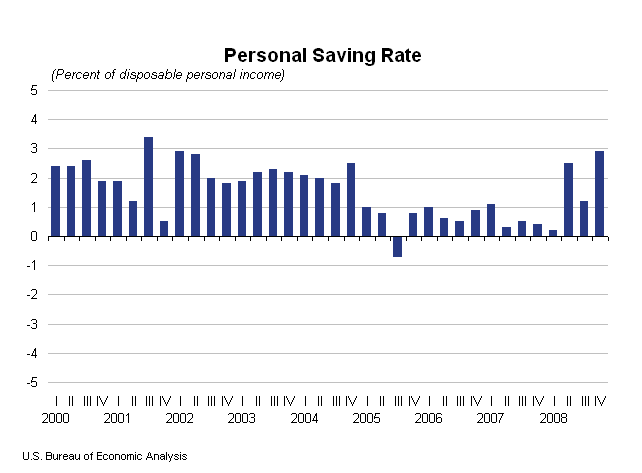
The New York Times published an article titled “Consumers Are Saving More and Spending Less” on Feb 2nd. The article said “The personal saving rate of 2.9 percent in the fourth quarter of 2008 was the highest since early 2002”.

Personal Savings Rate Chart (click on the chart to enlarge)

us-savings-rate-2008.gif

Source: The US Bureau of Economic Analysis

Americans saved $378.6 billion in December, compared with $299.1 billion in November 2008. In some ways this is a good start for consumers and the economy.

A few interesting points from the The NY times piece:

“A dollar saved does not circulate through the economy and higher savings rates translate into fewer sales and lower revenue for struggling businesses. As Congress considers an $800 billion package of tax cuts and spending plans, policy makers said that the most effective stimulus was money that would be spent quickly.

Still, some economists said the rising rate of savings was a natural reaction, penance for America’s spendthrift ways.

“If American consumers are less indebted, live within their means and have more money in savings, they are better positioned to spend on a sustainable basis for years to come,” said Greg McBride, senior financial analyst at Bankrate.com. “As painful as that is economically in the short run, these developments will better serve us in the long run.””

This leads us to the question of how high the Personal Savings Rate will go?. My research says that it can go over 7% based on the data shown below.

US Personal Savings Rate – Yearly:

[TABLE=135]

Source: OECD

The NY Times added “On average, Americans have saved about 7 percent of their disposable income since 1929, but that figure dropped to virtually nothing several years ago.” Hence a country of savers who saved 7% turned into a country of spenders with almost no savings in 2005 thru 2007. many of the OECD countries have much higher savings rates at double digits. For example in 2008, Germans saved 11.6% of disposable income compared to 1.6% by Americans. A table listing the savings rate of all the OECD countries can be found here.

Overall the current savings rate is expected to increase in the coming months and possibly years. Though the current interest rates on CDs and other instruments are very low, consumers will continue to save more until the housing and the equity market stabilizes.

Just Say No To TARP

On Feb 4, I wrote an article titled Top five US banks to invest in now which listed the top five regional US banks based on the Bank Director magazine. In that list, Glacier Bank (GBCI) was the top bank. Glacier Bank rejected to get help from the Treasury’s Troubled Assets Relief Program (TARP). Instead the bank went to private investors and did a successful common offering raising $98M.Due to strong investor demand the bank had increase the offering from 4 Million to 5 Million shares.

You may be wondering what does this have to this article. Well let me explain. Many small banks have declined to participate in the TARP program simply because they balance sheets are strong and they did not want to adhere to the conditions that came with the capital offered by TARP. For example, Citibank (C) , Fifth Third Bank (FITB) , etc. who accepted the government capital have been forced to suspend dividends drastically and now they offer a 1 cent dividend.

The recent edition of BusinessWeek has a piece titled “Small Banks say ‘No Thanks’ “. Basically the author states that the too many conditions of the TARP program does not attract many banks that are doing just fine. In fact the author notes that the banks that are not accepting capital from the Feds have actually increased lending. This is very interesting since the fundamental reasoning behind the Feds helping the banks was to ease the credit markets and have lending flow normally again. This has not happened especially with the so-called “SuperBanks”. Many of these institutions that took TARP capital have tightened lending and are sitting on enormous amount of funds in reserves.

The following are five banks that have not accepted federal aid and have increased lending in Q3 2008 Vs.Q3 2007:

1. New York Community Bankcorp Inc(NYB)
Lending increased by: 13.2%
Current Yield: 7.89%

2. Chemical Financial Corp. (CHFC)
Lending increased by: 4.1%
Current Yield: 4.85%

3. Dime Community Bancshares(DCOM)
Lending increased by: 12.6%
Current Yield: 5.41%

4. Smithtown Bancorp Inc (SMTB)
Lending increased by: 57.4%
Current Yield: 1.12%

5. SY Bancorp Inc (SYBTP)
Lending increased by: 13.7%
No regular dividends paid

We shall revisit these banks at the end of the year and see how they fared compared to other banks.