Top Five US Bank Stocks To Invest In Now

Last year the financials in the S&P 500 Index was the worst performing sector with a loss of 56.95% compared to the index return of -38.49%. Some banks fared even worse or failed. Others such as National City, Wachovia, merged with much larger banks to survive. Large banks such as Citibank(C), Bank of America(BOA), Chase (JPM), PNC Financial Services (PNC), US Bank(USB) etc. had to access the Troubled Assets Relief Program (TARP) whether to stay afloat or strengthen their balance sheets.

So far 2009 is turning out to be another bad year to be in bank stocks. The S&P Financials are down another 28.98% year-to-date. Considering these facts most investors are staying away from banks now. However there are opportunities abound if one is willing to do the research and uncover the diamonds among the rubble. Many of the failed banks such as Wamu, IndyMac were not small sized banks. They were all huge banks that undertook highly risky lending activities or participated in the derivatives game.

My research into finding small banks that are worth looking into now led to the recent issue of the Bank Director Magazine’sThe 2008 Bank Performance Scorecard: America’s Top 150 Banks” article. This piece lists the top banks based on a performance scorecard compiled by Sandler O’Neill & Partners L.P. These banks “maintain top standing in good times and bad—often with recurring high scorers.” The scorecard is based on six different metrics like Return on average assets (ROAA), Return on average equity (ROAE), Tier 1 capital ratio, the leverage capital ratio, nonperforming assets (NPAs) to total loans and “other real estate owned,” and loan loss reserves to total loans.

The Top Five Banks in this list are:

[TABLE=134]

1. Glacier Bancorp Inc (GBCI) ranks the number 1 bank in 2008. Based in beautiful Kalispell, Montana this regional multi-bank holding company operates 94 branches in Idaho, Montana, Utah, Washington, and Wyoming. Currently GBCI yields 3.27%. Glacier Bancorp ranked the top in all the six criteria of the scorecard analysis. In 4Q, 2008 the bank earned $17.014 million a decrease of 6% from 4Q, 2007. The NPA stood at just 1.46% as on Dec 31,2008.

2. The number two rank in the list is held by First Financial Bankshares Inc. (FFIN) of Abilene, Texas. This community bank holds “roughly 40% to 50% of the market share in such West Texas communities as Sweetwater, San Angelo, Stephenville, and Weatherford”. The strong economy of West Texas which is dependent on oil, natural gas, wind energy, agriculture helped the bank achieve impressive numbers. FFIN pays a dividend of 3.03%.

3. SVB Financial Group (SIVB) of Santa Clara, California “is the holding company for financial services firms that include $7.0 billion Silicon Valley Bank. In addition to operating 27 U.S. branches, SVB has offices in China, India, Israel, and the United Kingdom.” The Chief Strategy Officer Marc Verissimo commented “We don’t deal with developers”. SIVB does not pay regular dividends. The bank earned $2.9 in fourth quarter 2008.

4. Honolulu, Hawaii based Bank of Hawaii Corporation (BOH) ranked number 4 in the list. They had an excellent 23.24% ROAE (Return On Average Equity) in 2008. This traditional bank gains from the Hawaiian economy which has strong ties to Japan, tourism and defense spending. As tourism declines BOH will be impacted.

5. The number five in our list is Westamerica Bancorp. (WABC) of San Rafael, California.WABC pays a dividend of 3.42%. On Jan 22, they announced an increase in quarterly dividends by one cent. Chairman, President & CEO David Payne said that “This dividend increase recognizes Westamerica’s healthy level of profitability, asset quality, and capital.” which is echoed by the Bank Director piece.

To access the full list of Top 150 banks in the The 2008 Bank Performance Scorecard click here.

BRICs: Time To Take a Fresh Perspective?

The acronym BRICs refers to the emerging economies of Brazil, Russia, China and India. It was coined by Goldman Sachs in 2001.

Today The Financial Times had a piece titled “S&P; calls for Brics break-up“. The gist of S&P;’s call was that these countries should not be grouped together now as a single asset class because their outlook has diverged after the credit crisis. I totally agree with this assessment. All these four countries have different dynamics that it does not make sense to group them together.

S&P; also stated “whether the Bric countries ever shared much in common other than scale and high portfolio inflows.” Of course these countries did not have a lot in common other than the huge flow of foreign capital in their equity and debt markets. Lets take a quick look at some of the differences between these four countries.

1. Brazil
As a commodity exporter Brazil enjoyed a huge boom in the past few years. As the demand for commodities from countries like China and India soared Brazil benefited from it. Abundant with many natural resources and a relatively small population Brazil’s economy is dependent on the commodity prices. In general the economy is diverse and exports range from planes and cars to a wide range of commodities. On the political front Brazil is a democratic state with a free press unlike China and Russia.

2.Russia
Though considered a democratic country by some, Russia is actually an authoritarian state with no free press. In recent months many journalists who criticized the government have been murdered. Some of the biggest companies are under the control of the state. For example, the largest natural gas exporter in the world Gazprom is under the direct control of the government which owns over 50% of shares. As a large producer and exporter of crude oil, Russia gained immensely as the price of crude went over $140 last year. However in recent months Russia’s fortune has fallen together with the price of crude. The Rouble is collapsing and the stock market plunged last year due to the flight of foreign capital. In 2008 the Russian market fell a whopping 72.41% (Source: 2008 Country Returns ). Unless the price of crude rebounds the Russian economy may continue to suffer. The global credit crisis adds more woes to Russia’s problems.

3. India
S&P; says “India’s case is somewhere in between. It has experienced much higher growth rates than Brazil, but its public finances are also shaky”. As the world’s largest democracy the Indian economy had an incredible boom after the country liberalized the economy in the 90s. However the political system is unstable and corrupt. Foreign portfolio investments has dried up almost completely. India does not have much natural resources and is a net importer of many commodities such as crude, natural gas, etc. As foreigners pulled out of Indian equities, last year the main market index fell by 52.25%. India has a huge foreign debt ($221B in September 2008 – Source: Reuters) that continues to grow as government due to bloated public sector and subsidies. For example, last year the government ordered banks to waive all outstanding loans owed by farmers.

4. China
S&P; said “China is probably best positioned to find solutions in particular fiscal stimulus, to withstand an externally driven crisis.” Some of the reasons given for this assessment are a closed financial system, strong budget and low debt. In my view, China’s economy will not fare much better than other BRIC countries since China’s economy is dependent on exports to the US and Europe. On Feb 2nd, BBC reported that “20 million migrant workers have lost their jobs during the economic downturn“. While the government has announced a large stimulus package of $600B last year much of the details are not clear and some are questioning whether the amount is inflated. Even if the government invests this much money in infrastructure projects it is highly unlikely that the economy will improve quickly. The domestic consumption will not compensate for the fall in demand of its manufactured products in developed countries.

The Economy of Canada: Strong in 2008, But What about 2009?

The sub-prime crisis that started in the US impacted most of the world’s countries including Canada. However last year the Canadian economy stayed strong relative to other developed economies. When one looks at the macroeconomic fundamentals it does not bode well for Canada in 2009.

When researching into the reasons for the strength of the Canadian economy I came across a paper titled “The US Financial Crisis, Global Financial Turmoil, and Developing Asia: Is the Era of High Growth at an End?” published in December,2008 by the Asian Development Bank. This post summarizes some of the key points the authors note about Canada and includes some of my own observations.

Some of the reasons the economy of Canada stayed strong in 2008 are:

1.As a natural resources exporting nation Canada benefited well from the high commodity prices in the past few years.

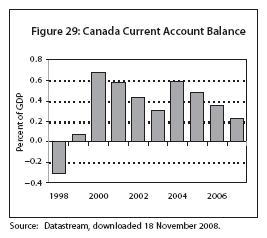
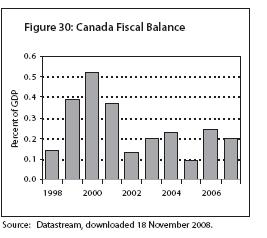
2. The high commodity prices helped Canada achieve a current account and fiscal surpluses. In fact Canada is one of the one few OECD countries to have a surplus for many years now (Refer charts below).

Chart – Canada’s Current Account Balance

Canada Current Account

Chart- Canada Fiscal Balance

Canada Fiscal Balance

3. The strong fiscal and current account balance provided Canada with a “cushion” against the raging credit crisis worldwide.

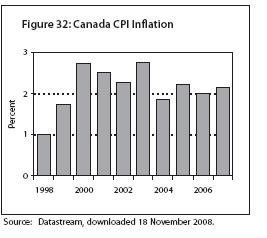
4. Inflation has remained stable under 2% thru 2007 but started heading upwards since 2008 as the chart shows below

Chart- Canada CPI Inflation

canada inflation

5. The money supply growth has been kept under control.

6. Consumer credit growth continued to increase leading to rise in housing prices. But they have stated to cool like in other countries.

How will the economy perform in 2009?

The Canadian economy will experience slower growth in 2009 due to reduction in imports by US. This scenario is most likely to occur since USA is Canada’s largest trading partner. In 2007, 76% of all exports totaling about $440B by Canada went to the USA (Source: Wikipedia). The main exports to the US are agricultural, forestry products and energy. For the month of November,2008 alone trade between US and Canada amounted to $41.77B, the highest among all the countries the US trades with. (Source: www.Census.gov)

As the US residential and commercial real estate market continues to deteriorate the export of timber will grind to a halt.

One of the largest manufacturing sector in Canada is auto manufacturing concentrated in Ontario province. Most the cars assembled there are exported to the US. The big three US automakers and Japanese auto makers employ a large number of Canadians in the factories located in Ontario. Since the demand for new autos has fallen off the cliff in the US many of these factories will be affected. In addition to the automakers, many auto parts manufacturers have plants as well in Ontario. Already there have been news reports of layoffs in some of these companies.

Another sector that will face the effects of slowdown more quickly is the oil and natural sector. The Toronto Stock Exchange (TSX) site states “More oil & gas companies are listed on Toronto Stock Exchange (TSX) and TSX Venture Exchange than any other exchange in the world. At the end of November 2008, there were 404 oil & gas companies with a total market capitalization of $295.2 billion listed on Toronto Stock Exchange and TSX Venture Exchange”. Since the consumption of gas has decreased dramatically in the US last year the demand for Canadian crude has decreased as well.

Overall though Canada will not be affected heavily due to the financial issues related to credit crisis, the economy will experience slower growth due to the lower imports by US. It is highly unlikely that Canada’s second largest trade partner China and other countries will be able to substitute for the loss of US demand for Canadian resources.

The Five Best and Worst Foreign Banks Year-To-Date

January has come to a close this year. The S&P; 500 is down 8.57%. The Financials in the index are down an incredible 26.55% in just one month.

Worldwide bank stock stocks continue to get hammered as the credit crisis deepens. Banks are doing everything they can to shore up their capital. Investors have lost trust in the numbers reported by banks and this has led to banks being treated as “rotten fish”.

To get a feel for how the foreign banks have performed this month I looked at the performance data and what I found is interesting.

The five best performing foreign banks YTD are:
1.Woori Finance (WF)
YTD Change: 16.75%

2. Banco Macro (BMA)
YTD Change: 13.77%

3.Corpbanca (BCA)
YTD Change: 5.00%

4. Banco de Chile (BCH)
YTD Change: 4.92%

5. Banco Santander Chile (SAN)
YTD Change: 1.00%

In the above list except Woori Finance of South Korea, all the other banks are from Latin America.

The five worst performing foreign banks YTD are:
1. Royal Bank of Scotland (RBS)
YTD Change: -60.45%

2. Barclays Bank of Scotland (BCS)
YTD Change: -41.73%

3. Allied Irish Bank (AIB)
YTD Change: -41.58%

4. Bank of Ireland (IRE)
YTD Change: -37.11%

5. Deutsche Bank (DB)
YTD Change: -36.96%

All the worst performing banks above are European banks with British and Irish banks being the biggest losers. There is some talk in the media that the RBS might be nationalized completely and the commons wiped out.

Long : RBS, BCH

A Look At The Top Latin American Stocks

The countries of Latin America such as Argentina, Brazil, Chile, etc. hold lot of potential due to their immense natural wealth. Some of the Brazilian stocks had an incredible run in the past up until the credit crisis due to the demand for commodities.

So in general if an investor wants to pick up a few Latin American stocks where can he start?

To answer the above question, I selected the Bank of New York Mellon Latin America 35 ADR Index which contains some of the Top Latin American companies.

The following are the common stocks included in the above index:

1. Ambev – ABV

2. America Movil – AMX

3.Banco Bradesco – BBD

4. Banco Itau – ITU

5. Bancolombia – CIB

6. Brasil Telecom – BRP

7. Cemex – CX

8.Centrais Eletricas Brasileiras-Eletrobras – EBR

9.Companhia Brasileira de Distribuicao-CBD

10.Companhia Energetica de Minas Gerais-CEMIG – CIG

11.Companhia Siderurgica Nacional-CSN

12.Companhia Vale do Rio Doce-CVRD – RIO

13.Compania de Minas Buenaventura – BVN

14.CPFL Energia – CPL

15.Ecopetrol – EC

16.Embraer – ERJ

17.Endesa-Empresa Nacional de Electricidad – EOC

18.Enersis – ENI

19.Fomento Economico Mexicano – FMX

20.Gerdau – GGB

21.Grupo Televisa – TV

22.Net Servicos de Comunicacao – NETC

23.Perdigao – PDA

24.Petroleo Brasileiro – PBR

25.Soc. Quimica y Minera de Chile – SQM

26.Tele Norte Leste – TNE

27.Telefonos de Mexico – TMX

28.Tenaris – TS

29.Ultrapar – UGP

30.Unibanco – UBB