Knowledge is Power: Ten Great Wines Edition

1. The financial crisis and economic downturn are likely to put upward pressure on government debt. The trouble is, according to OECD in Figures 2008, public debt (general government debt, which includes central and local government) had already risen quite sharply in the OECD as a whole since 1987, from 59% of GDP to 75% in 2007. Two decades ago, Belgium had the highest public debt, but today that position is filled by Japan, whose debt rose from below 60% to 170% of GDP. Italy’s debt has also shot above 100% of GDP in the past 20 years. Debt burdens

2. The U.S. Postal Service has already suggested dropping a day of mail delivery to save money. Now, with economic gloom everywhere, it’s turning to early retirements, management cutbacks and office closings.US Post Service looks for new ways to cut losses

3.Denmark is confirmed as the OECD’s highest-tax country, followed by Sweden, while Mexico and Turkey remain the lowest-taxing countries, the latest 2008 edition of Revenue Statistics says. Denmark’s tax-to-GDP ratio stood at 48.9% in 2007, while Turkey’s was at 23.7% of GDP. Tax burden nears peak

4.Does less-invasive winemaking result in a more flavorful drink? Try these bottles to see for yourself. Ten Great Unfiltered, Unfined Wines to Try

5.More mutual-fund firms such as Vanguard Group are set to raise their fees in response to stocks’ plunge, signaling a tough year ahead.Funds hike fees, adding to investors’ pain

6.Aim is to bolster member states outside the euro zone — including Hungary, whose prime minister offers to step down Saturday.E.U. doubling crisis fund

7. The Wall Street Journal issued a story that appeared to rely on a single source “a person familiar with the data said” and Bloomberg, apparently unable to corroborate the leak, repeated key bits of the Journal article, with attribution. WSJ: Chinese Imports, Exports Continued to Fall in December

How Bad Is Mortgage Delinquencies In Canada?

On March 5, the Mortgage Bankers Association announced that mortgage delinquencies continued to rise in the US. The press release said “The delinquency rate for mortgage loans on one-to-four-unit residential properties rose to a seasonally adjusted rate of 7.88 percent of all loans outstanding as of the end of the fourth quarter of 2008, up 89 basis points from the third quarter of 2008, and up 206 basis points from one year ago”. The percentages of loans that were 60, 90 days or more past due also set new records in 4Q,2008 compared to 3Q,2008.

How does the mortgage delinquency rate in Canada compare to the US rate of 7.88%?

A review of the data from the Canadian Bankers Association shows that the delinquency rate in Canada is much lower than the US rate. Though the data shown in the below table goes only up to October of 2008, it still provides some interesting insight to analyze mortgage delinquencies in Canada.

Number of Residential Mortgages in Arrears

[TABLE=145]

Source: Canadian Bankers Association

Note:Includes data from BMO(BMO), CIBC(CM), HSBC Bank Canada, National Bank of Canada, RBC Royal Bank(RY), Scotiabank(BNS), TD Canada Trust(TD) and Manulife Bank. Mortgage arrears means delinquencies of 3 months or more.

As seen in the above table, mortgage delinquencies in Canada as of October, 2008 stood at just 0.29%. This is much below the 7.88% figure in US reported by the Mortgage Bankers Association. While the Canadian rate increased from 0.27% in the beginning of 2008 to 0.29% in October, it is still below 1% of all outstanding mortgages. Data for the last two months of 2008 is not yet available in the site. As the Canadian economy weakens further it will be interesting to see impact on the mortgage delinquency rate in the coming months.

Savings Rate in US Since 1980

On February 10, I wrote about savings rate in the US in the article How High Will The US Personal Savings Rate Go?.

As a follow up to that piece, here is a chart showing household savings in the UK, USA, France, Germany and Japan since 1980:

US Savings Rate since 1980

Source: The Global Economic Crisis: Systemic Failures and Multilateral Remedies, UNCTAD (United Nations)

In the above research paper, UNCTAD says:

“Without the high level of consumption in the United States, today most of the developed world and many emerging-market economies would have much lower standards of living, and unemployment would be much higher.”

With regard to the economic growth in the US and UK, the paper says:

“Indeed, the consumption boom in the United States since the beginning of the 1990s was not well funded from real domestic sources. To a significant degree it was fuelled by the speculative bubbles that inflated housing and stock markets. The “wealth effect” of higher prices for housing or stocks led households in the United States and in the United Kingdom to borrow and consume far beyond the real incomes that they could realistically expect, given the productivity growth of the real economy and the dismal trends in personal income distribution. With overall household saving rates to close to zero (figure 1.1) consumer demand in both countries expanded rapidly but at the same time the growth process became increasingly fragile because it meant that many households could only
sustain their level of consumption by further new borrowing. ”

The graph above clearly shows that the savings rate in the US deteriorated overtime from 10% in 1980 to reach 0% in 2004. The French and the Germans save about 15% of their disposable income. Interesting to see that in the past few years savings level in Japan has fallen below that Germany and France.

Knowledge is Power: Failed Banks Friday Edition

1. Three more banks were shutdown today. They were TeamBank, National Association, Paola, KS , Colorado National Bank, Colorado Springs, CO and FirstCity Bank, Stockbridge, GA. The full list of failed banks in 2009 can be found at the FDIC page Failed banks list.

2. List of Banks by Country – from Wikiepdia

3. Get the latest business news from blogs: Via Newflashr – the all-in-one news search enging.

4. The Bundestag, Germany’s lower house of parliament, has passed controversial legislation enabling the state to seize control of ailing commercial lender Hypo Real Estate. German Parliament Approves Hypo Real Nationalization Bill

5.Finding a parking spot for your Mercedes or BMW on Greenwich Avenue, the main shopping strip of the U.S. hedge-fund capital, used to be a challenge. Not anymore. Greenwich’s `Rodeo Drive’ Abandoned by Customers as Hedge Funds Collapse

6.What Makes A Good Bank Good? As our Board Performance Scorecard show, high profitability, a strong balance sheet, and outstanding asset quality are what it takes to be become a high-performance bank.

7.It couldn’t always have been like this. No, the country today would be a far different place if across the span of American history had the nation constantly chosen to focus on the most picayune of arcane and unimportant irrelevancies, as it’s doing currently with the AIG bonus controversy, instead of on matters with some actual import.US Fed’s move is the bigger problem

8.While the world talks about new ways to save struggling banks, there are a handful of economists who think some banks shouldn’t be saved at all. American economist James Galbraith told Manager Magazin that it might make more sense to break them up and start over. Financial Crisis Caused by a ‘Culture of Complicity

9.Investors can improve their odds by learning how to assess the fundamentals of the gold exploration companies. A good tool for this job is what I call “The Five M’s.”

By using the Five M’s, an individual investor can build a simple but powerful model to initially sort through the many hundreds of upstart gold companies to find better opportunities.The “Five M’s” for picking gold stocks

10. An excellent site for researching UK and other market stocks: http://www.Digitallook.com

Knowledge is Power: Autostadt Car Tower Edition

1.Despite major stimulus packages announced by advanced economies and several emerging markets, trade volumes have shrunk rapidly, while production and employment data suggest that global activity continues to contract in the first quarter of 2009, the IMF says in a new assessment of the global economy. Advanced Economies to Contract Sharply in 09, Upturn Next Year–IMF

2.The economic recession and financial crisis have a ‘devastating’ effect on the automotive industry with serious implications for the wider economy.“The crisis is devastating” — Global Insight Research

3.As the banking industry descends into ever-deeper gloom, the more ethical, risk-sharing approach offered by the Islamic finance industry is attracting an increasing amount of attention. The Banker’s Top 500 Islamic Financial Institutions ranking lists the sector’s key players.Top 500 Islamic Financial Institutions

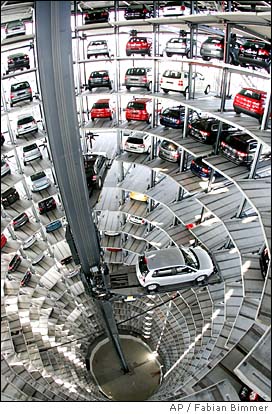
4.Photo -An auto elevator lifts a Volkswagen to its appointed parking space in the VW Autostadt “car tower” in Wolfsburg, Germany.

Car Tower