Transaction Banking Award Winners 2009

The Asset magazine based in Hong Kong announced The Asset Triple A Transaction Banking Award Winners for 2009 last week. The awards were given for different categories such as cash management, trade finance, etc.

The winners for this year are:
Best Transaction Bank – Deutsche Bank (DB)
Best Cash Management Bank – HSBC (HBC)
Best E-commerce Bank – CitiBank (C)
Best Trade Finance Bank – J.P.Morgan (JPM)
Best Structured Trade Finance Bank – Standard Chartered Bank
Best in Securities and Fund Services – HSBC
Best Global Custodian – Bank of New York Mellon (BNY)
Best Subcustodian – HSBC

On the Country awards for Best Transaction Banks, the winners are:
Australia, J.P.Morgan
China, ICBC
Hong Kong, HSBC
India, ICICI Bank (IBN)
Indonesia, Citi
Japan, J.P.Morgan
Korea, SC First Bank
Malaysia, HSBC
Pakistan, Deutsche Bank
Philippines, Citi
Singapore, DBS Bank
Sri Lanka, Deutsche Bank
Taiwan, Chinatrust Commercial Bank
Thailand, Siam Commercial Bank
Vietnam, Deutsche Bank

For more details on award winning banks, go here.

Knowledge is Power: Fool’s Gold Edition

1.MOSCOW – Russia’s Prime Minister Vladimir Putin has put his signature on one of the strangest mine prospector’s pay-sheets drafted in the history of mining.

For companies such as listed and cash-rich Chinese goldminers Zijin Mining Group and Zhongjin Gold Corp, now experiencing almost vertical share-price takeoffs, Putin’s message is to stay away, at least until the dust settles.Fool’s gold

2. Speaking before the European Parliament on Wednesday, Mirek Topolanek described the stimulus measures and financial bailouts passed by US President Barack Obama as the “way to hell.” EU President Says America is on ‘Road to Hell’

3.ONCE it was a theory, then it became a hope, now it’s a desperate plea. The notion that the developing nations of the world, particularly the Bric countries (Brazil, Russia, India and China) would take up the slack in global economic system is now officially gone.Why Bric countries are not taking up the slack 

Heron Island, Queensland, Australia

Photo: Heron Island, Queensland, Australia

4.The outbreak of the current crisis and its spillover in the world confronted us with the long existing but still unanswered question, i.e., what kind of international reserve currency do we need to secure global financial stability and facilitate world economic growth, which was one of the purposes for establishing the IMF?

There were various institutional arrangements in an attempt to find a solution, including the Silver Standard, the Gold Standard, the Gold Exchange Standard and the Bretton Woods system. The above issue, however, as the ongoing financial crisis demonstrates, is far from being solved, and has become even more severe due to the inherent weaknesses of the current international monetary system. Reform international monetary system

5.MANILA, PHILIPPINES – South Asian countries can weather the global financial crisis by taking both short- and long-term measures to stimulate their economies, says a new study commissioned by the Asian Development Bank (ADB). South Asia Can Weather Economic Crisis, Says New Study

6.Latin America and the Caribbean see slower growth in next four years – IDB surveys leaders in the region about the impact of global financial crisis.Latin American and Caribbean leaders expect per capita income to fall or grow moderately in the 2009–2012  period and governments to rely more on financing from international institutions, according to a survey by the Inter-American Development Bank (IDB). The expectations contrast sharply with the recent economic performance in the region, where product per capita grew 4.1 percent annually in the past five years.

7.Mumbai, March 25 The Obama administrationâ’s recent plan to cleanse toxic assets of up to $1 trillion from the US banks has stoked Foreign Institutional Investors (FII) interest in Indian stocks.US move on toxic assets whets FII appetite for Indian stocks again

Grim Prospects For The Airline Industry In 2009

Geneva,Switzerland-based The International Air Transport Association (IATA) announced a revised outlook for the airline industry in 2009. Due to the worsening economic conditions worldwide, IATA increased the global loss outlook from $2.5B in December to $4.7B now.

Some of the key points from the news release are:

  • Air Cargo demand is to decline 13% this year
  • Passenger traffic is expected to contract by 5.7% over last year
  • Asian carriers are going to the worst hit with a fall of nearly 7% in demand
  • To and from traffic to China and India will decline
  • North American carriers are expected to report a profit in 2009 due to careful capacity management and lower jet fuel prices
  • European demand will fall by nearly 7%
  • Demand in Latin America is projected to fall by 7.8%
  • Middle East is the only region that is projected to have a positive growth this year

Giovanni Bisignani, IATA’s Director General and CEO said:

“Fuel is the only good news. But the relief of lower fuel prices is overshadowed by falling demand and plummeting revenues. The industry is in intensive care. Airlines face two immediate fundamental challenges: conserving cash and carefully matching capacity to demand,”

The above statement is an excellent depiction of the current state of the airline industry.

Some of the airline ADRs are:

TAM(TAM) and Gol Linhas Aereas Intelligentes(GOL) of Brazil

RyanAir (RYAYY) of Ireland

China Eastern (CEA) and China Southern Airline(ZNH) of China

Lan Airlines (LFL) of Chile

Many of the US carriers such as Delta (DAL), Continental (CAL), Southwest (LUV) may perform better than their peers in other countries. However they will also be impacted adversely due to the slowing economy. Consumers will cut down on unnecessary travel while business travelers will use other means of communication such as video conferencing.

Knowledge is Power: UK Economy Is Doomed Edition

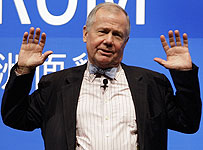
Jim Rogers1. A legendary investor on why the UK economy is doomed He’s said it before, but Jim Rogers this week fleshed out his concerns for the British economy.

2.Overall investors have mainly been focusing on dividend cuts in 2009. I believe that most stocks that pay out dividends are cyclical in nature. Thus, they do not have the specific competitive advantages, which provide for a long and sustainable annual dividend increases over time. Dividend Aristocrats keep raising their dividends

3. The economic slowdown will have a much bigger impact on Germany than previously thought. Experts say the economy will contract by up to 7 percent, and push unemployment up to 4.75 million by the end of 2010. Economic Gloom

4. Tata says landmark ‘comparable to Moonshot’ and believes world’s cheapest car could sell a million a year. Tata Nano: World’s cheapest car is India’s answer for cash-strapped drivers

5.Does the Treasury’s toxic asset plan come at the cost of recapitalising banks? Successful bank rescue still far away

Top Latin American Mid-Cap Banks 2008

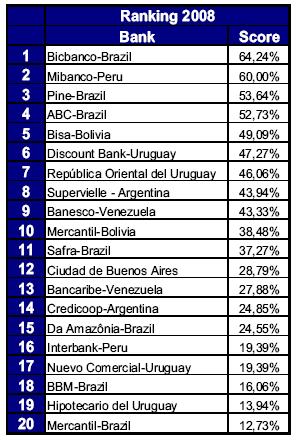
The following is the Top 20 Mid-Cap Banks in Latin America from a study by Latin Finance and Management&Excellence. These most sustainable Latin American Mid-Cap Banks are for 2008. The data for 2009 is not yet out. The banks listed here are from Argentina, Bolivia, Brazil, Peru, Venezuela and Uruguay. They were evaluated on 330 different factors.

None of the banks shown below trade in the US markets. However they may be listed in the local exchanges of the respective countries.

Top 20 Latin American Mid-Cap Banks 2008:

Top 20 Latin American Mid-Cap Banks 2008

Source: Management&Excellence