Â
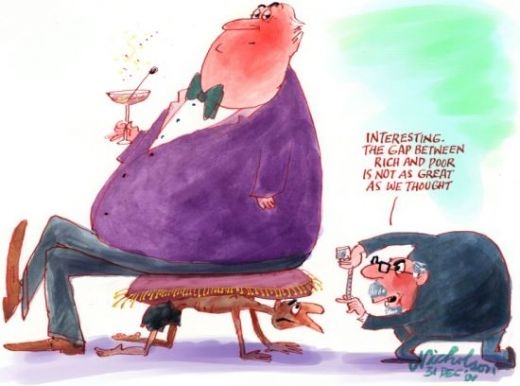
Most markets in the developed world have rallied sharply since hitting the lows in March this year.For example, the S&P 500 is has rallied 40%Â from March lows as of yesterday. Fed officials and many others have been talking up the economy and there have been talk of “green shoots” appearing in the economy.Some economists are projecting a recovery in the second half of this year.
Despite rallies in the stock markets and talk of recovery, the recent Global Financial Stability Report by IMF states that economies of the developed world will experience a deeper protracted recession due to further deterioration in residential and commercial real estate markets, tight lending conditions and rising defaults in corporate and consumer loans.

Futures are pointing to further declines in the US and UK residential mortgages of both prime and subprime loans. Loan workout programs and foreclosure moratoriums have failed to reverse the decline in the housing market. The charge-off rates in residential real estate market in the US is projected to peak in late 2010. Commercial mortgages are projected to follow the residential markets and has already begun to worsen in the US and UK.

Source: Global Financial Stability Report, Responding to the Financial Crisis and Measuring Systemic Risks, April 2009, IMF
Writedowns by financial institutions in 2010 is estimated to be equal to the total writedowns in 2009. European and US Bank’s earnings before provisions are projected to drop between a third and half all the way thru mid-2010. Total charges is expected to peak at 4.2% in the US, 3.4% in the UK 2.8% in the Euro zone. These levels are well above those experienced during the Great Depression in the USA. Banks in Europe and USA would post losses thru 2010 though a modest return to flat returns is possible in 2010.
Last month I wrote an article about the Top Ten Creditors to the USA. Today we shall review two charts that show the top net exporters and importers of capital in 2008.
Countries that Export Capital in 2008
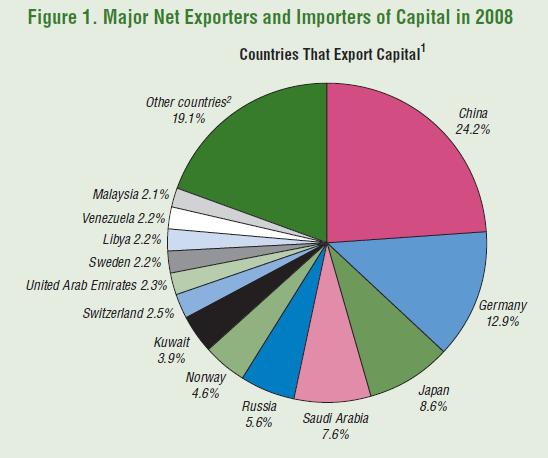
The largest net exporter of Capital is China with 24.2% of total. This is not surprising since China is the largest buyer of US debt holding $767 Trillion at the end of March,2009. Interesting to see Germany as the second largest exporter next to China and ahead of Japan. These top three countries accoutn for nearly 46% of total capital exports. Most of the remaining countries in the chart (except Other countries at 19.1%) are net oil exporters. For example, Malaysia is in the list since it exports more crude oil than domestic consumption.
Countries that Import Capital in 2008
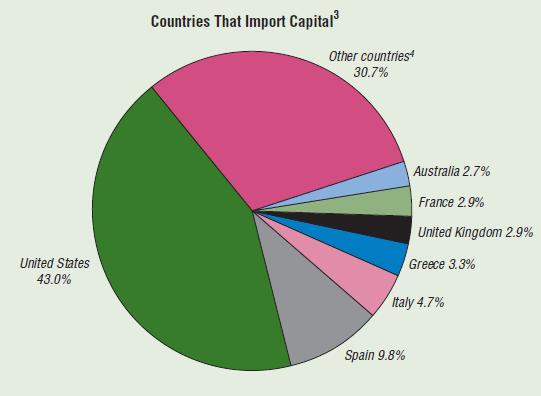
Data Source and Notes: IMF, World Economic Outlook database as of April 16, 2009.
1 – As measured by countries’ current account surplus (assuming errors and omissions are part of the
capital and financial accounts).
2 – Other countries include all countries with shares of total surplus less than 2.1 percent.
3 – As measured by countries’ current account deficit (assuming errors and omissions are part of the
capital and financial accounts).
4 – Other countries include all countries with shares of total deficit less than 2.7 percent.
USA was the largest net importer of capital receiving 43% of all capital exported since it is the most favored destination for primarily China and Japan. Despite the collapse in the real estate sector, Spain came second followed by Italy. UK attracted just 2.9% of total capital in spite of London being one of the important financial center in the world.
Source: Global Financial Stability Report, Responding to the Financial Crisis and Measuring Systemic Risk, April 2009, IMF
The following are the ” Best Banks in Central and Eastern Europe for 2009″ according to rankings published by Global Finance magazine:
Albania – International Commercial Bank
Belarus – Belarusbank
Bosnia and Herzegovina – Raiffeisen Bank Bosnia Hercegovina
Bulgaria – Raiffeisenbank Bulgaria
Croatia – Privredna Banka Zagreb
Cyprus – Bank of Cyprus
Czech Republic – Raiffeisenbank
Estonia – Swedbank
Hungary – OTP Bank
Latvia – Aizkraukles Banka
Lithuania – Swedbank
Macedonia – Komercijalna Banka
Malta – HSBC Bank Malta
Moldova – Moldova Agroindbank
Poland – Bank Pekao
Romania РBRD-Groupe Soci̩t̩ G̩n̩rale
Russia – VTB
Serbia – Raiffeisen Banka
Slovakia – Tatra Banka
Slovenia – Nova Ljubljanska Banka
Turkey – Akbank
Ukraine – UkrSibbank
The top ranking banks in Serbia, Bosnia and Herzegovina, Bulgaria and Czech Republic are subsidiaries of Raiffeisen which is one of the largest financial groups in Austria. Austrian banks expanded heavily in Central and Eastern Europe after the fall of communism. One of the reasons for this expansion is that Austrians have always viewed this area as their own back yard due to historical ties. However while this strategy initially was a huge success for Austrian banks, after the credit crunch started and emerging markets in Europe were affected severely Austrian banks were impacted equally.
In the Baltic countries of Lithuania and Estonia the subsidiaries of Sweden-based Swedbank (SWDBY) are the winners. Swedbank was founded in 1820 as Sweden’s first savings bank.Today the group has 272 branches in the Baltic countries and 216 branches in Ukraine.As with Raiffeisen of Austria, Swedbank has been suffering due to its Baltic exposure as many of these economies are in recession. Latvia, for example is on the verge of collapse or a currency devaluation.The fortunes of Swedbank are tied to the stability and growth of the Baltic countries.
A glance at a selected 100 of the world’s most beaten up mining stocks, including a focus on misadventures and bad luck in the gold space.Bottom fishing global mining stocks
THE IMF has increased its growth forecast for next year by more than 25pc, fuelling hopes of recovery.Sharp rise in IMF 2010 growth forecast
Local equities have rallied recently, tracking oil. Investors now wonder whether it’s sustainable
and when an economic recovery may begin.Russia battles downturn
The right and wrong ways to deal with the rich world’s fiscal mess.The biggest bill in history
Zoellick: Global Slump to Continue The world economy is set to contract this year by more than previously estimated, and poor countries will continue to be hit hard by multiple waves of economic stress, said World Bank Group President Robert B. Zoellick today.