Housing Mortgage Markets: Canada Vs. USA Comparison

The housing market in U.S. and Canada have taken different paths since the credit crisis began. In the U.S. it continues to get worse since the crash that started last year. In 2008, more than 3 millions foreclosures were filed setting a record. Foreclosures in 2008 was up 71% from 2007. This year foreclosures have been in excess of 250K each month reaching 342K in April but backing down to 321K in May according to Realtytrac. A recent New York Times editorial mentioned that rising unemployment numbers and falling home prices are causing new foreclosures with no end in sight.

Unlike the U.S. housing market crash, home foreclosures have not yet become a serious problem in Canada. Other than losses sustained due to their sub-prime exposure in the U.S., the five major Canadian banks – Bank of Montreal (BMO), Bank of Novo Scotia (BNS), Toronto-Dominion Bank  (TD), Canadian Imperial Bank of Commerce  (CM) and Royal Bank of Canada (RY) are staying strong and their earnings have not take a huge hit due to mortgage defaults. This is not the case with American banks such as Bank of America (BAC), Citibank (C), US Bank (USB), Wells Fargo (WFC) and many others who have been forced to seek government aid to prevent complete meltdown.

This brings us to the following questions: What are the primary causes of the housing market collapse  in the U.S?. Why is the housing mortgage market so strong in Canada? What are the real differences between the Canadian and American mortgage systems? Why didn’t Canadian banks suffer huge losses due to mortgage loan losses?

Some of the answers to the above questions can be found in the following table which lists the differences between the housing markets in Canada and US.

[TABLE=169]

Source: Canadian Residential Mortgage Markets: Boring But Effective?, By  John Kiff, June 2009, IMF Working Paper

In summary, in Canada lending standards are much more strict and banks are not as innovative and aggressive as their peers south of the border but perform their main function as deposit takers and housing loan providers. American banks on the other hand have deviated from their primary functions over the years  in order to generate higher above-average returns year after year. Relaxation of regulations by the government and creating favorable environment promoting home ownership by all added fuel to the fire.

Norway: Attractive Investment Destination

Among the Nordic countries, Norway’s economy is strong and is well positioned for an economic recovery. In fact, Norway is one of the favorite investment destinations among European countries.

The Norwegian economy was able withstand the current economic crisis better than most other European countries since Norway’s financial institutions did not invest in risky sub-prime mortgage derivatives and other instruments. The country is blessed with oil resources which has become a boon during the past few years when oil prices soared. As a result of this Norway’s sovereign wealth fund is one of the largest in the world with assets of about £380B. As the fund has tremendous amount of cash reserves, the fund was able to pick high quality equities at dead cheap prices during the market crashes in the past few months.

In addition Norway has many advantages relative to other economies of the world. Some of the key points are:

  • Norway is a surplus country with NOK 76 billion in current account surplus as of 1Q,2009
  • GDP Growth rate for 1Q,2009 was the lowest at -0.4% seasonally adjusted when compared with other Scandinavian countries, UK, Europe and US
  • Gross national Savings remain high in Norway at NOK 757 B at the end of 2008
  • Households decreased their borrowing and increased savings in Q1,2009
  • Government wealth stood at 144% of GDP at the end of 2007, the highest among Nordic countries
  • In 2008, due to record high crude oil prices the trade surplus was the highest ever with a total of NOK 460.5 billion

Source: Statistics Norway
Note: 1 Norwegian Kroner = 0.15659 US Dollar

For US investors, there is not a single-country ETF for Norway. However there are a few stocks that trade in the US markets.

In the oil and gas sectors, there are four Norway ADRs:
Acergy – ACGY
Petroleum Geo-Services – OTC: PGSVY
StatoilHydro – STO
Teekay Petrojarl – OTC: TKPOY

Two other large Norwegian companies that trade in the OTC market are:
Telenor – OTC: TELNY (Mobile Telecom)
Yara International : OTC: YARIY (Chemicals)

Research Paper Review: Economic Outlook for India

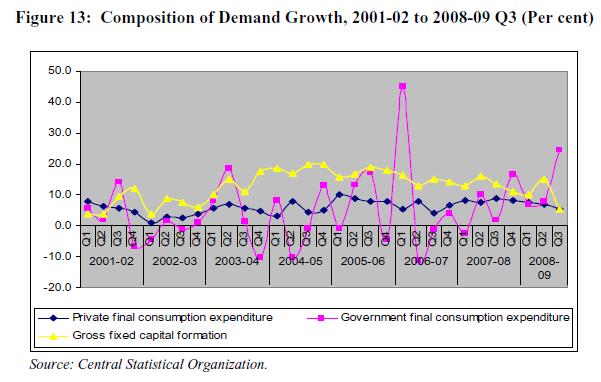
The global economic recession is projected to impact the economy of India adversely taking down the GDP for this year according to paper titled “Indian Economic Outlook 2008-09 and 2009-10” from the Indian Council for Research on International Economic Relations (ICRIER). The authors also argue that “There is real downside risk that the growth rate could plummet to the pre-1980s levels if appropriate countercyclical measures are not taken immediately and are not urgently followed by necessary structural reforms”.

As the recession continues to slow consumer demand, governments across the world are stepping up their of goods and services. This is true in India as well as the chart shows below. The government consumption expenditures as a percentage of GDP is rising faster as the private final consumption expenditure is going down.

India-Economy-Growth-Government-Expenses

For more details on the Indian economy click Indian Economic Outlook 2008-09 and 2009-10

Spain has the Highest Unemployment Rate in EU at 18.7%

Yesterday the BLS released the unemployment data for the month of June. A total of 467,000 jobs were lost in June and the unemployment rate remained almost the same at 9.5%.

The Eurostat also released the unemployment report for the EU but for the month  of May. The unemployment rate in the Euro area stood at 9.5% seasonally-adjusted in May .In the expanded EU 27 states, the unemployment rate was 8.9% in May.An estimated 21.462 million in the EU27, of which 15.013 million were in the Euro area, were unemployed last month.

The lowest unemployment rates were in:
The Netherlands – 3.2%
Austria – 4.3%

The highest unemployment rates were in:
Spain – 18.7%
Latvia – 16.3%
Estonia – 15.6%

While the EU unemployment rate was 9.5% in May, the rate in the USA and Japan were 9.4% and 5.2% for the same month respectively.

EU-Unemployment-Rate-May-2009

Source: Eurostat