Rising NPAs of Indian Banks Need Not be a Worry

Back in April this year, the rating agency Crisil warned that gross Non-Performing Assets (NPA) of banks in India may reach 5% by 2011. Most of the rise in NPA will be due to problems with commercial loans.

ICICI Bank’s (IBN) NPA stood at 4.33% in May a 1% increase over the previous year. The NPA of HDFC Bank (HDB) was at 1.91% of total assets. However both these banks are exposed to high retail loans due to aggressive growth in the past few years. Comparatively ICICI is a bit more risky than HDFC.

Despite the rating agency warning, the NPA ratios of Indian banks are small and manageable even if they grow to 5%. This is because historically the NPA has decreased over the past few years as shown below:

Year 2003 = 9.06%
Year 2004 = 7.19%
Year 2005 = 4.91%
Year 2006 = 3.48%
Year 2007 = 2.66%
Year 2008 = 2.40%

Source: Reserve Bank of India

So NPA is projected to double by 2011 from last year’s 2.4%. However as mentioned above, the NPA ratio fallen continuously from 9% in 2003 to less then 3% in 2008. So the rise to 5% in 2011 may not be a severe hit to the banks. While rising NPA is a cause for concern, it may not derail the growth of the banking sector in India and it will be manageable as banks have adequate capital reserves/

A Review of Top U.S. Bank Choices for 2009

On January 2nd this year, Stifel Nicolaus released a list of top U.S. bank choices for this year based on its research.

The top bank choices were:

BancorpSouth (BXS)
City Holding (CHCO)
Danvers Bancorp (DNBK)
First Horizon (FHN)
People’s United Financial (PBCT)
TCF Financial (TCB)

Stifel Nicolaus said: “Though not unscathed by the credit cycle, these institutions maintain adequate capital levels, in our view, and, in many cases, will capitalize on weakened competitors.”

The Year-To-Date (YTD) performance and dividend yield of these stocks are as follows:

BancorpSouth (BXS)
YTD Change= -9.0%
Dividend Yield = 4.23%

City Holding (CHCO)
YTD Change= -12.4%
Dividend Yield = 4.75%

Danvers Bancorp (DNBK)
YTD Change= -1.5%
Dividend Yield = 0.61%

First Horizon (FHN)
YTD Change= 19.7%
Dividend Yield = N/A

People’s United Financial (PBCT)
YTD Change= -10.2%
Dividend Yield = 4.01%

TCF Financial (TCB)
YTD Change= 5.0%
Dividend Yield = 1.50%

The best performer in the list is Memphis, Tennessee-based First Horizon. The Wall Street Journal recently had a rave review of FHN saying that the bank had cleaned up its mortgage business and is a survivor of the credit crunch. Danvers Bancorp is a Massachusetts-based small S&L. We will review these picks again at the end of the year.

HSBC – The Best Global Bank for 2009

HSBC Holdings Plc (HBC) of U.K. was awarded the title of “Best Global Bank”  by the highly respected Euromoney magazine in London on July 8th.

Congratulating the bank Euromoney said:

After a period in which banks suffered for putting too many eggs into too few baskets, one of the things that stands out at HSBC is the diversity of its business. It is a truly global bank.HSBC has adopted a clear policy of focusing expansion on emerging markets, and to place the bank in a position to focus on the international connectivity of those markets with the developed world. It is scoring a number of successes. The bank achieved almost full subscription to the rights issue. No other bank could have raised so much money in this way at that time. The market had made a judgment on HSBC.”

HSBC LogoThe CEO of HSBC, Michael Geoghegan commented “Conservativism, strong capital management and responsible practice have certainly been the core of HSBC since we were founded in 1865. In practice, this character is personified every day by our 300,000 plus staff around the world and it’s on their behalf that I am delighted to accept the global bank of the year award for HSBC.”

Currently HBC has a 3.95% dividend yield and a market cap of $98.4B. The stock has nearly doubled from its March lows of nearly $23. HSBC made a disastrous deal back in 2002 when it acquired consumer finance company Household International. As a result of losses with the purchase, HSBC had to  take a $10.6 billion goodwill impairment charge. After that deal, the bank made many strategic changes and positioned itself to be a strong survivor once the credit crisis hit the markets worldwide. HSBC never took British government bailout funds and successfully raised money with a rights issue. The bank that calls itself “The World’s Local Bank” has a strong presence in many countries especially in Asia since it was originally founded in Hong Kong.

Euronomey named Standard Chartered of the U.K. as the best emerging market bank. Called simply as Stanchart, it does trade in the U.S. markets.

The list of other global award winners for “Awards for excellence 2009″  are:

Best commodities house     – Morgan Stanley (MS)
Best corporate restructuring house     – Lazard
Best DCM house  –    HSBC (HBC)
Best ECM house    -  Goldman Sachs(GS)
Best emerging market debt house     – Citi (C)
Best emerging market equity house  –   J.P.Morgan (JPM)
Best emerging market investment bank -  J.P.Morgan (JPM)
Best emerging market M&A house    – Credit Suisse(CS)
Best equity derivatives house  –   Societe Generale Corporate & Investment Banking (SCGLY)
Best foreign exchange house     – Barclays Capital (BCS)
Best hedge fund    -  Paulson & Co
Best infrastructure and project finance house –    BNP Paribas (BNPQY)
Best investment bank     – Credit Suisse (CS)
Best investor services house    -  Bank of New York Mellon (BNY)
Best M&A house  –   J.P.Morgan (JPM)
Best private equity firm    -  Blackstone
Best risk management house-     Deutsche Bank (DB)
Best securities restructuring house    -  Goldman Sachs (GS)
Best short-term debt house   -  Goldman Sachs (GS)
Best sovereign advisory    -  Rothschild
Best structured products house –    RBS (RBS)
Best transaction banking house  –   HSBC (HBC)
Best wealth management house    – Credit Suisse (CS)

Source: Euromoney

Some Global Stock Indices Are Up Big YTD

The S&P; 500 is down 2.67% year-to-date (YTD). Within the index some sectors such as financials, energy, industrials, telecom services are down more than 10%. The IT sector components are up nearly 20%. Among the international stock indices, some indices are up significantly so far this year.

The stock indices that are up by more than 10% YTD are:

Sao Paulo Bovespa (Brazil) – 31.1%
Caracas General (Venezuela) – 27.4%
Tel Aviv (Israel) – 30.1%
SX All Share (Sweden) – 16.4%
Shanghai Composite (China) – 71.0%
Hang Seng (Hong Kong) – 23.1%
Bombay Sensex (India) – 40.0%
Straits Times (Singapore) – 31.0%
Kospi (South Korea) – 27.0%
Weighted (Taiwan) – 47.5%

Source: WSJ Market Data Group

The Shanghai Composite Index is the top-performing index. The emerging markets of China, Brazil and India are showing strength while the developed market indices are performing poorly. Like the S&P; 500, the CAC 40 (France), FTSE 100 (UK) and DAX (Germany) are also down under 10% .

Despite being heavily dependent on contract manufacturing of electronic products, Taiwan is up nearly 50% YTD. This could be due to the strong demand for electronic items such as semiconductor chips, computer peripherals from emerging markets. The makers of these products such as Cisco Systems (CSCO), Broadcom Inc (BRCM), Advanced Micro Devices (AMD) , Apple Inc (APPL) , Dell Inc (DELL), etc. are benefiting nicely from overseas demand. Incidentally these stocks were once hi-fliers during the dot com boom but had fallen hard after the dot com collapse. Due to the strong performance of the IT sector companies, the IT components in the S&P; 500 are up 19.70% while the overall index is down. Singapore also has a growing electronic components industry. But most of the economy is dependent on global trade. As global trade returns to normal levels Singapore’s economy will benefit.

Emerging markets and select developed markets are likely to be the winners by the end of the year based on their performance YTD. The performance of the emerging markets suggests that they are becoming less dependent on exports to the developed world and are relying more on the domestic economy.

Canadian Unemployment Rate Is Less Than The U.S. Rate

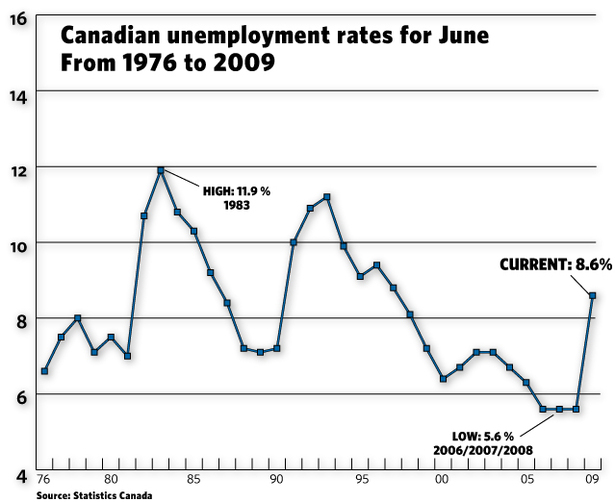
The unemployment rate in Canada for the month of June stood at 8.6% in June. This rate is 0.9% lower the rate in the U.S. for June when it was 9.5%.

Unemployment Rate in Canada for June,2009

Unemployment Rate in Canada

via The Star

It is interesting to note that the current US unemployment rate equals or exceeds the rate in some European countries. And now it is higher than the rate in Canada. Hard-hit sectors in Canada include construction, manufacturing and tourism. Due to the recession in the US lesser number of Americans are visiting Canada.