Tier1 Capital Ratio of Large European Banks

Last month we reviewed the  Tier 1 Capital Ratios of Large US Banks. Most of them had Tier1 ratios in the 10% range based on data from first quarter. Today lets take a look at the Tier1 Ratio of large European banks.

[TABLE=170]

Note: The data shown above are the latest available from the company sites. They may be end of 2008 or Q1,2009 earnings report. They are known be accurate but do your own research before making investment decisions

One of the ratios that can be used to identify the strength of a bank is the Tier1 Capital Ratio. Unlike other ratios, Tier1 is the most commonly published ratios by many banks of the world.

Despite government infusions of billions of pounds, British banks still have Tier1 ratios under 10%. While Erste bank(EBKDY) of Austria has high East European exposure,  the bank received a 2.7 B euro capital infusion from the government. The deal was favorable to Erste because it sold the government non-voting securities, redeemable after five years, on an 8.0% rate of interest. The shares were also non-dilutive to existing shareholders. Erste must have to increase its Tier1 capital ratio higher from the current 7.20%. The Swiss, German, Greek and Government Bank of Ireland(IRE) are stronger with relatively high Tier1 ratios.

Daily Wisdom: Brazil ADRs Edition

From today under the “Daily Wisdom” title I shall post links based on particular theme. Today’s theme is ADRs of Brazil and also the economy. The idea here is to offer investors information on a specific theme from around the web in one place.

Best Economy in the Americas – Brazil. Wall Street tends to take a very myopic view of the world – the view that the entire financial universe revolves around them and the United States. And that what goes on in other countries is unimportant.

List of all Brazil ADR stocks. A list of Brazilian ADRs listed in the US.

Despite a recent drop in profits amid the country’s economic slowdown, Brazilian banks are poised for long-term growth.Features: Profiting From Prudence

Emerging Markets Investment – Brazil the Next China Like Miracle
Just a few years ago, suppose you had known that China, a backward, deeply impoverished communist country, would quickly transform itself into the fastest-growing capitalist economy on the planet. And suppose you had invested $10,000 in the leading Chinese companies.

BRAZIL BOVESPA STOCK IDX SNAPSHOT from Bloomberg. Offers up-to the minute data on Bovespa.

Brazil’s government has taken a number of steps to jump-start growth in its economy and ETF. This now includes slashing interest rates back to a record low. Brazil ETF: 5 Signs of a Rebound

Brazilian stocks have been pummeled in October’s global market rout. But Martin Hutchinson says this has created a great opportunity for investors. South America’s largest economy still has a robust growth outlook and moderate inflation. These six “bargain basement” stocks are now well worth a look.The Six Best Brazilian Stocks On The NYSE

P.S.: Occasionally a few of the links may point to older articles.

Knowledge is Power: In Ben Bernanke We Trust? Edition

No exit for Ben US Federal Reserve chairman Ben Bernanke believes that his new gadgetry will allow him to perform a feat of monetary magic no other central banker has managed to pull off. He can talk about it all he likes, but when it comes time to actually pulling the trigger, his nerves will buckle. – Peter Schiff

The US Federal Reserve’s pursuit of low interest rates has compromised the entire US financial system, while its present strategy of inflating the economy is inequitable and has many associated risks. A national debate of Fed policies and its possible reorganization has become a pressing matter for the United States. It’s time to revamp the Federal Reserve

Nouriel Roubini is a famous–and famously prescient–economic pessimist. So why is he smiling? Dr. Doom Has Some Good News

Loan cash and stimulus money are not going to waste, but are creating a ‘wealth effect’ that will continue to drive stock prices further, argues George Yan. HSBC: A-shares will rock on to 2010

Exporters yet to fully cash in on domestic demand. China may have become the largest auto market because of the unexpected surge in the sale of vehicles in the past six months, but its prospects of becoming the world’s largest goods exporter don’t seem all that rosy.

Econowatch – What we’re seeing now is not really deflation . . . at least, not yet.Deflation is the word that strikes fear into the hearts of economists more than any other, and this week it was the one on everybody’s lips. Both Canada and the United States reported that consumer prices slipped into reverse in June. The 0.3 per cent decline in Canada’s consumer prices was the biggest since the 1950s, and the first time the cost of living has dropped from a year earlier since 1994.

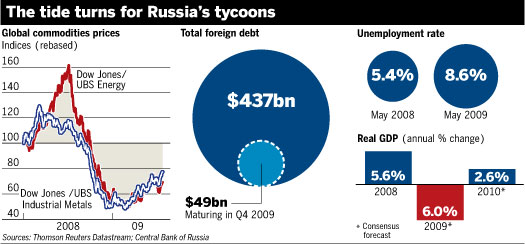
Russia-GDPSource: Financial Times

When Oleg Deripaska was forced to seek a multi-billion dollar bail-out loan from the government late last year, even the Russian tycoon’s closest associates thought he was finished. Drowning in debt, he was advised to hand control of his vast aluminium interests to the government.

“I told him to go to [prime minister Vladimir] Putin and offer him a deal,” says a long-standing business partner. “It was the only option.”Too big to fail

In Spain, good politics makes good economies. Democracy power

Fuel oil, the waste left after making gasoline and diesel, is becoming as valuable as crude for the first time in six years.  Maersk Hit With Frontline as Fuel Oil Beats Crude

Many investors are shunning traditional equity-only funds in favour of vehicles that aim to deliver positive returns in all stock market conditions… Investors flock to new-style ‘safe’ funds

The chancellor grills bank bosses over high profits and takes a hard line on responsibilty to lend to householders and businesses. Darling threatens banks with investigation to encourage lending

Stockmarkets are rising and retailing is buoyant. But even if the worst of the recession is over, past crises have taught economists that next month is no time to be going on holiday.Why August is the cruellest month of all

The sharp rally in U.S. stocks is giving well-regarded investor Jeremy Grantham more than a moment’s hesitation.GMO’s Grantham: Stocks expensive


Can the U.S. Economy Recover with No Growth in Lending?

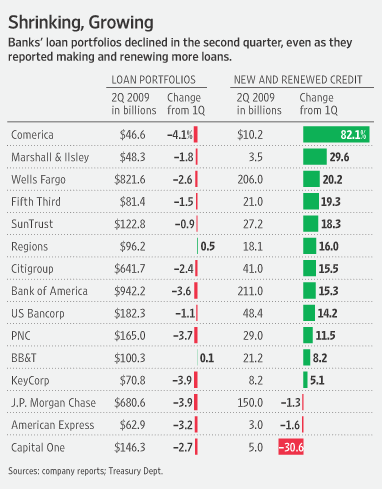
In my opinion, the U.S. economy is unlikely to recover without growth in lending by banks. As the world’s largest consumption-driven economy credit is the lifeblood that keeps our economy running smoothly. Despite the billions in bailout money given to banks by the government banks are not lending. Today’s WSJ article Loans Shrink as Fear Lingers says:

“Lending continues to slow as bankers and borrowers refrain from taking risks, in a bearish sign for the economy.

The total amount of loans held by 15 large U.S. banks shrank by 2.8% in the second quarter, and more than half of the loan volume in April and May came from refinancing mortgages and renewing credit to businesses, not new loans, an analysis by The Wall Street Journal shows.

The numbers underscore two related trends weighing on the economy. Financial institutions are clamping down on lending to conserve capital as a cushion against mounting loan losses. And loan demand is falling as companies shelve expansion plans and consumers trim spending to ride out the recession.

That combination is making it harder for the U.S. economy to rebound, and some analysts predict that loan portfolios won’t start growing until the second half of 2010.”

Banks  are hoarding the funds they received from the TARP and other programs in order to cut down on taking more risk and to shore up their capital base.It is amazing to see that these banks that were reckless with lending just a while ago are now being being cautious, prudent or say that they could not underwrite high-quality quality loans due to the recession.

The chart below shows the loan portfolios of 15 large U.S. banks shrank  in 2Q,2009.

US-bank-Loans

Source: The Wall Street Journal

Banks will continue to tighten their lending standards to prevent further losses. As soaring unemployment forces more folks to default on mortgages and other types of loans, banks will not extend additional credit to borrowers and cancel unused credit lines.Already this scenario is occurring with many banks. Similar to the vicious housing market cycle – where fall in prices leads to fall in demand since many buyers may wait for prices to fall even more – the lending freeze is also likely to prevent a strong recovery of the US economy.

A Look at Four Singapore ADRs listed in Nasdaq

Electronics manufacturing is one of the large industries in the small city state of Singapore. The government’s policies so far have been successful in attracting foreign capital and companies to invest in this sector.

There are four Singapore ADRs that are traded in the NASDAQ market.The following is a brief overview of these stocks:

1.Chartered Semiconductor Manufacturing Ltd.(CHRT)
Chartered is in the semiconductor foundry business with operations in 9 locations in 7 countries throughout North America, Europe and Asia. Last year the company had $.14 in revenues. Temasek Holdings Pte, an investment fund controlled by the Singapore government, holds a 64% in Chartered.CHRT pays no regular dividend.

2.Verigy Ltd.(VRGY)
Verigy is another semiconductor firm which designs, develops, manufactures, sells and supports test systems and solutions for the semiconductor industry.VRGY also pays no dividend.

3.Flextronics International Ltd.(FLEX)
Flextronics is a contract electronics manufacturer with operations in 30 countries. Flextronics used to a hot stock during the dot com era of the 90s. Last year the company lost money. This is a high beta stock.

4.GigaMedia Limited(GIGM)
GigaMedia is a gaming software company. It is also provides software and services to casinos in China, Hing Kong, Macau and Taiwan. As the gaming industry is suffering in the current recession, investors can avoid Gigamedia for now.