Twelve Canadian Dividend Stocks

One of the Dividend Indices in the family of Dow Jones Stoxx Dividend Indices is the “Dow Jones STOXX® Americas Select Dividend 40 Index” for the Americas. The objective of this index is “to measure the performance of the highest dividend-paying stocks relative to their home markets”.

Some of the unique features of these STOXX Dividend indices are:

  • Stocks are screened by defined historical non-negative dividend-per-share growth rates and dividend to earnings-per-share ratios.
  • Index components are weighted by their indicated annual net dividend yield, i.e. the largest dividend-yielding companies have the highest weight in the index.
  • Fixed component numbers and cap factors guarantee index diversification

As of June 30,2009 the dividend yield of this index is 3.97%.

In this post, lets take a look at the 12 Canadian components in the Dow Jones STOXX® Americas Select Dividend 40 Index. The Canadian companies represented in this index are:

Bank of Montreal (BMO)
Great-West Lifeco Inc
Power Financial Corp
CIBC Group (CM)
IGM Finanacial Inc
Power Corp. of Canada
Bank of Nova Scotia (BNS)
TD Banking Group (TD)
National Bank of Canada
Royal Bank of Canada (RY)
Transcanada Corp (TRP)
Enbridge Inc (ENB)

Of the twelve companies, the five major banks are included and two energy companies are listed in the US exchanges as inter-listed stocks. All the Canadian banks have weathered the credit crunch well and have rebounded strong from the March lows. The most profitable bank in Canada, Royal Bank (RY) has a 3.86% yield now and has more than doubled form recent lows. The stock is also is a consistent performer over many years. Scotia Bank (BNS) has a significant present in Mexico and the Caribbean. BMO currently pays a 5.18% dividend. TD and Canadian Imperial Bank have also come back strong. The five banks are solid long-term investment plays.

Enbridge Inc (ENB) operates in the crude oil and natural gas industry while TransCanada (TRP) operates pipelines and also in the energy area. TRP has a 4.96% yield. Enbridge recently announced that its on target to achieve 20%+ growth this year and 10%+ thru 2013.

Daily Wisdom: Emerging Markets Rock Edition

EPFR Global attributes the strong inflows to corporate earnings and macroeconomic trends.Equity fund inflows hit one-year high

According to Barclays Global Investors, there were 272 ETFs with exposure to emerging markets as of end-June.Assets of emerging market ETFs reach $116 billion

The story of the BBC Box mirrors the fortunes of the global shipping industry.Where is the BBC Box?

Consumer debt is crippling Canadians to such a degree that banks are offering unprecedented flexibility to the fiscally distressed. They’re lending a hand with measures including forgiven mortgage payments and consolidation loans at preferred rates.Shelter from the storm

Commodity prices may rise further in 2010 as the global recession abates, said Nouriel Roubini, the New York University economist who predicted the financial crisis. Roubini Says Commodity Prices May Rise in 2010 as Global Recession Abates

Concerns are switching from the residential to the commercial sector.The collapse in commercial property. Towers of debt

Results for HSBC and Barclays expected to raise fresh concern over return of bonus culture. Back in black – revenues soar for UK high street banks

Should the U.S. Stop Immigration?

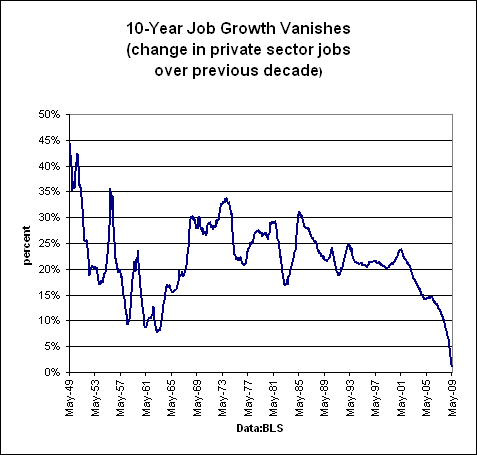
Back in June, Michael Mandel of Business Week wrote an interesting piece titled A Lost Decade for Jobs in which he analyzed the growth Private Vs. Public sector job growth. His research showed that the private sector “job growth was almost non-existent over the past ten years”.

Private-Sector-Jobs-Growth

He added “Between May 1999 and May 2009, employment in the private sector sector only rose by 1.1%, by far the lowest 10-year increase in the post-depression period.

It’s impossible to overstate how bad this is. Basically speaking, the private sector job machine has almost completely stalled over the past ten years.”

Public-Sector-Jobs-Growth

Source:  Economics Unbound, Business Week

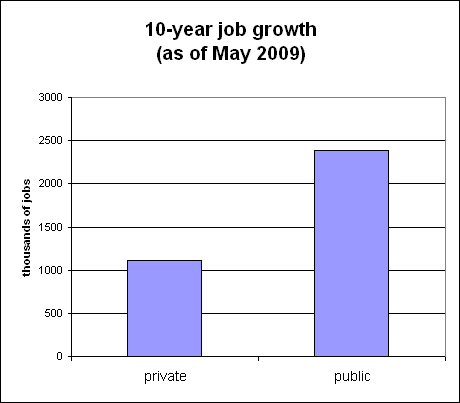
“Over the past 10 years, the private sector has generated roughly 1.1 million additional jobs, or about 100K per year. The public sector created about 2.4 million jobs.

But even that gives the private sector too much credit. Remember that the private sector includes health care, social assistance, and education, all areas which receive a lot of government support.”

So for the past 10 years private sector job growth was just 100K per year which is very minuscule for an economy of our size. I wanted to see how this compares with the growth of population in our country especially due to immigration. In the post I shall try to analyze some of the effects of job growth against high growth in immigrants intake.

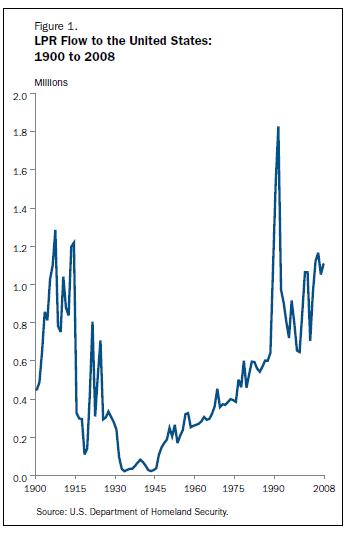
According to Office of Immigration Statistics, a total of 1,107,126 persons became Legal Permanent Residents (LPRs) or Green Card holders of the United States in 2008. 58% of them already lived here. The following chart shows the growth of LPR from 1900 to 2008 into the U.S.:

LPRs-Flow-inot-USA

Source: Annual Flow Report, March 2009
Office of Immigration Statistics, Department of Homeland Security

The above chart shows that immigration growth increased from 2000.The Annual Flow Report stated “The annual LPR flow has exhibited an upward trend since World War II . The annual average LPR flow quadrupled from 250,000 during the 1950s to just over one million during 2000 to 2008.”

When the private sector created 100K jobs between May 1999 and May 2009, the annual issue of LPRs averaged 1 Million per year from 2000 to 2008.  Both the private and public sector combined created 3.5 new jobs in the past decade. This is simply far less than the 10 million immigrants admitted to the country. It must be noted that not all of the one million LPRs issued are working age adults. Some of them may have been here already with jobs when they became permanent residents. Overall more immigrants came into the country during the decade when the private sector job growth was almost non-existent. We must also remember that the above statistics do not reflect the flow of illegals that entered the country during the period discussed which could also be in the millions in a decade.

The following table  shows the yearly growth of Legal Permanent Residents into the U.S. from 1997 thru 2007:

[TABLE=172]

Source: U.S. Department of Homeland Security, Office of Immigration Statistics, 2007 Yearbook of Immigration Statistics 

During the past two decades millions of jobs have disappeared in the US as those jobs were exported to low-wage countries such as Mexico, China, India, Vietnam, etc. Manufacturing was hard hit as literally thousands of factories were shutdown and moved to overseas locations as part of NAFTA and globalization. Entire towns in the midwest were decimated and became “rust-belt” towns overnight because of this phenomenon.

In addition to the granting of legal permanent residency status, the U.S. also allows thousands of workers into the country under different categories of visas. One of the most popular category is the controversial H1B visa which “allows U.S. employers to temporarily employ foreign workers in specialty occupations” per Wikipedia. This visa is granted for a maximum of six years. Currently a total 65,000 per year can be issue in this category. Due to high economic growth the limit was increased to 195,000 in 2001, 2002 and 2003.

In the past, the entire total of such visas for a year was exhausted in just a few weeks as the demand for them was extremely high among aliens wanting to work here. However the demand is falling in recent months due to high unemployment and the recession as many of the workers realize that their chances are of finding a job are better in their home countries than in the U.S.. The Top 10 users of the H1B visas are the IT outsourcing firms from India. Some of high-paying IT jobs that were not off-shored to other countries went to folks on H1B visas since they could be hired at wages much lower than the wages demanded by a US citizen.This H1B visa program probably exacerbated the unemployment situation. example, 195K visas were issued in 2001 when only 100K private sector jobs were created.

In response to the current recession, some countries have announced plans to reduce the number of immigrants allowed into the country. Australia has announced “a 14 per cent cut to the skilled migration program, capping the number of workers to enter Australia next year at 115,000, down from 133,500 in 2008-09”. Despite having high unemployment levels, Canada did not reduce the number of immigrants allowed into the country for this year. Many have questioned this decision by the Canadian government. Because the Canadian economy is highly dependent on the US, jobs growth in Canada will be non-existent until the economy improves south of the border.

The U.K. has also announced that immigration will be cut as the unemployment levels soar. From an article in The Times: “Phil Woolas, in his first interview since taking over as Immigration Minister, said that he wanted to see a dramatic reduction in the number of migrants coming to Britain.

In what many will see as extraordinary remarks for a Labour minister, he told The Times that the economic backdrop changed everything. “If people are being made unemployed, the question of immigration becomes extremely thorny . . . It’s been too easy to get into this country in the past and it’s going to get harder,” he said.”

So far, the U.S. has not announced plans to cut immigrants intake despite rising unemployment. Today’s New York Times  reports that “Over the coming months, as many as 1.5 million jobless Americans will exhaust their unemployment insurance benefits, ending what for some has been a last bulwark against foreclosures and destitution.” in a piece titled Prolonged Aid to Unemployed Is Running Out. So should the U.S. cut immigration drastically or perhaps stop immigration temporarily? With unemployment rate projected to cross 10% this year it may be a prudent move on the part of the politicians to implement a law restricting immigration until there is improvement in the economy.

In the past, the U.S. has banned immigration due to unemployment problems. For example the Chinese Exclusion Act of 1882 excluded  “skilled and unskilled laborers and Chinese employed in mining from entering the country for ten years under penalty of imprisonment and deportation”. The law also imposed additional restrictions on Chinese who wished to immigrate or gain citizenship.

Until now there haven’t been any meaningful discussion in the media about the effects of growing immigration levels on the already suffering economy. It is high time that policy makers addressed this issue. What are your thoughts on this issue?. Please leave your opinions in the comments section.

More on Capital Ratios of U.S. Bank Holding Companies

The Tier 1 common capital to risk-weighted assets ratio historically stood at 7¼% over 1997–2007  for all FDIC banks in the U.S. The U.S. Supervisory Capital Assessment Program (SCAP) which performed the stress tests to assess risks faced by banks assumed a target of 4% Tier 1 common capital to risk-weighted assets ratio which is lower than the historical standard.

The SCAP also assessed the capital needs of the largest 19 Bank Holding Companies (BHCs) under pessimistic scenarios. To achieve the target 4% ratio, it found that the banks needed $185B in capital. The IMF’s April 2009 Global Financial Stability Report (GFSR) “estimated that all U.S. banks would need $275 billion of additional capital to maintain a 4 percent leverage ratio (tangible common equity/tangible assets) or $500 billion to maintain a 6 percent leverage ratio, over the same period.”

Capital-Ratios-US-banks

Note: Top four banks include Citigroup, JPMorgan, Bank of America and Wells Fargo. Tier 1
common capital is total tier 1 capital less qualifying minority interests in consolidated subsidiaries,
qualifying trust preferred securities, and preferred stock and related surplus. Tangible common equity
is total equity capital excluding goodwill and other intangible assets and preferred shares and related
surplus.

Source: IMF Country Report No. 09/228, United States

The top four banks  Citigroup (C) , JPMorgan (JPM) , Bank of America(BAC) and Wells Fargo(WFC) have lower capital ratios than the total BHCs in Q1,2009 based on both SCAP and IMF measures. By IMF’s measure the ratio is just 2.9% which is much lower than the target level of4%. If the recessions continues to worsen and losses mount, IMF estimates that for the period 2011-2014 U.S. banks’ capital needs would increase dramatically.

Related Post: A Review of Tier 1 Capital Ratios of Large US Banks

IMF: U.S. Economic Recovery Likely to be Gradual

The latest IMF Country Report for U.S.A released yesterday says that the financial strains are still high and the recovery is likely be gradual.

Some of the key takeaways from this report are listed below:

  • Exports of goods and services would be restrained due to the sluggish growth in countries with which the U.S. trades
  • Near-term outlook is highly uncertain due to the continued deleveraging process of households with credit tightening and soaring unemployment
  • Fall in commercial  real state is likely to continue
  • Economic forecasts projected by the U.S. government are still more optimistic
  • U.S. households savings rate is expected to rise providing funds for investment
  • The U.S. dollar is moderately over-valued
  • Concerned about the high level of underwater mortgages
  • The balance sheet of the Fed currently standing at 15% of the GDP, could double to 30% of GDP if all available facilities are deployed
  • The U.S. government will need to slowly phase out its interventions in the markets
  • The crisis revealed major weakness in the supervision and regulation of the financial sector
  • Rising pension liabilities and health-care expenditures would widen fiscal imbalances
  • Household consumption is likely to remain weak due to high debt to disposable income ratio
  • The U.S. consumer is unlikely to be the global “buyer of last resort” and hence U.S. may not be the engine of global growth in the future

The last point is particularly important. Moving forward, the world cannot depend on the U.S. consumer since they are tapped out and will not consume stuff like they used to before. Programs to stimulate demand such as the “Cash-for-Clunkers” are great in the short-term but they are unlikely to provide long-term consistent growth. The winding down of the American consumer has major implications for export dependent countries.  China especially will have to look elsewhere to export their goods and already due to lack of overseas demand thousands of factories have been shutdown there.  This brings us to some critical questions. If U.S. consumers will not be the driver of global growth in the future who will replace them?. Which country would likely take the place of the U.S. and import the majority of goods made by China? Can the emerging markets continue to grow without depending on the U.S. economy?