Top 25 Middle East Banks

The list Top 25 Banks in the Middle East was published The Banker magazine last month. The National Commercial Bank of Saudi Arabia was the highest ranked bank in the region. But its Tier 1 capital fell 15% last year and it slipped 12 places to end at 120th spot in the world’s top  bank rankings.The second rank was also held by a Saudi Arabian bank. Saudi Arabia-based Riyad Bank doubled its Tier 1 capital in 2008 to $6.1B.

The Top 25 Banks in the Middle East:
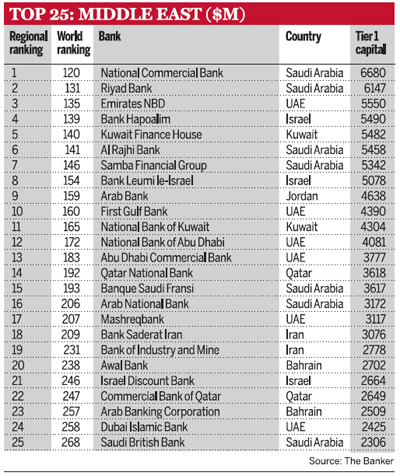
Top-25-Middle-East-Banks

Source: The Banker

According to the magazine “The Middle Eastern banking sector has remained relatively isolated from the worst of the crisis in the financial markets, but its banks are being hit indirectly by the wider global economic downturn and plunging commodity prices, in particular oil.”
Are Too Many Financial Institutions in the U.S. the Problem?

The FDIC shutdown 4 more banks yesterday bringing the total bank failures this year 81. The failed four banks are:

Guaranty Bank of Texas
CapitalSouth Bank of Alabama
First Coweta Bank of Georgia
ebank of Georgia

Guaranty Bank is the 3rd largest bank failure this year with assets of $13 B and deposits of $12 B. Bilbao Vizcaya Argentaria (BBV) of Spain assumed control of Guaranty Bank thru its US subsidiary BBVA Compass. Commenting on the acquisition, the chairman of BBVA Compass Jose Maria Garcia Meyer,  said: “excellent strategic sense” and represents an opportunity for BBVA to expand its presence in the “high growth Sunbelt Region.”

In a Bloomberg Television interview, the analyst Meredith Whitney predicted that more than 300 banks would fail this year. This brings us to the title of my post. Yes. There are too many financial institutions in this country. All these institutions are chasing the fewer number of customers and their deposits. Some of the smaller banks may have to consolidate their operations with other branches. Other banks such as the “problem banks” may have to be closed if they continue to suffer with losses and recovery is not possible in any way.

From the FDIC’s Quarterly Banking Profile, 1Q, 2009:

“The number of FDIC-insured commercial banks and savings institutions reporting financial results declined from 8,305 to 8,246 in the first quarter.During the quarter, the number of insured banks and thrifts on the FDIC’s “Problem List” increased from 252 to 305, and total assets of “problem” institutions rose from $159 billion to $220 billion.”

There are a total number of 8,147  U.S. Credit Unions in the US (Source: CUNA).

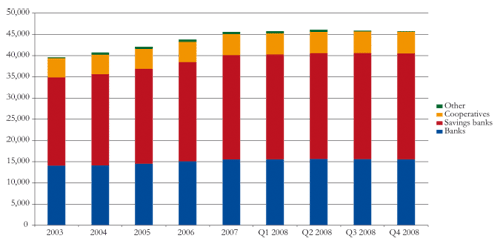
This phenomenon of having too many banks is not a problem just in the US. In Spain, Savings banks expanded too fast in the past decade and now must merge with other banks in order to survive. While most Spanish banks are run very conservatively they are still exposed to economic problems such as the growing high unemployment and the collapse of the real estate sector. The following chart shows the growth of savings banks in Spain since 2003:

Spain-Banks-Growth

Source: Euromoney

From a total of 20,871 branches at the start of the decade, savings banks in Spain expanded by more than 4,100 in the next 5 years. The two large Spanish banking giants Santander (STD) and BBVA (BBV) are not interested in acquiring some of these savings banks as they do not want domestic expansion. This is one reason why Bilbao Vizcaya Argentaria (BBV) acquired Guaranty Bank and eyes strong growth in the US markets.

One of the senior banking executive of the two large Spanish banks said:

“There are simply too many of these financial institutions. Ultimately we must reduce installed capacity.”

His statement probably holds true for US as well. Due to high profit margins a large number of banks opened in the US in the past few decades. As the economy contracts and Americans reduce consumption, some of the banks may not be needed.

Top 10 Banks in the World by Assets

BankersAlmanac.com, a site run run by the information database provider Reed Elsevier, tracks the world’s top banks based on assets.

The World’s Top 10 Banks ranked by Total Assets:

[TABLE=173]

Note: Data compiled from banks’ balance sheet information included on Bankersalmanac.com on 5th August 2009

European banks dominate the above list. Royal Bank of Scotland (RBS) ranks the number one bank in terms of assets held. Currently the British government is the largest owner of the bank and due to severe losses and conditions of government bailout, RBS stopped paying dividends. The total assets held by RBS  is more than double the size of assets held by Bank of America. Deutsche Bank (DB) has a large global presence  but now offers a low yield.

Among the large French banks, BNP Paribas fared the credit crisis better than Societe Generale. And
Societe Generale took a $7.2 B loss last year due to the rogue trader Jérôme Kerviel. US-based banks JP Moran Chase(JPM) and Bank of America(BAC) are two of the so-called “too big to fail” banks. JP Morgan Chase is in a much better shape than Bank of America. As shown above, JPM also has the highest dividend yield.

Related Post from 2008:

Top Banks of the World available as ADRs

Most Valuable Brands of Canada 2009

“Branding is about having a unique personality, a point of view and a positioning.”
David Haigh
CEO, Brand Finance plc

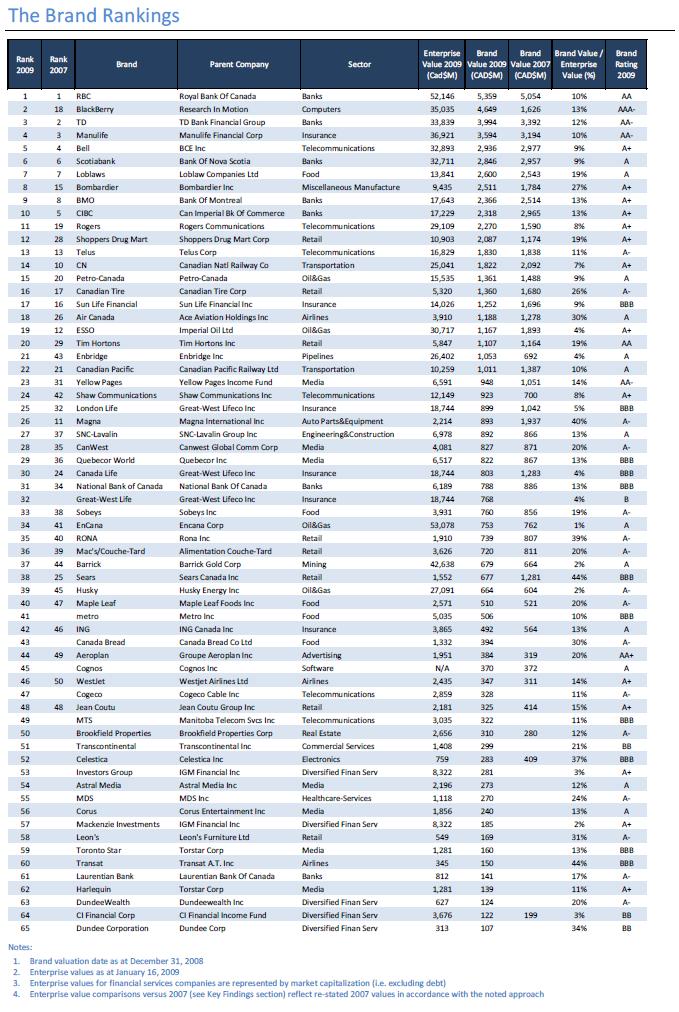
The Most Valuable Brands of Canada for 2009 were published by Brand Finance a while ago. The rankings ” represents a point-intime examination of the Canadian ‘brandscape’, including many brands who are ‘getting it right’ – and consequently are playing an increasingly important role on the global stage during these challenging times.”

Royal Bank of Canada is the top brand with an estimated brand value of almost C$5.4 B. RIM’s BlackBerry is Canada’s highly rated brand with a score of AAA-. Canada Post ranks the best among ‘Iconic’ brands. In 2009, 65 companies were included in the most valuable brands list.

The Ten Most Valuable Canadian brands are listed by rank order (ascending):

Royal Bank of Canada (RY)

Research In Motion (RIMM)
Toronto-Dominion Bank (TD)
Manulife Financial (MFC)
BCE Inc. (BCE)
Bank of Nova Scotia (BNS)
Loblaw Companies Ltd
Bombardier
Bank of Montreal (BMO)
CIBC (CM)

Mining, Oil & Gas and Banking form the top 3 sector by enterprise value in 2008. So its not surprising to see the five large banks in the list above.

To see the complete list of 65 most valuable brands click on the icon below.

Canada-Top-Brands-List-2009

The Top 20 World Ports in 2008

The Top 20 World Ports for 2008 are shown below. Not surprisingly China dominates this list with taking 3 out of the top 5 spots. In addition, out of the total 20, ten of them are Chinese ports. Shanghai ranked the top port last year. In the US, the top ports were LA, South Louisiana and Houston.

Click to Enlarge Image

Top-20-World -Ports-2008

Top-20-World -Ports-2008-by-chart

The Top 20 World Container Ports for 2008 are listed below. Singapore tops the list followed by Shanghai, Hong Kong  and Shenzen in China.

Top-20-World-Container-Ports-for-2008

Rotterdam was the number one container port in 2008. The Top 20 European Container Ports for 2008 are displayed below:

Top-20-European-Container-Ports-for-2008