Global Saving and Investment Trends 2009

The September edition of the Reserve Bank of Australia’s “Reserve Bank Bulletin” has an excellent article titled “Patterns and Trends in Global Saving and Investment Ratios”. The article compares saving and investment ratios of different countries and regions and their impact on the current deficits.

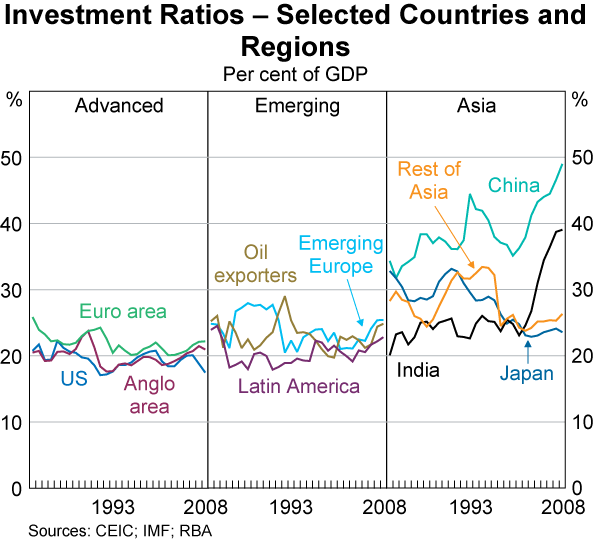
In this post, let me present some of the key points from the article. Saving and investment ratios tend to vary across regions and countries. Traditionally Asian countries have had high saving ratios. In recent times, the investment ratios of Asian countries is also tending higher as shown in the graph below.

China and India are among the top savers in the world. India’s saving accounts for over 35% of GDP. For China, it is close to 60%. Developed countries have low saving ratios. The United States has the lowest saving ratio in the developed world. In addition to high Saving ratio, the Chinese have high investment ratio as well.
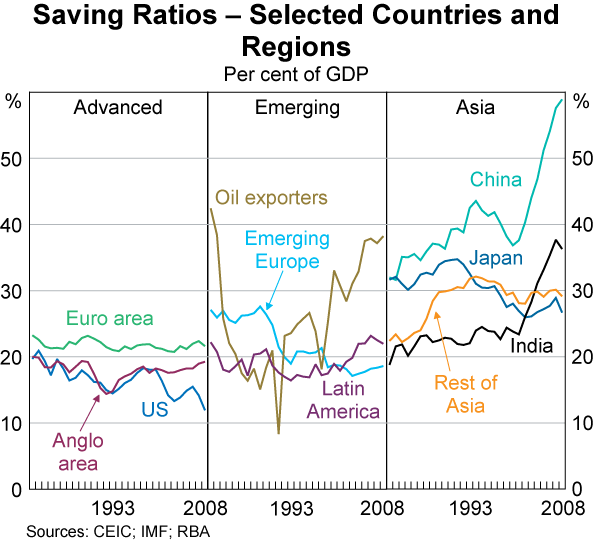
Saving-Ratios-Country-Regions

Investment-Ratios-Country-Regions

In Asia, saving ratios traditionally exceeded investment ratios producing a large current account surplus. China has run a current account surplus since 2000. Oil exporting countries in the Middle East and Russia also have current account surplus. These countries supply their global saving to developed countries. The advanced economies historically have run current account deficits. Since the early 90s, the current account deficit has increased sharply in US.
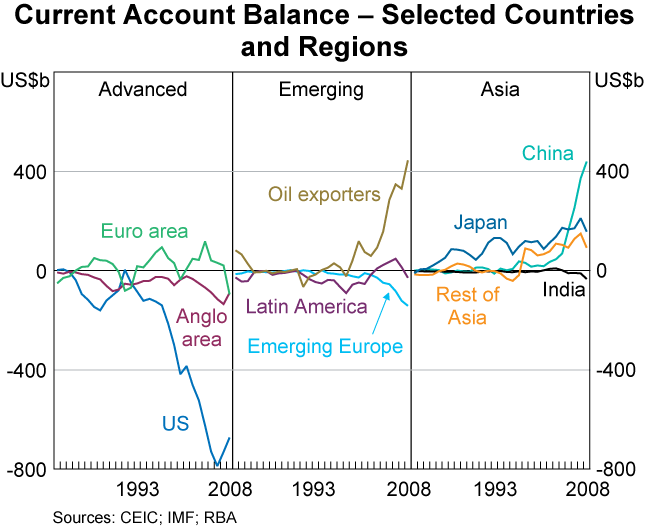
Current-Account-balance-Countries

On the development in saving and investment ratios in the U.S., the article noted:

“As noted, the current account deficit in the United States widened sharply between the late 1990s and mid 2000s as the saving ratio fell – with a large decline in public saving in particular – while its investment ratio was boosted by a rise in housing construction. But since the mid 2000s, the US investment and saving ratios have changed by a broadly similar magnitude, and hence the US current account has been comparatively steady.” This analysis is absolutely correct since residential construction was one of the major drivers of the US economy until a few years ago. Large and small banks handed out loans liberally for investment purposes in the real estate sector. While that strategy boosted profits in the short run and increased the investment ratio for a few years, the negative effects of that reckless lending is being felt on a daily basis in the US. For example, the total number of failed banks has risen to 94 as of last Friday.
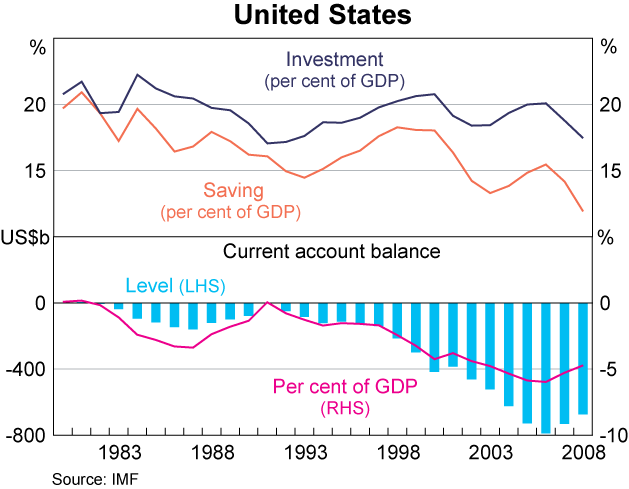
US-Investment-SAving-Ratios

The effect of rise in construction spending leading to high investment ratio is evident in Spain as well as the chart below shows. The chart also shows that since the 1990s Germany has had a high saving ratio but low investment ratio.
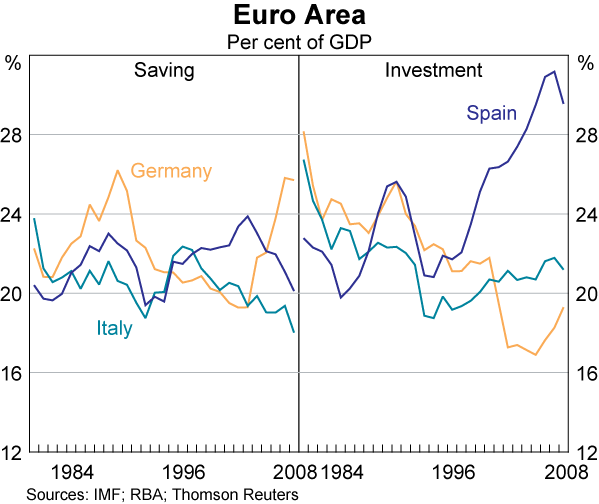
EU-Investment-SAving-Ratios

The article concludes that declining domestic demand and tight financial conditions will lead to a sharp fall in investment in the U.S. Globally the economic downturn is projected to lead to a decline in saving and investment ratios in major countries and regions.

Top Emerging Market Mining ADR Stocks

One of the fastest growing sectors in emerging countries is the mining sector. Many of the emerging countries are heavily commodity-based economies. Russia is dependent on crude oil, Chile is dependent on copper, Brazil for a wide variety of natural resources, South Africa for gold and other precious metals, etc. As a result, when the prices of commodities rise these emerging markets perform very well.

One way to identify the top mining and metal sector companies in emerging markets is to review an index that specializes in this area. The Dow Jones Emerging Markets Metals & Mining
Titans 30 Index is one such index. It contains 30 of the largest emerging-market companies in the this sector. These companies are selected based on “rankings by float-adjusted market capitalization, revenue and net profit.”

In 2008, this index lost 65%. However this year as of August 31st, it was up by an incredible 90.94%. The current dividend yield is 1.65%. About 50% of the portfolio is composed of stocks from Brazil and South Africa.

The following is a brief overview of the Top 10 Components in this index:

1.Brazil-based Vale S.A.(VALEP) is a steel mining company. Vale pays no regular dividends.Yesterday Rio Tinto Plc of U.K. closed the sale of a mine to Vale for $750 M.

2.Impala Platinum Holdings Ltd.(IMPUY) owns the world’s biggest platinum mine, the Rustenburg mine. Impala mines platinum and other precious metals.

3.China Shenhua Energy Co. Ltd.(CSUAY) is a Chinese coal miner. It pays a 1.46% dividend.

4.AngloGold Ashanti Ltd. (AU) is one of the largest gold producers in the world with over 21 operations. The company has interests in silver, uranium oxide and sulphuric acid. Last year’s revenue was $3.2B and the stock has a beta of 0.8.

5.Russia-based Norilsk Nickel Mining & Metallurgical Co. (NILSY) is a nickel producer. It pays not regular dividends.

6.Companhia Siderurgica Nacional (SID) is Brazil-based integrated steel producer. The beta is 1.9 and the dividend yield is 3.56%. The average profit margin last year was about 32% from a revenue of $1.7B.

7.Gold Fields Ltd. of South Africa. It does not trade in the U.S. markets.

8.Gerdau (GGB) is a producer of long rolled steel of Brazil. It has 60 steel producing units worldwide. The beta is high at 2.2. Average annual earning growth over the past 5 years is about 31%.

9.Jindal Steel & Power Ltd. of India is not listed in the U.S.

10.Usinas Siderurgicas de Minas Gerais (USNZY) is an iron and steel maker in Brazil.

For some of the companies mentioned above, the index contains their preferred shares.I have used the common tickers since common is mostly traded by investors.

Spanish Property Market to Recover in 2016

Recently Madrid-based influential real estate market analysts R.R. de Acuña & Asociados released the annual report on the property market in Spain. Releasing the report, Fernando Rodríguez y Rodríguez de Acuña, president of the company said “There are no green shoots around here” describing the state of the Spanish property market.

This is not surprising since Spain’s property markets has been booming to incredible levels until the credit crisis started. The construction sector offered jobs to millions of locals and migrants alike. However in recent months that has changed dramatically. The unemployment rate in second quarter reached to 17.9% more than twice the European average.

Demand for housing is expected to be about 220,000 homes per year while there were 1.6 million unsold houses at the end of 2008. At these levels it will take 6 to 7 years for the market to recover.

Fernando Rodríguez pointed out that “The market situation doesn’t justify more building, and anyway the banks won’t lend money to build something that won’t sell” and and predicts that 75% of all Spanish property developers will be wiped out in the next 5 years due to excessive debt, the current property market slump and “bad management”.

Mr.Fernando Rodríguez makes an astute observation on the Spanish market. This scenario holds true for the U.S. market as well. There is no reason for developers to continue adding to the existing inventory. However some builders are already starting to initiate new development plans here.

Due to their significant overseas presence, the two largest banks of Spain, Banco Santander(STD) and BBVA(BBV) are not impacted heavily by the domestic housing market collapse. In addition to Europe, Latin American these two banks are also concentrating on expansion in the U.S. Santander bought Sovereign Bank and more recently BBVA acquired the failed bank, Guaranty Financial of Texas.

A Look at Foreign Bank Stocks Traded in OTC Markets

In addition to the foreign banks listed in the New York Stock Exchange(NYSE), there are many banks that trade on the OTC markets. Some of the banks moved to the OTC a few years to due to the high listing fees charged by the New York Stock Exchange. Others prefer the easier listing and regulatory requirements of the Over-The-Counter markets.

The table below lists forty two foreign bank stocks that trade as Sponsored ADRs in the U.S.:

[TABLE=179]

Some of the stocks shown above have very light trading volumes.Others do not trade at all on a daily basis. Though these trade on the OTC markets, some of them are large banking groups in the home countries. For example Societe Generale (OTC: SCGLY) and BNP Paribas (OTC:BNPQY) branches can be found through out France. Both the banks have decent daily trading volumes and are up about 50% and 92% respectively YTD.

Among the Asian banks, Singapore-based banks United Overseas Bank(OTC:UOVEY) and DBS (OTC: DBSDY) are stable long-term growth stocks. As Singapore and other South East Asian countries recover from the recession DBS and UOB will perform well.

Among the lesser known banks, DNB Nor ASA of Norway(OTC:DNBHY), NedBank of South Africa (OTC: NDBKY) and Hang Seng Bank (OTC: HSNGY) of Hong Kong can be researched further for potential investment opportunities.

Knowledge is Power: The Financial Crisis Already Behind Us? Edition

There is clearly a class of people who do not face the full force of the law because of who they happen to be. The same stunning level of corruption is also true for banks, bailouts and financial systems. This will be the unsavory legacy of the Lehman Brothers aftermath.Moral hazard is back

Opponents of overhauling U.S. health care argue that Canada shows what happens when government gets involved in medicine, saying the country is plagued by inferior treatment, rationing and months-long queues.Canadian Health Care, Even With Queues, Bests U.S.

Interview with IMF Head Dominique Strauss-Kahn: ‘It Is Dangerous to Think the Financial Crisis Is Already Behind Us’

Neeraj Mehta likes saving money but is turned off by the ultra-low interest rates offered by Canadian banks.Banking on India

Guest Post: Are Financial Blogs Trustworthy?
By George Washington of Washington’s Blog.
The talking heads say that financial blogs aren’t trustworthy.But the whole debate about blogs versus mainstream media is nonsense.

Amsterdam, Holland