The Top 10 Global Insurance Companies

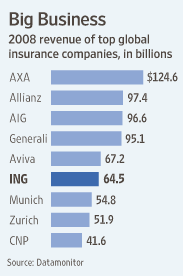
In this post lets take a quick look at The Top 10 Global Insurance Companies by 2008 revenues.

On October 27th, ING (ING) one of the world’s largest insurance companies, was forced to split itself into two in order to comply with the strict rules enforced by the EU on firms that received government financial aid during the credit crisis last year. ING plans to divest its US online baning operation ING Direct, insurance business and about 6% of the retail banking in domestic market. ING ranks 6th in the world based on its insurance revenues and 13th among European banks as of June this year.

 

ING-Headquarters

ING’s World Headquarters, Amsterdam, The Netherlands

After the restructuring ING’s Tier 1 ratio would stand at 7.6% forcing it to raise further capital form investors. ING plans to raise 7.5 EUR to repay half of the bailout funds it received from the Dutch government.This divestiture plan is a good strategic move for ING. It never made sense to operate in two unrelated fields – banking and insurance as a conglomerate. Globally firms that operate exclusively in insurance have thrived much better than banks that try to get into insurance. Firms generally end to perform better when they operate in one niche area that they can concentrate on with all their resources.

In addition to ING, what are the other Top Global Insurance companies?

The following chart shows the top global insurance firms by 2008 revenue:
 

Top-10-Global-Insurers

Source: The Wall Street Journal

France-based insurance company AXA (AXA) currently pays a 2.16% dividend and has nearly tripled from March lows. Insurance is a big business in France since the French save large amounts for retirement via insurance policies. German insurer Allianz recently delisted its stock form the NYSE. The fifth largest global insurance company Aviva (AV) of UK recently started trading in the NYSE. Zurich Financial Services AG of Switzerland (OTC: ZFSVY) has a 4.34% dividend yield.

Top Ten Reasons To Invest in Malaysia

Unlike its neighbor Singapore, the country of Malaysia is often overlooked by investors. The economy of Malaysia is commodity-based with palm oil, crude oil and rubber being the major exports. Among the Asian emerging markets, Malaysia has some unique comparative advantages. Some of the top reasons for investing in Malaysia are listed below:

1. The Malaysian banks was virtually unaffected by the global credit crisis last year that decimated many banks especially in the western world. The Top Banks such as May Bank, Public Bank, CIMB and Malayan banking (OTC: MLYBY) were not involved heavily in derivatives and weathered the crisis easily.

2. After the Asian crisis, Malaysia enacted many regulations which prevented the reckless flow of capital into and out of the country. These regulations require that capital invested in Malaysia stay invested for some years before they can be taken out.

3. As the world’s largest producer of Palm oil, Malaysia has a leadership position in providing cheap edible oil to many developing countries. Palm oil is a cheaper substitute for vegetable or sunflower oil which are used in cooking. There are many huge palm oil plantations in Malaysia which benefited nicely last year when palm oil prices soared. Kuala Lumpur Kepong which trades in the OTC market with ticker KLKSY is engaged in palm oil and rubber production among other products.

4. In 2008, Foreign Direct Investment (FDI) into Malaysia increased by 38% (RM 46.1 Billion) from the previous year. Australia was the largest investor followed by US, Japan and Germany. However this year, FDI plunged to just $13 B from January thru May. But in the future FDI may increase substantially as the government has announced many liberalization measures and the country holds potential in sectors such as renewable energy, manufacturing, etc.

5. Since Islam is the largest and official religion in Malaysia, the financial sector follows the principles of Islamic finance and take very low risks compared to banks in other countries.

6. Since Independence from the British, the country has been a Parliamentary democracy
with a stable government in most years. Hence political risk is low.

7. Corruption is lower in Malaysia relative other ASEAN countries such as Indonesia, Thailand and others.

8. In addition to palm oil and rubber, Malaysia is blessed with an abundance of forestry, fertile agricultural land minerals like copper, iron-ore,etc.

9. Crude oil and Natural gas were discovered offshore in the 1970s and today Malaysia subsidizes gasoline for domestic consumers and is a net exporter of crude oil. The famous Petronas Tower is owned by the national state-owned oil giant Petronas.

10. While Malaysia has failed to succeed in innovation based industries like IT, biotechnology, semiconductors, etc. it has been able to excel in the agricultural and commodity sector and more recently is heavily encouraging the growth of tourism, healthcare and education sectors. Genting Berhad (OTC:GMALY) is a major entertainment company that operates the famous Genting Highland Resorts outside of Kuala Lumpur, Sentosa Island in Singapore and others.

The following chart shows the 30 Most Valuable brands of Malaysia:
Click to enlarge

Malaysia-Top-brands

Source: Interbrand

A simple and easy way to invest in Malaysian equities is via the iShares MSCI Malaysia ETF (EWM). It has about 50% of the assets in financials and industrials. This ETF has an asset base of $544 M and in 1 year has performed well with a growth of about 24%.

Six Foreign Bank Stocks Under $10

Some of the foreign banks that fell heavily during last year and early this year are still languishing under the $10 range. Most of them either don’t pay or have suspended dividend payments.

The following is a list of Foreign Bank ADRs that closed at under $10 as of 1/05/2009:

1.Bank: National Bank of Greece (NBG)
Country: Greece
Price: $7.75
Dividend Yield: 1.57%

2.Bank: Grupo Financiero Galicia (GGAL)
Country: Argentina
Price: $6.00
Dividend Yield: No regular Dividends Paid

3.Bank: Allied Irish Banks (AIB)
Country:Ireland
Price: $5.63
Dividend Yield: No regular Dividends Paid

4.Bank: Mitsubishi UFJ Financial (MTU)
Country:Japan
Price: $5.44
Dividend Yield: No regular Dividends Paid

5.Bank: Lloyds Banking Group (LYG)
Country: U.K.
Price: $5.57
Dividend Yield: No regular Dividends Paid

6.Bank: Mizuho Financial (MFG)
Country: Japan
Price: $4.10
Dividend Yield: No regular Dividends Paid

Lloyds Bank of UK is trying hard to free itself from the yoke of the British government which is a major shareholder now. Before the crisis began Lloyds used to be an excellent British bank stock with strong and consistent dividend payments year over year.Even now the bank has a highly valued franchise in the UK. Unlike its competitor Anglo Irish Bank which was nationalized by Ireland, Allied Irish Bank survived and continues to operate as a private financial institution.

European and American Banks with Assets in Trillions

The credit crisis followed by the recession triggered many bank failures and forced mergers worldwide. As a result of these mergers some of the banks which were already larger became larger in size creating the so-called “superbanks” especially in the U.S. These banking giants hold assets in excess of Trillions of Euros or US Dollars.

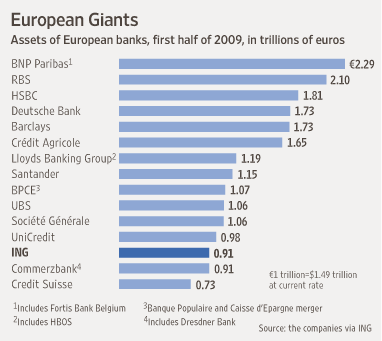
The following graphic from The Wall Street Journal shows the European banks with assets in Trillions of Euros in the first half of this year:

European-Banking-Gaints

Except Unicredit, ING (ING), Credit Suisse (CS) and Commerzbank (OTC: CRZBY) all the other banks hold assets in excess of 1T Euros. BNP Paribas (OTc: BNPQY) of France is the largest in terms of assets held. Its competitor Societe Generale (OTC: SCGLY) is much smaller in size by assets. ING will soon itself into two divisions and spinoff its US online banking unit ING Direct.

In the US, just four superbanks have emerged from this crisis with each having over $1 Trillion in assets. These four banks are:

1. Citibank (C)
2. JPMorgan Chase (JPM)
3. Wells Fargo (WFC)
4. Bank of America (BAC)

Two Foreign Utilities with more than 6% Dividend Yield

CPFL Energia S.A. (CPL) of Brazil and National Grid plc (NGG) of UK current have dividend yields of over 6%.

CPFL Energia S.A. (CPL earnings growth is about 35% and the revenue growth is about 10%. Last year the company had a total revenue of $5.8B. It is one of the highly profitable electric ) is an electric utility with 6.4 Million customers. The average annualutilities with a net margin of 12.60%. The current dividend yield is 7.40%.

Uk-based National Grid(NGG) operates both in the electricity and natural gas business. In the UK, it delivers gas to 11 million homes. The US division of National Grid delivers electricity to 5 million customers in Massachusetts, New Hampshire, New York and Rhode Island. Average annual earnings growth is flat in the last 5 years and the profit margin is about 6%. NGG pays a dividend of 6.87%. On October 15, S&P; put a Buy recommendation on National Grid’s ADS.

S&P; stated:
” We continue to believe that NGG’s low-risk regulated revenues and dividend policy make the ADSS attractive for above-average total return. We expect the board to implement an 8% increase in the dividend, which currently yields about 6.4%, and above the average yield of about 5.0% for U.S. peers. We still see EPS of $3.80 for FY 10 (March) and $3.95 for FY 11. Assuming a weighted average cost of capital of 4.9% and terminal growth rate of 2.0%, we keep our 12-month target price of $53, reflecting a premium to U.S.-peers P/E of 13.9X our FY 10 estimate.”

With a juicy dividend of over 6% and possibility of a further increase in dividends NGG may be an attractive foreign utility stock now.