Household Savings in China, India and South Korea

The household saving rate in Asian countries like India and China continue to be much higher than the U.S. personal saving rate. In the U.S., the personal saving rate as a percentage of disposable income was just 4.4% in October this year. This rate is actually higher than where it stood in 2008. In the first quarter of last year it was just over 1%. From 2008, the rate has been increasing and reached 5% in the second quarter this year as consumers saved more of their disposable income and reduced consumption.
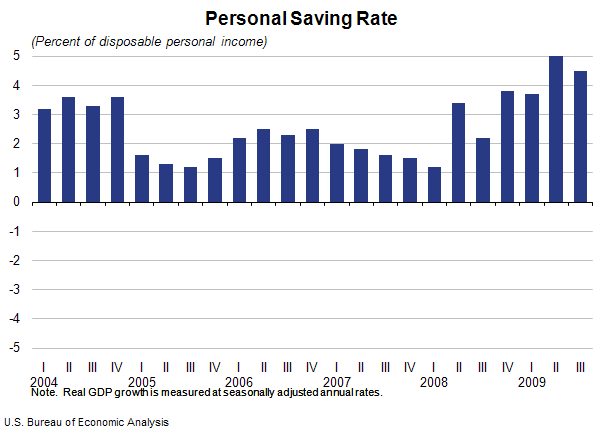
U.S.Personal Saving Rate by Quarter

Source: BEA

The latest edition of Finance and Development magazine from the IMF, has an interesting article titled “Rebalancing Growth in Asia”.

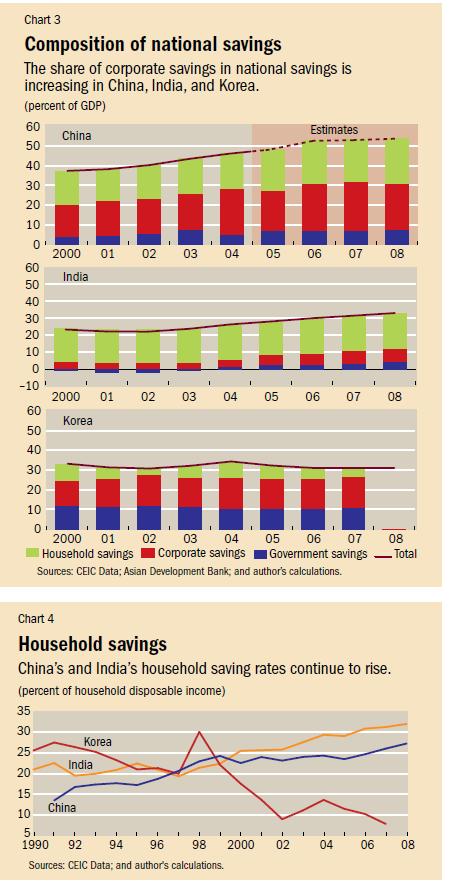
National and Household Savings
Household-saving-Rate-india-China-Korea

The following is a summary of main points about household savings in China, India and South Korea:

  • In India, since the 2000s household savings have remained the major source of national savings, amounting to about 20 percent of GDP
  • In South Korea, household savings has fallen as a percentage of GDP since the 1990s
  • China’s household saving rate reached 28% in 2008 after rising consistently from 1991
  • The household saving rate as a percentage of disposable income in India has increased to an incredible 32% in 2008 from about 20% in 1998
  • South Korea’s saving rate has fallen from about 30% in the 90s to just 7% in 2007

It is interesting to note than during periods of tremendous economics growth in India and China, the household saving rate has increased nicely.This is in sharp contrast to the US where the personal saving rate actually decreased to almost negative levels during the high growth period of the 1990s.

The Banker: Bank of the Year Awards 2009

The Banker Magazine published the Bank of the Year Awards  for 2009 last month. The awards “celebrate the achievements of the most innovative, dedicated, creative, resilient and ambitious banks in each region of the world, and across 144 countries.”

The Global and Regional Awards winners:

Global Bank of the Year – Banco Santander of Spain (STD)

Western Europe – Banco Santander of Spain (STD)

Central & Eastern Europe – UniCredit of Italy

Asia – Standard Chartered Bank of UK

Americas – Itaú Unibanco of Brazil (ITUB)

Middle East – Blom Bank of Lebanon

Africa – Standard Bank Group of South Africa

Some key takeways from the winners report:

Banco Santander owns Alliance & Leicester,Bradford & Bingley and Abbey in the UK, Sovereign Bancorp in the US and Banespa and Banco Real in Brazil. Spain accounts for just 27% of group’s profits.

Unicredit’s member banks in Central and East European countries  such as Turkey, Hungary, Ukraine and Poland stayed profitable despite economic downturns in soem countries.

Standard Chartered continues its growth trajectory in Asia with expansion in Vietnam, Japan, Singapore, Taiwan, Thailand, etc. StanChart has a strong presence in Asia for over 150 years.

As a result of the merger between Itau and Unibanco, Itau Unibanco now has a presence in 1100 Brazilian municipalities, a total of 57 million customers, and branches in 12 foreign markets.

Blom Bank had an impessive financial performance last year and into 2009. This is the first time a bank in Lebanon won the Middle East award. Blom also expanded operations in the Gulf, the Levant and Egypt.

In 2007, Chinese bank ICBC bought a stake in Standard Bank Group. Lasy year net profits were up by a healthy 8% in 2008 and the bank boosted assets by 20% and Tier 1 capital by 40%. The bank conitnues to expand in other developing countries outside of Africa as well.

Knowledge is Power: Shenzen, Britain, Canada Housing Edition

Shenzhen has been at the vanguard of China’s economic reform over the past 30 years as a testing ground for policies later adopted nationwide. A recent crackdown on protests belied the city’s liberal characteristics and Beijing’s swift condemnation suggests it is unlikely to be repeated anytime soon. Shenzhen raises iron fist to protests

Nouriel Roubini has joined the gold naysayers, but Alec Hogg reckons he’d better beware. Gold’s enemies multiplying

He’s a top entrepreneur who recently put all his investments into cash, believing the UK faces bankruptcy. Read James Palumbo’s opinions on the economy…Does Britain face bankruptcy?

Is business turning the clock back to the 1970s?Robert Peston

Greece is in trouble. Swamped by public debt and shunned by international investors, the country has been told by EU leaders to face up to its fiscal crisis on its own. German papers on Friday ask how much fellow Europeans ought to do to help and who is to blame for the mess.‘No One Should Rule Out a Greek Bankruptcy’

China’s economic recovery is gathering momentum, with industrial activity and spending rising. Chinese numbers fire up confidence

Why didn’t Canada’s housing market go bust?James MacGee, a professor at the University of Western…

The Best Banks of Asia by Country

Recently The Asset magazine of Hong Kong published The Country Awards 2009 listing the winners in various categories including the Best Domestic Banks.

The Best Domestic Banks by Country for 2009 are:

China – ICBC
Hong Kong – Hang Seng Bank
Taiwan – Taipei Fubon Commercial Bank
South Korea – Shinhan Bank (SHG)
Australia – No Winner
India – ICICI Bank (IBN)
Pakistan – MCB Bank
Indonesia – Bank Mandiri
Malaysia – Public Bank
Philippines – Bank of the Philippine Islands
Singapore – OCBC
Thailand – Siam Commercial Bank
Vietnam – Asia Commercial Bank

It is not clear why none of Australian banks won the best domestic bank award. For more details checkout the magazine’s site.

The magazine has also published “The Asset Triple A Awards” which lists the best companies in Asia in 3 categories. The list can be found by clicking Top-Companies-Asia-2009 (pdf).

28 US Dividend Stocks from the DJ STOXX Global Select Dividend 100 Index

The Dow Jones STOXX® Global Select Dividend 100 Index tracks the performance of the 100 highest-yielding dividend companies in North America, Asia/Pacific and Europe. Of the 40 stocks from North America, 28 are from the U.S. and the rest are from Canada. Some of the Canadian components in this index include Enbridge (ENB), Bank of Montreal (BMO), Trans-Canada Corp (TRP), National Bank of Canada (NA.TO), etc. In this post, lets take a quick look at the US companies represented in this index.

The 28 US stocks in the  DJ STOXX Global Select Dividend 100 Index and their Current Dividend Yields are shown below:

[TABLE=253]

Altria (MO), CenturyTel (CTL) and New York Community Bancorp (NYB) offer over 7% dividends now. Altria is a favorite stock among many US dividend investors. It expects to maintain a dividend payout ratio of about  75% of net earnings. A $10,000 investment in the stock on January 2, 1970 would have grown to $516,533.33 for a return of 22,216.14% based on the closing price yesterday. The original 277.78 shares would have increased to 26,666.67 split adjusted. (Source: Investment Value Calculator at Altria’s  IR site).

New York Community Bancorp Inc (NYB) is offering 60 Million shares of common stock at $13.00 per share to fund the acquisition of the failed Cleveland,Ohio-based AmTrust Bank. PNC (PNC) and Regions Financial (RF) in the list are not great dividend payers now. Utilities such as Duke Energy (DUK), Consolidated Edison (ED) offer yields above 5%.