The Top 50 Financial Trans-National Companies by Geographical Spread Index

The United Nations Conference on Trade And Development (UNCTAD) publishes the World Investment Report each year. This year’s report contains the top 50 multi-national financial companies based on the Geographical Spread Index (GSI).  The GSI is “calculated as the square root of the Internationalization Index multiplied by the number of host countries. The”Internationalization Index”, is calculated as the number of foreign affiliates divided by the number of all affiliates.”

The Top 50 Financial Multi-National Companies Ranked by Geographical Spread Index:

Click to Expand

Top-50-Global-Financial-TNCs

Note: Assets are in US $ millions
Source: World Investment Report, 2009

The ranking is based on 2008 data. So in the recent months some of these companies have  disappeared due to mergers or acquisitions. ABN Amro of The Netherlands was acquired by a consortium of Royal Bank of Scotland(RBS), Fortis, and Banco Santander(STD) in 2007. It is not clear why ABN Amro is still in the above list. It could be that when this ranking was done ABN Amro still operated as a separate entity in many countries. Last year BNP Paribas of France acquired a majority stake in Fortis of Belgium making the Belgium and Luxembourg governments minority shareholders. During the credit crisis, Merrill Lynch of USA was taken over by Bank of America (BAC), which itself was bailed out by the U.S.  The German lender Hypo Real Estate Holding AG was nationalized by Germany this year.

The global financial landscape has changed dramatically after the crisis last year with many banks writing down billions of dollars of bad assets while others simply do not exist anymore. 2010 may also prove to be another interesting year for the financial sector as many still struggle with further deterioration in the quality of their assets. So it is hoped that investors can use the above list to identify financial companies with global reach.
Ten Emerging Markets Metals & Mining Sector Stocks

The Dow Jones Emerging Markets Metals & Mining Titans 30 Index represents “30 of the largest emerging-market companies in the Industrial Metals & Mining and Mining Sectors.Stocks are selected to the index based on rankings by float-adjusted market capitalization, revenue and net profit.”

The index is up about 135% as of November 30, 2009. Brazilian stocks account for about 28% of the index.

The Top 10 Components of this index are:

Vale (VALE)
Brazil

China Shenhua Energy Co. Ltd.
China

AngloGold Ashanti Ltd. (AU)
South Africa

Norilsk Nickel Mining & Metallurgical Co. (OTC: NILSY)
Russia

Companhia Siderurgica Nacional (SID)
Brazil

Impala Platinum Holdings Ltd. (OTC: IMPUY)
South Africa

Jindal Steel & Power Ltd.
India

Gerdau (GGB)
Brazil

Gold Fields Ltd.(GFI)
South Africa

Grupo Mexico S.A.B. de C.V. (OTC: GMBXF)
Mexico

Top 10 Holdings of one of UK’s Most Popular Funds

The Invesco Perpetual High Income Fund is one of the largest and most popular unit trust (mutual fund) in the U.K. The fund aims to achieve high level of income in addition to capital growth. This fund invests mostly in UK-based companies with the rest invested globally.

At the end of November, 2009 it has total assets of £8.9B or $14.3B.  From its launch date in 1988 this fund continues to be popular with investors for consistent performance. Due to the presence of large number of defensive companies in the fund, the performance has slightly declined recently. But over the 5 and 10 year periods the returns easily beat others in the same fund category.

The Top 10 Holdings of the Invesco Perpetual High Income Fund as of November, 2009 are:

GlaxosmithKline (GSK)
Current Dividend Yield:4.62%

Astrazeneca (AZN)
Current Dividend Yield: 2.52%

BG Group (OTC: BRGYY)
Current Dividend Yield: 1.02%

Vodafone Group (VOD)
Current Dividend Yield: 3.89%

Reynolds American Inc (RAI)
Current Dividend Yield: 6.69%

British American Tobacco (BTI)
Current Dividend Yield: 2.85%

Tesco (OTC: TSCDY)
Current Dividend Yield: N/A

National Grid (NGG)
Current Dividend Yield: 4.40%

BT Group (BT)
Current Dividend Yield: 3.46%

Imperial Tobacco Group (OTC: ITYBY)
Current Dividend Yield: 5.55%

Three of the above picks are tobacco stocks. It is interesting to note that this fund does not have any financials in the top 10 holdings. In fact financials account for less than 10% of the total portfolio.

Five Companies with the Largest Market Cap Gains in this Decade

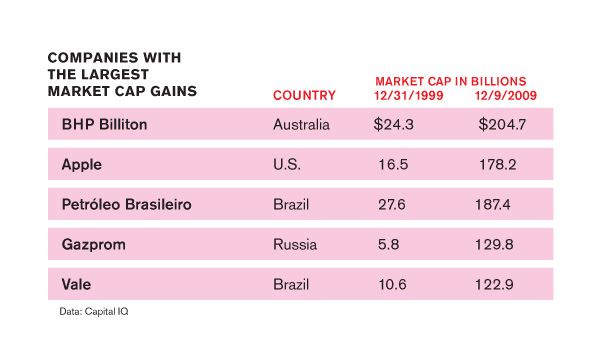
The Numbers section of the latest edition of BusinessWeek magazine lists the five global companies with the largest market cap gains in the past decade.

Top-Mkt-Jumps

Of the five companies listed, two each are energy and mining companies and Apple is a hi-tech powerhouse. The growing prominence of emerging market companies is shown by the presence of the two Brazilian companies and Gazprom of Russia.

I wanted to see how much the common stocks of these companies would have returned had an investor invested in them 5 years ago. The table below shows the returns based on data provided by S&P:

[TABLE=266]

Note: Past performance is no guarantee of future results

Clearly US-based Apple had the best performance growing a $10K investment into $63,315 in just 5 years. Petrobras and Vale also have had incredible runs in the same period. It must be noted that miner BHP Billiton trades on the NYSE as BHP Billiton PLC (BBL) and BHP Billiton Ltd (BHP). The amount noted above is for BBL.

U.S. Should Increase Exports To Avoid Another Recession and Financial Crisis

Howard F. Rosen of The Peterson Institute for International Economics presented a testimony on International Trade to the Senate Finance Committee Subcommittee this month. He argues that “In order to avoid another financial crisis and recession, it is imperative that America produce more than it consumes and increase the amount of goods and services it exports.”

The following are some of the key takeaways from his interesting testimony:

  • Only 4% of the U.S. companies export
  • Just five hundred companies account for 60% of all U.S. exports
  • 58% of exporting companies trade with only one country
  • Exporting firms produce twice as much and employ twice  as many workers as nonexporting companies
  • US exports of Goods and Services account for just over 10% of the GDP. This is much less than the figure for other countries such as China, Canada, Japan, etc. as shown in the table show below:exports.JPG
  • The US economy is dependent on foreign capital due to low household savings and rising government and private debt
  • Since 2000, the US net debtor position has been increasing at a rate of 23% per year which is more than four times the annual growth of the US economy
  • The only way the US can get out of the economic mess is to increase exports significantly
  • Since 1977, we have been consuming more than we produce and hence the gap between consumption and production rose to 5% of the GDP in the last three decades
  • To reduce our dependence on foreign capital, we must increase the national saving rate and reduce the federal budget deficit
  • Printing more money is not an option since it “brings back images of Germany in the 1920s, Hungary immediately after World War II, and Argentina, Bolivia, and Israel during the 1980s, when store prices changed several times a day.”
  • Individuals must reduce their own debt since the total outstanding household debt is $13.7 Trillion, a little less than our Total GDP
  • Increasing exports would create plenty of high-paying and sustainable jobs thereby eliminating the “jobs deficit” currently weighing down the economy
  • Since the US has comparative advantage in many products, we must improve both the quantity and quality of products and services we export
  • Similar to other countries the US should offer more incentives for firms to export. Funding for export promotion efforts must be raised since it fell by an average of 8% every year from 2004 thru 2008