Most American investors have low exposure to foreign equities in their portfolios. There are many reasons for this type of asset allocation strategy. One of them is that financial advisors recommend putting just 10% to 20% of one’s assets in foreign equities. Another reason is due to the “home country bias†inherent in all of us. Americans prefer US-based companies than foreign ones because they know those companies better, those companies advertise heavily in the media, they sponsor community social/charity programs, etc. Some consider it to be even patriotic to invest in US companies.
Some investors think that foreign markets are very risky due to political issues, lack of transparency, accounting methods, lack of publicly available information, currency risks, lack of regulations, etc. While most of these factors are true, in my opinion foreign companies are getting better and are no more riskier than US companies. One can find risky companies anywhere whether it is a bio-tech start-up based in China or a gold miner such as Bre-X in Canada or an IT firm like Satyam based in India. However there are many excellent foreign companies that are as good as any large US company that US investors can consider adding to their portfolios.
The following are Ten Reasons to Invest in Foreign Stocks:
1. Investing globally offers diversification for a portfolio. In this age of globalization diversification is not complete if one invests just in US companies. One can argue that foriegn stocks are not required in a portfolio since about half the earnings of S&P 500 companies comes from overseas revenue. But that does not mean one is diversified enough just putting their money in an index fund tracking the S&P. Overseas companies operate under different dynamics than US companies and the only way to capture their growth is investing in them. As mentioned above, financial advisors also suggest adding some foreign equities for diversification.
2. Going abroad can offer better returns to investors than staying with only US stocks. For example, the S&P500 was up 23.5% last year. But emerging markets such as Brazil, India, Russia, China were all up 82%, 81%,79% and 111% respectively.Among the developed markets, Australia was up 30% , Sweden was up 43% and The Netherlands was up by 36%. Other Western countries such as France, UK, had similar returns like the US S&P500. America’s largest trade partner Canada was up by 30%. The US market performance in the past decade was dismal as I discussed here.
A quick review of Callan’s Chart for developed markets reveal that US stock returns have been average to less than average relative other markets. The S&P 500 was never the top ranking performer among the developed market indices in any year between 1970 to 2005.
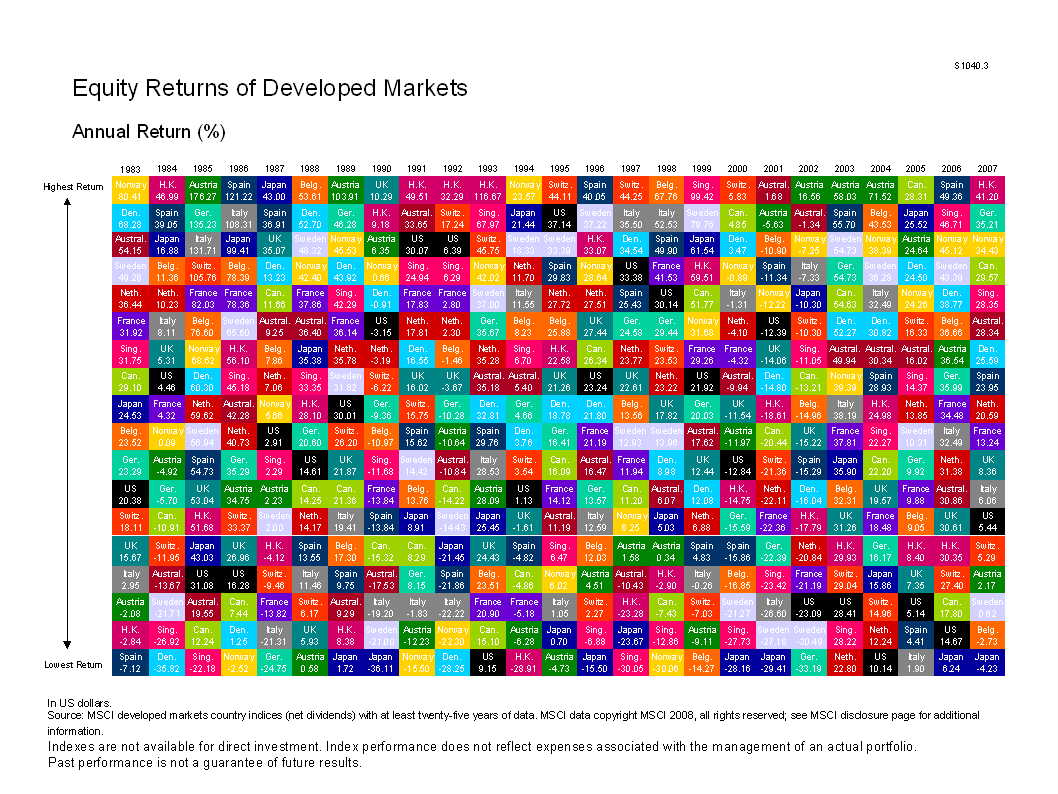
3. Americans already own their homes in the US. Hence they must have higher exposure to foreign markets to counteract the heavy exposure to the U.S. assets. In addition, it is possible that all US-based assets such as homes, stocks and interest rate on bank deposits can all go down at the same time like it occurred since the credit crisis. So investing overseas provides diversification as well as reduces the risk of putting all eggs in the same basket.
4.The US dollar may fall further this year due to sluggish economic growth here. If ones believes in this view, then one can invest in foreign equities as the return on foreign investments will be amplified when currency exchange value is taken into account.
5.The total market capitalization of all the world’s stock exchanges is $45.4 Trillion as of Nov, 2009. The US markets (NYSE and NASDAQ) account for just about $14.5 Trillion.(Source: World Federation of Exchanges). This shows that more capital is flowing to markets outside the US and plenty of investment opportunities exist in other countries.
6. Thousands of publicly listed companies trade outside the US. Out of the total 45,826 listed companies wordwide in November 2009, only 6,066 trade in the US exchanges. That is just 13% of all public companies available for investment.(Source: World Federation of Exchanges). So investors have a large universe of companies to choose from by looking outside the US borders. Many of the world-class companies such as Nokia (NOK), Vodafone(VOD), Toyota(TM), BASF(OTC: BASFY), Nestle(OTC: NSRGY), Unilever(UL, UN), Danone(OTC: DANOY), ABB(ABB), etc. are based in other countries.Some emerging market firms such as Tata Motor(TTM), Petrobras (PBR),Gazprom (OTC: OGZPY), etc. are also turning into global players.
7. Many foreign markets have higher dividend yields than the US S&P 500. The S&P 500 has an average yield of about 3%. In many developed markets such as Singapore, New Zealand, Australia, France, UK, Germany, etc .the dividend yields are higher than 3% with some exceeding 5%. So US investors can earn more by buying foreign stocks.
8. The current estimate for US Economic growth this year is lower than most developed and emerging markets.
9.The current US business management style is not as great as it is hyped up to be. The credit crisis is a classic example that showed that all the risk management controls in companies were ignored by those in charge or simply did not exist.This was true especially in the banking industry.Many large European companies are shareholder friendly and strive to make things better for all the stakeholders in the firm.Sure there were some European firms such as Royal Bank of Scotland(RBS) which abandoned its core principles and let down its investors. But there are many more companies that are well run and are world champions. In emerging countries, managements work harder due to lack or proper infrastructure, political corruption and myriads of other problems in order to attract capital and achieve growth by following sound management techniques. Compared to those companies, I think managers in US companies have become lazy and do not work as hard to better serve their stakeholders. One reason could be the culture that has changed so much in the past few decades leading many executives to worry only about their own earnings, stock options, golden parachutes, etc. than about anything else. Corporate boards have also become complacent in performing their fiduciary duties to the firm.
10. The population in the US is relatively small compared to the population of developing countries such as India and China. In the US, the majority of the working population is experiencing negative to flat growth in income levels compared to rising household income in many countries. Hence the demand for goods and services will go down in the US if the job and income levels do not improve. With their 401K retirement accounts down, mortgages underwater, wiped out home equity and low saving rate it is highly unlikely that that American consumer will do the heavy lifting for the US economy as in the past. This is in sharp contrast to the developing world and most of Europe where the economy is in much better shape.
Earlier:
Why should you invest in Foreign Stocks?
Why Should You Own Dividend Paying Stocks?
Is Global Diversification Dead?
Related: