U.S. Unemployment Varies Significantly Based on Income Levels

The U.S. official unemployment rate was 9.7% in January, 2010. The number of unemployed persons in the country stood at 14.8 million.

The distribution of unemployment among the major worker groups:

Whites= 8.7%
Blacks = 16.5%
Hispanics =  12.6%
Asians= 8.4%
Adult Men=  10%
Adult Women = 7.9%
Teenagers= 26.4%

While the above distribution gives us some indication of unemployment rates among various groups it does not tell us how income levels affect unemployment. For example, it does not tell us which group of workers are the most and least affected.

A recent research paper from Center for Labor Market Studies,Northeastern University, Boston, Massachusetts analyzed the unemployment issue from an income level perspective using the fourth quarter 2009 data . The study showed that jobs losses disproportionally affected American workers.

Charts:

US-Unemployment-Rates-by-Income-Levels

us-ur-declies.JPG

Source: Labor Underutilization Problems of U.S. Workers Across Household Income Groups at the End of the Great Recession: A Truly Great Depression Among the Nation’s Low Income Workers Amidst Full Employment Among the Most Affluent

By Andrew Sum, Ishwar Khatiwada, With the Assistance of Sheila Palma, Center for Labor Market Studies,Northeastern University, Boston, Massachusetts

The following are some of the key takeaways from the study:

  • The total number of unemployed and underemployed has doubled in the last two years
  • Four year college graduates, many managers, government employees,  professionals are well protected from job losses
  • Blue-collar workers particularly in the construction sector, teenagers and black men have higher unemployment rates
  • From the chart above, we  can infer that workers in the top two deciles have unemployment rates of just 4.0% and 3.2%
  • Workers in the lowest decile – those earning $12,499 or less – faced a Great Depression era unemployment rate of about 31% and the second lowest declie had an unemployment rate of about 20%
  • Both Unemployment and Underemployment rates increase dramatically from high income to low income levels

The study above clearly shows that lower-income Americans are affected greatly by the current recession while people at the top of the pyramid have almost negligible unemployment rates. Since the majority of the low-income workers are employed in the service sector, they face a further bleak future as consumer spending is still down. The study confirms that the headline rate unemployment rate of 9.7% is vastly misleading since it is much worse than that for low-income workers. Most of the Wall-Street bankers, government employees and other professionals have escaped this recession unscathed while it is not the same case with the rest of the workers.
Israel: A Leader in High Technology

A new report from Silicon Valley nonprofit groups Joint Venture: Silicon Valley Network and Silicon Valley Community Foundation casts doubt on the future prosperity of the region and mentions that the valley’s innovation engine is at risk.

From a news report:

“Silicon Valley’s innovation engine has driven the region’s prosperity for 60 years, but at the moment we’re stalled,” said Russell Hancock, CEO of Joint Venture, in a statement. “What’s hard to say is whether we’re stuck in neutral, which has happened before, or whether it’s time now for a complete overhaul.”

Like the rest of California, the region has taken a serious hit during the recession. According to the “2010 Silicon Valley Index,” Silicon Valley lost more than 90,000 jobs since 2008, commercial vacancy rates jumped 33 percent, and more than 14,000 homes were foreclosed on.

Moreover, the region’s companies aren’t able to attract the same numbers of talented foreign workers, which it called Silicon Valley’s “lifeblood,” according to the report. And the number of foreign students receiving degrees stateside in science and engineering has been steadily declining since 2003.”

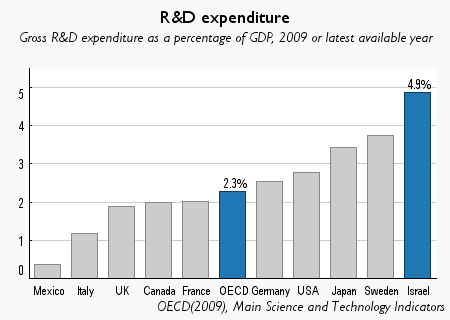
While the Silicon Valley and other regions of high tech innovation in the U.S. are struggling, start-ups are  flourishing in Israel. In the past few decades Israel has become a leader in the hi-tech field. According to some estimates, Israel has a higher density of start-ups than any other country in the world. One of the main reason for this high rate of success is the amount spent on R&D by Israel.

Israel-RD

Source: High-Tech Israel, OECD

Israel spends about 5% of its GDP on R&D, the highest among OECD countries and  more than double the OECD average of 2.3%. It is interesting to note that the U.S. lags Israel, Sweden and Japan in R&D spending.

Ten Reasons to Invest in Chile

After Brazil, Chile is the one of the attractive destination for overseas investors.  While Chile’s economy is primarily a commodity-based economy, there are many other factors that favor Chile.

From a recent report by OECD:
“Chile has managed the crisis better than other small open economies ,” said OECD Secretary-General Angel Gurría. “Thanks to sound fiscal policies and good monetary policy management during the boom years, there was room for decisive stimulus measures which are now proving their worth.”

The following are some of the reasons to invest in Chile:

  1. Chile is on its way to become the 31st member of OECD
  2. The economy is expected to grow 4.1% this year and 5.0% in 2011
  3. Chile has low debt
  4. In 2009, Chile was number 5 in the Economic Freedom of the World Report, ahead of the U.S.
  5. Corruption is very minimal
  6. Chile has a liberal capital market and stable financial system
  7. Follows free trade economic policies
  8. Last month, Sebastian Pinera, the country’s first democratically elected conservative leader in more than half a century was elected
  9. Chile is the largest producer of copper in the world
  10. The Total Government Expenditure is low

The easiest way to invest in Chile is via the iShares Chile ETF (ECH). Financials constitute under 10% in this ETF. The fund has an asset base of $380M and has 32 holdings. Another way to invest is to pick some of the Chilean ADRs trading in the US markets. The list of Chilean stocks can be found here.

11 Hi Dividend Yield, Hi Dividend Growth Rate Foreign Stocks

When picking dividend stocks, in addition to an attractive dividend yield it is important to select stocks that have high annual dividend growth rate.These two factors will give a better picture about the stocks than going with just the yield alone.

The following foreign stocks satisfy the two conditions:

Dividend Yield = > 2%
Average Annual Dividend Growth Rate in the past 5 years = > 10%

1.Endesa-Empresa Nacional de Electricidad (EOC)
Chile
Current dividend yield: 2.23%
Average Annual Dividend Growth Rate: 36%

2.Enersis (ENI)
Chile
Current dividend yield: 2.24%
Average Annual Dividend Growth Rate: 14%

3.National Grid (NGG)
UK
Current dividend yield: 4.56%
Average Annual Dividend Growth Rate: 13%

4.Veolia Environnement (VE)
France
Current dividend yield: 5.15%
Average Annual Dividend Growth Rate: 17%

5.Bancolombia (CIB)
Colombia
Current dividend yield: 2.76%
Average Annual Dividend Growth Rate: 34%

6.Corpbanca (BCA)
Chile
Current dividend yield: 4.84%
Average Annual Dividend Growth Rate: 26%

7.Bank of Novo Scotia (BNS)
Canada
Current dividend yield: 4.16%
Average Annual Dividend Growth Rate: 12%

8.Bank of Montreal (BMO)
Canada
Current dividend yield: 5.13%
Average Annual Dividend Growth Rate: 12%

9.Royal Bank of Canada (RY)
Canada
Current dividend yield: 5.33%
Average Annual Dividend Growth Rate: 15%

10.City Telecom (CTEL)
Hong Kong
Current dividend yield: 7.56%
Average Annual Dividend Growth Rate: 16.12%

11.Portugal Telecom (PT)
Portugal
Current dividend yield: 7.34%
Average Annual Dividend Growth Rate: 27.60%

Note: Data noted above is believed to be accurate. Please do your own research before making any investment decisions.