Ten Highest Dividend Paying Stocks from the Eurozone Countries

The Dow Jones EURO STOXX Select Dividend 30 Index consists of the 30 high-dividend-yielding companies of the Eurozone. The Eurozone countries include Austria, Belgium, Finland, France, Germany, Greece, Ireland, Italy, Luxembourg, the Netherlands, Portugal and Spain.

The ETFlab DJ EURO STOXX® Select Dividend 30 ETF tracks the performance of the above index.  The Top 10 holdings in this ETF are:

1. Banco Santander (STD)
Current Dividend Yield: 5.36%
Spain

2.Vallourec
France

3. Erste Group Bank (OTC: EBKDY)
Current Dividend Yield: 2.27%
Austria

4. Metso Oyj (OTC: MXCYY)
Current Dividend Yield: 3.04%
Finland

5. Wartsila OYJ
Finland

6.Banco Popular Espanol
Spain

7. Unilever NV (UN)
Current Dividend Yield: 1.77%
The Netherlands

8. Bilfinger Berger AG
Germany

9. Enel Spa (E)
Current Dividend Yield: 6.08%
Italy

10. Wereldhave nV
The Netherlands

Please note that the dividend yields are noted only for the companies that trade as ADRs in the US markets.
30 S&P 5-STARS Rated Stocks

The S&P’s Platinum Portfolio consists of the top rated stocks from the Standard & Poor’s Fair Value Portfolio and its Stock Appreciation Ranking System (STARS). To be eligible in this portfolio, all stocks must carry a 5-STARS rating and a Fair Value Ranking of 5.

The table below lists the 5-STARS rated stocks in the portfolio as of February 19th:

[TABLE=399]

New York Community Bancorp (NYB) currently has a dividend yield of 6.40%. With the purchase of AmTrust Bank of Cleveland, Ohio the bank is expanding from its traditional footprint to Ohio, Arizona and Florida. The food products company General Mills (GIS)  and the world’s largest retailer Wal-Mart (WMT) are also in this list.

Stocks Outperform Bonds in the Long Run

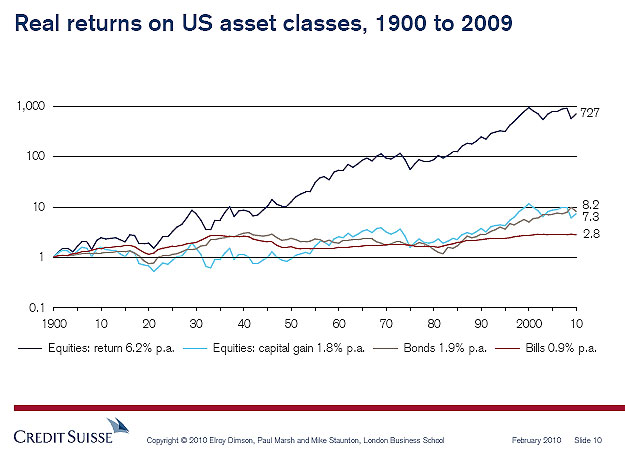
The 2010 edition of the Credit Suisse Global Investment Returns Year Book confirms that equities outperform bonds over the long term. The chart below shows the performance of U.S. stocks, bonds and T-bills from 1900 thru 2009:


US-Market-Returns-1900-2009


A $1,000 invested in U.S. equities in 1900 would be worth $727,000 now. This number is adjusted for inflation. The real rate of return equals to 6.2% which is very good. However it must be noted that the majority of the returns came from dividend reinvestment and not capital appreciation. Capital gains accounted for just 1.8% per year.This study proves again the importance of investing in dividend paying stocks and dividend reinvestment. When compared to stocks, the rate of return on bonds and T-bills is very low.

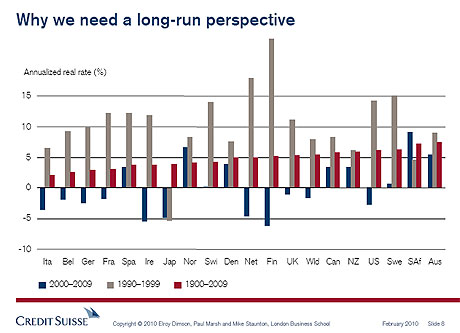
The following graphic shows the rate of return for equities over different time periods:


Stock-Returns-Comparison

Source:  Credit Suisse Global Investment Returns Year Book 2010

14 Cheap International Closed-End Funds

The Wall Street Journal’s Jason Zweig has written an interesting article on the risks of high yields paid by closed-end funds. Closed-end funds trade like stocks and are considered cheap when they trade at a discount to their NAVs. They trade at a premium if the market price is more than their NAV. Closed-end funds can be extremely volatile especially during tough market conditions.

Jason Zweig mentions three funds which recently traded at a high premium and whose high yields may be unsustainable. The three funds noted are:

Pimco Global StocksPLUS & Income Fund (PGP)
Pimco High Income Fund(PHK)
Gabelli Utility Trust (GUT)

Investing in closed-end funds just for high yields is risky. However they can be considered for gaining some diversification in a portfolio.

The following 14 International Closed-End Equity Funds trade at a discount of at least 10% to their NAVs:

1. The Central Europe & Russia Fund (CEE)
Current Premium/Discount: -11.83%

2. Morgan Stanley Eastern Europe Fund (RNE)
Current Premium/Discount: -10.04%

3. The Mexico Fund (MXF)
Current Premium/Discount: -12.23%

4. First Israel Fund (ISL)
Current Premium/Discount: -10.05%

5. Korea Equity Fund (KEF)
Current Premium/Discount: -10.90%

6. First Trust/Aberdeen Emerging Opportunity (FEO)
Current Premium/Discount: -11.44%

7. Clough Global Equity (GLQ)
Current Premium/Discount: -13.88%

8. Clough Global Opportunities (GLO)
Current Premium/Discount: – 13.07%

9. The Thai Fund (TTF)
Current Premium/Discount: -15.55%

10. The Malaysia Fund (MAY)
Current Premium/Discount: -14.08%

11. The Taiwan Fund (TWN)
Current Premium/Discount: -11.53%

12. The Thai Capital Fund (TF)
Current Premium/Discount: -17.01%

13. Morgan Stanley Frontier Emerging Market Fund (FFD)
Current Premium/Discount: -13.91%

14. Emerging Markets Telecommunications Fund (ETF)
Current Premium/Discount: -12.30%

Source: CEFA

Ten Promising Agribusiness Stocks

The S&P Agribusiness North America Index consists of 24 largest publicly-traded agribusiness companies that are either Producers, Distributors & Processors and Equipment & Materials Suppliers in this sector.

The Constituents in this Index must meet the following criteria:

  • Trade on the U.S. and Canadian exchanges including ADRs
  • Have minimum market capitalization of US$ 500M at re-balancing time
  • A six-month average daily trading value above US$ 2 million

The Top 10 components in the S&P Agribusiness North America Index are:

1. Bunge Ltd (BG)
Country: USA
Current Dividend Yield: 1.34%

2.Archer-Daniels-Midland Co (ADM)
Country: USA
Current Dividend Yield: 2.00%

3. Potash Corp (POT)
Country: Canada
Current Dividend Yield: 0.35%

4.Monsanto Co (MON)
Country: USA
Current Dividend Yield: 1.36%

5.Syngenta (SYT)
Country: Switzerland
Current Dividend Yield: 2.00%

6. The Mosaic Co (MOS)
Country: USA
Current Dividend Yield: 0.33%

7.Hormel Foods (HRL)
Country: USA
Current Dividend Yield: 2.02%

8.Deere & Co (DE)
Country: USA
Current Dividend Yield: 1.96%

9.Tyson Foods (TSN)
Country: USA
Current Dividend Yield: 0.94%

10. Perdigao SA
Perdiagao and Sadia merged to form BRF Brasil Foods (BRFS)
Country: Brazil
Current Dividend Yield: N/A

In the U.S., the BLS reported that prices of dairy and related products, fruits and vegetables rose sharply last month contributing to a rise in the food consumer price index. In Asia food price increases are pushing inflation higher.

Chart:

Asia-Food-Inflation

Source: WSJ

Prices of food staples such as rice, milk, and sugar have been rising in recent months. Other food items such as  fruits, vegetables and cooking oils have also been increasing in some countries. Countries such as India, China, Thailand and Indonesia are battling with rising food price inflation. With huge populations, India and China are particularly vulnerable if prices escalate further. Agribusiness stocks offers good investment choices for investors now especially since some economists are talking about a double-dip recession. Food stocks tend to offer stable growth and withstand downward pressure in falling markets. While consumers may cut down on discretionary spending, they still have to spend on necessities such as food, utilities, etc.