Forget Emerging Markets and Choose Frontier Markets in 2010?

While many of the investors are focused on the emerging markets, some brave and sophisticated investors are looking beyond the horizon and venturing into the frontier markets. Some examples of  the frontier markets are Saudi Arabia, Kuwait, Morocco, Algeria, Lebanon, Colombia, Vietnam, etc.

The prevailing low interest rates in many countries around the world and the rising demand for commodities are two of the reasons that are advantageous to frontier markets.  For example, rising crude oil and natural gas prices are benefiting Kazakhstan. Saudi Arabia, Qatar, Nigeria, Oman and Kuwait are profiting from higher crude oil prices.

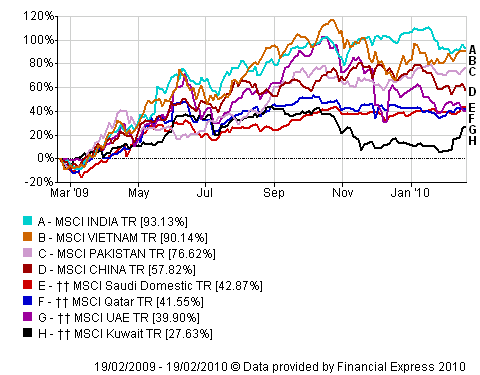
The performance of a select few frontier markets and India, China are shown in the following chart:

frontier-markets

A recent research report noted:

Mark Mobius, executive chairman of Templeton Asset Management believes frontier markets represent some of the best contrarian investments at the moment.

Mobius, who manages a number of emerging markets portfolios at Franklin Templeton, considers countries such as Vietnam, Pakistan, Bangladesh and Romania as ones to watch this year. He says he currently favors commodity and consumer orientated stocks. Qatar, Kazakhstan and Nigeria are being watched because of their natural resources.”

A huge bubble is forming in the emerging markets of India and China especially in the real estate sector. This does not portend well for the future. The real estate bubble in the US lead to the credit crisis bringing the global economy to its knees. Hence it may be the time to explore some of the frontier markets. However frontier markets are not for the faint-hearted. So extreme caution is needed before jumping into any of these markets. Equities in frontier markets may be highly illiquid and information may not readily available to evaluate companies.

Some of the Frontier Market ETFs include:

Claymore/BNY Mellon Frontier Markets ETF (FRN)
Market Vectors Gulf States ETF (MES)
Market Vectors Africa ETF (AFK)
Market Vectors Vietnam ETF (VNM)
WisdomTree Middle East Dividend Fund (GULF)
SPDR S&P Emerging Middle East & Africa ETF (GAF)

U.S. Healthcare System – Is it Any Better ?

We have discussed about the U.S. healthcare system before a few times. On Thursday, the President hosted a day-long televised healthcare summit. It ended without a deal after many hours of bickering by both the parties. Its been more than a year since the President took office and yet the healthcare debate still rages on this country with no end in sight. Thousands of  hours have already been wasted by all those involved including lobbyists, politicians, company executives, media pundits, etc. discussing the pros and cons of the health care reform proposals.

From a BBC news report today:

“The president and his allies want to expand health coverage to include millions of uninsured Americans.

Republicans said his plans were not acceptable and called for a fresh start.

In his radio address, he said he remained “eager and willing to move forward with members of both parties”.

“It’s time for us to come together. It’s time for us to act.

“It’s time for those of us in Washington to live up to our responsibilities to the American people and future generations. So, let’s get this done.”

None of the proposals put forward by the administration or the Republicans addresses some  the key issues that should be the main points of any discussion of the U.S. healthcare system. Two of them are the soaring costs and the inefficiencies in the current system.

The chart below shows the comparison of some of the healthcare factors between the U.S. and a few other countries:

us-healthcare-comparison.JPG

Source: WHO data via The Guardian

The  U.S. spends the highest on a per capita basis on healthcare and has only 26 doctors per 10,000. Germany spends a bit above half the US spending and still has more doctors, hospital beds and a higher life expectancy. There is a precipitous drop in per capita spending from the U.S. figure to the next highest spending country Canada. Japan also spends much lesser than the U.S. and yet the Japanese have a higher life expectancy, more midwives and hospital beds. Clearly the U.S. healthcare system needs a much complete and thorough analysis and redesign than the ones currently under discussion.

Credit Suisse: 27 Great Brands of Tomorrow

The Credit Suisse Research Institute released the 27 Great Brands of Tomorrow that have the potential to outperform the market in the next 3-5 years. Their research shows that “Strong brand companies have consistently generated out-sized long-term growth and returns for shareholders.”

The 27 “Great Brands of Tomorrow” are:

  1. Alibaba.com
  2. Almarai
  3. Amazon (AMZN)
  4. Apple (APPL)
  5. BIM
  6. Capitec
  7. China Merchants Bank
  8. Commercial Aircraft Corporation of China
  9. Enfamil (MJN)
  10. Facebook
  11. Hyundai Motor
  12. Indian Hotels
  13. Julius Baer
  14. Li Ning
  15. Mahindra & Mahindra
  16. MercadoLibre
  17. Mercedes-Benz
  18. Polo Ralph Lauren
  19. Sonova Holding
  20. Swatch
  21. Tiffany & Co (TIF)
  22. Tingyi
  23. Trader Joe’s
  24. Tsingtao Brewery (OTC: TSGTY)
  25. Under Armour (UA)
  26. Uniqlo
  27. Yakult Honsha

Some of the companies that own the brands listed above are expanding into regions where they did not have a big presence before. For example, DaimlerChrysler (DCX) the owner of the global luxury brand Mercedes-Benz is now focusing on emerging markets where the demand for luxury products is growing. Last month the company announced that the sales of its high-end Mercedes-Benz autos in China shot up by 77% in 2009 compared to 2008. Simiarly Mahindra & Mahindra of India is slowly expanding in the US market with its cheap but high quality tractors for the farming industry. Mahindra & Mahindra is coompeting against established American player Deere & Co (DE).

New Site Feature: Stock Lists

Recently we have added a “STOCK LISTS” tab on this site. The tab is on top of the site shown below:

dsds.JPG

In this tab, we plan to add lists of stocks by sector so that it is easier for investors to access all stocks in a sector in one place. The stocks are listed in table format and are linked to Yahoo Finance. For example, all Railroad stocks are listed in one table for easier access. It must be noted that these lists include stocks from both the US and other countries traded in the US exchanges.

A sample of the stock lists already posted are as follows.

Stocks Trading on the New York Stock Exchange:

  1. The Complete list of Electric Utility Stocks
  2. The Complete list of Drug Stocks
  3. The Complete list of Coal Stocks
  4. The Complete list of Consumer Staple Stocks
  5. The Complete list of Railroad Stocks
  6. The Complete list of Food Stocks
  7. The Complete list of Trucking Company Stocks
  8. The Complete list of Water Utility Stocks
  9. The Complete list of Air Courier stocks
  10.  The Complete list of Airline stocks

Currently we have stock lists by sector. More types of lists will be added soon.

The Five Best and Worst Performing Latin American ADRs YTD

With two months over for the equity markets lets take a quick look at the leading and lagging Latin American ADRs from a performance perspective.

The five best performing Latin American ADRs YTD as of 2/26/10:

1. Banco De Chile (BCH)
Country: Chile
Sector: Banking
YTD Change: 15.01%

2. GRUMA (GMK)
Country: Mexico
Sector: Food Producers
YTD Change: 13.34%

3. Nortel Invesora (NTL)
Country: Argentina
Sector: Fixed Line Telecom
YTD Change: 13.13%

4. Vina Concha y Toro (VCO)
Country: Chile
Sector: Beverages
YTD Change: 12.44%

5. Ecopetrol (EC)
Country: Colombia
Sector: Integrated Oil & Gas
YTD Change: 10.92%

The five worst performing Latin American ADRs YTD as of 2/26/10::

1. Cemex (CX)
Country: Mexico
Sector: Construction & Materials
YTD Change: -19.12%

2. Fibria Celulose S.A. (FBR)
Country: Brazil
Sector: Forestry & Paper
YTD Change: -19.66%

3. Grupo TMM (TMM)
Country: Mexico
Sector: Industrial Transportation
YTD Change: -20.21%

4.  Brasil Telecom (BTM)
Country:Brazil
Sector: Fixed Line Telecom
YTD Change: -33.33%

5. Centrais Eletricas Brasileiras-Eletrobras (EBR)
Country: Brazil
Sector: Electricity
YTD Change: -38.36%

Banco De Chile (BCH) is the top performer with a return of 15% YTD. BCH is consistent high dividend payer and the current yield is 6.57%. The next dividend payment is $3.90 with a record date of March 19th and a pay date of April 6, 2010. Ecopetrol (EC) of Colombia has a dividend yield of 5.62%. For the full year 2009,  the company increased production of crude oil and natural gas by 17% from 2008 and sales volume rose by about 19% compared to 2008. Cement and construction materials maker Cemex(CX) announced disappointing quarterly results in January.