Knowledge is Power: Big Gold,China, Debt Doom Edition

Special report: Are the days of “big gold” over? As cash pressures mount, gold majors move to mine the markets, which are proving more lucrative than the mining of gold.

Built on a Lie – The Fundamental Flaw of Europe’s Common Currency

A new forecast from RBC Economics says Canada’s economy is poised for real GDP growth of 3.1 per cent this year and 3.9 per cent in 2011. Canadian economy ready for major rebound, RBC says

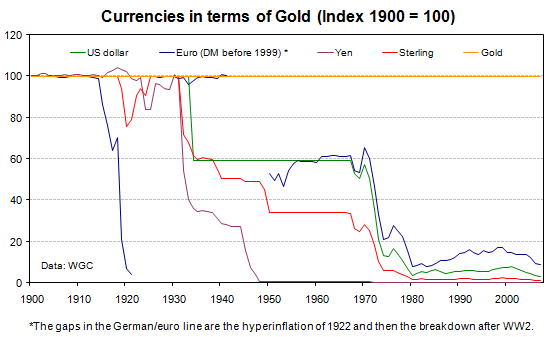
Debt doom ahead US Congressional Budget Office figures, showing how horrendously large the national debt will become, indicate that the United States economy will be 71% bigger within 10 years. If everything costs twice as much by then, why not? And the only people better off will be those who are buying gold now!!!

China showing signs of overheating

CHINA’S industrial output has hit a five-year high, adding to the case for the Government to pare back stimulus measures.

Can the Chinese Renminbi Replace the US Dollar as the World’s Reserve Currency?

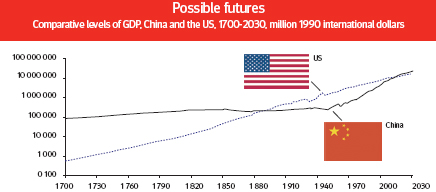
China was the world’s largest economy before 1890. According to Professor Angus Maddison, author of the Chinese Economic Performance in the Long Run, China’s role in the world has changed dramatically in the last thousand years and China is likely to become the world’s largest economy by 2015 beating the US. The author mentioned that China’s economic growth in the next 30 years will not be diminished due to the recent global credit crisis.

The graph below shows the possible futures for the economies of China and the US:


US-China-GDP-Comparison

Source:  Towards a new reserve currency system?, OECD Observer

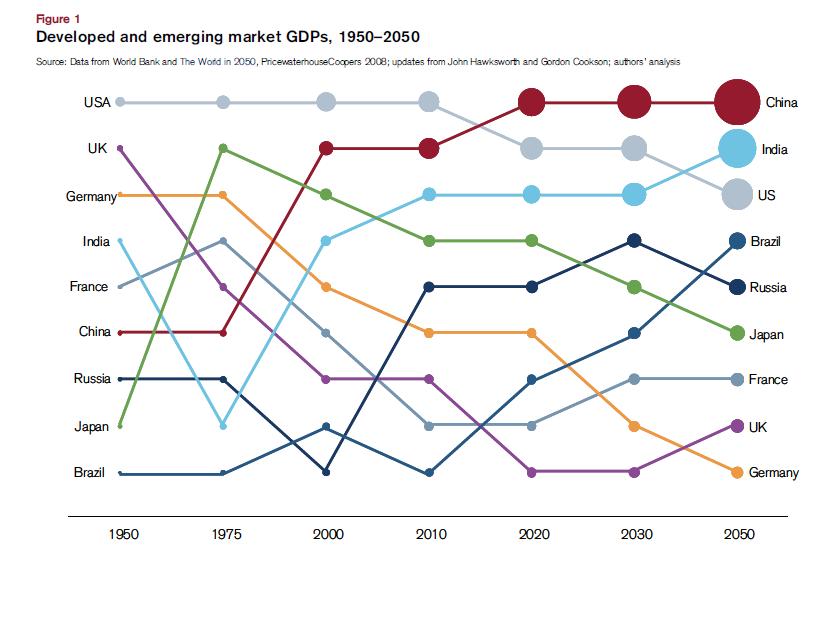
Chart showing the projected growth of GDP in Developed and Emerging Markets thru 1950:

Developing-Emerging-Markets-GDP-Comparison

After the World War II, the US dollar dethroned the British sterling to become the world’s reserve currency. The dollar accounts for about two-thirds of the global reserves and 88% of daily foreign exchange trades.

From the OECD Observer article noted above:

The additional demand for dollars has generated “seigniorage” revenues: in 2008 the US Fed made a net interest income of $43 billion from issuing the currency, which as The Economist newspaper once put it, effectively makes US dollars in global circulation an interest-free loan by the public to the nation’s central bank.”

Empires based on currency rise and fall according  to Professor Avinash Persaud. In his 2004 speech titled “When Currency Empires Fall”  he noted the following:

“There are good reasons why there is seldom more than one dominant currency. Reserve currencies have the attributes of a natural monopoly or in more modern parlance, a network. If it costs extra to trade with some one who uses a different currency than you, it makes sense for you to use the currency that most other people use, this makes that currency yet bigger and cheaper to use. There is a good analogy with a computer operating system. In that world, Windows is the dollar.

This networking power is why Central banks store dollars in their reserves in a far greater proportion than the proportion of trade with the US. While 30% of international trade is with the US, 70% of central bank reserves are in dollars. It is why most commodities, like oil, copper and coffee are priced in dollars, wherever they are found and whoever they are sold to.

Something else we can be more certain of is that reserve currencies come and go. They don’t last forever.  International currencies in the past have included the Chinese Liang and Greek drachma, coined in the fifth century B.C., the silver punch-marked coins of fourth century India, the Roman denari, the Byzantine solidus and Islamic dinar of the middle-ages, the Venetian ducato of the Renaissance, the seventeenth century Dutch guilder and of course, sterling and now the dollar.

A necessary condition of a currency becoming a reserve currency appears to be its breadth of use and cost and ease of transaction, not, as some might think, the ability to hold its value. Clearly hyperinflation would not serve a reserve currency, and the end of reserve currency status is often associated with a cycle of inflation. But within the normal bands of inflation, it is size as a trader that matters. In the long-term, the Swiss franc and yen have been better stores of value than the dollar. Since 1980, they have appreciated by more than 21% and 54% versus the dollar respectively. Yet for much of this time, combined, they have represented no more than 10% of central bank reserves.

In the 18th century Britain was the largest economy of the western world, London was the centre of international trade and finance, the currency was convertible and so sterling became the world’s reserve currency. By the late 19th century, the US had become the world’s largest economy, a position solidified by Europe’s repeated attempt at self-annihilation from the 1880s to the 1940s. By the 1960s, the dollar had usurped sterling and was the world’s new reserve currency with 60% of total central bank reserves being held in dollars, twice the level of sterling reserves.

But time doesn’t stop. By the mid-21st century, the US will no longer be the world’s largest economy. By then, China and India will have overtaken the US, western Europe and Japan, on purchasing power parity terms at least, which should represent where exchange rates are likely to be in the long-run. Indeed optimistic measures of sustainable growth in China and India suggest this will be the case in twenty years time. Ladies and gentlemen, within my life time, the dollar will start to lose its reserve currency status, not to the euro, but to the renminbi.

According to the latest Treasury data, the Chinese hold $ 894.8 billion of US Treasury securities as of December 2009. China is the largest creditor nation in the world while the US is the largest debtor nation. The Chinese renminbi may become the global reserve currency by 2050 since its economy in terms of purchasing power parity is projected to outstrip the US economy. However China has to make its currency fully convertible, remove restrictions on foreign capital entering and leaving the country, accelerate financial reforms before the renminbi can become the world’s currency of choice.

Related:

The Rise of the Renminbi: Will China’s Yuan Become a Global Reserve Currency?, July 23, 2015, Mark Mobius

The World’s Best Developed Market Banks 2010

Last month the Global Finance magazine announced the awards for the best banks in the developed world for this year. The winners were selected in 25 countries excluding Ireland and Iceland.

From the magazine report:

“All selections were made by the editors of Global Finance, after extensive consultations with bankers, corporate financial executives and analysts throughout the world. In selecting these top banks, we considered factors that range from the quantitative objective to the informed subjective. Banks were invited to submit entries supporting their selection. Amid nominally objective criteria were growth in assets, profitability, geographic reach, strategic relationships, new business development and innovation in products. Subjective criteria included the opinions of equity analysts, credit rating analysts, banking consultants and others involved in the industry.”

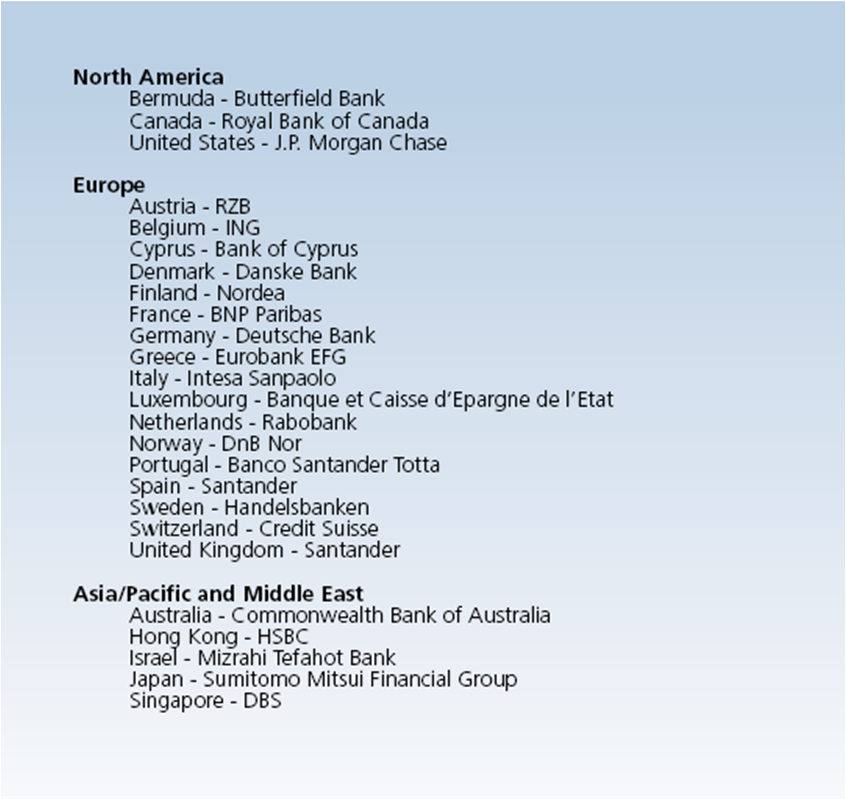
The World’s Best Developed Market Banks for 2010 are:

The-Best-Developed-Market-Banks-2010

Source: Global Finance

Among the banks in the U.S., one of the four supers JP Morgan Chase (JPM) was ranked the best bank. After last year’s low in March Chase has rebounded well and closed at $42.81 yesterday.Royal Bank of Canada(RY), the winner from Canada has a 3.45% dividend yield now.The bank is a consistent long-term performer.

Some of the notable top ranked banks in Europe were ING(ING) of Belgium, Danske Bank (OTC: DNSKY) of Denmark, BNP Paribas(OTC: BNPQY) of France and Deutsche Bank(DB) of Germany. Santander(STD) of Spain was the winner in both Spain and the UK.

Santander rebranded the British banking brands Abbey National, Alliance & Leicester and Bradford & Bingley under the Santander name this year.Santander has about 1,300 branches in the UK. While its competitor Societe Generale(OTC: SCGLY) is still suffering from losses, BNP Paribas survived the credit crisis and remains strong. Its fourth quarter earnings more than doubled but the bank raised its dividend  by 50%.

DBS Group Holdings (OTC: DBSDY) of Singapore currently pays a 3.99% dividend.

10 Leading Swiss Companies

The Dow Jones Switzerland Titans 30 Index tracks the performance of 30 leading stocks in traded in Switzerland. The stocks in this index are selected based on float-adjusted market capitalization and average trading volume.

The Top 10 components in the Dow Jones Switzerland Titans 30 Index are:

1. Company: Novartis AG (NVS)
Sector: Health Care
Current Dividend Yield: 3.66%

2. Company: Nestle S.A. (OTC: NSRGY)
Sector: Consumer Goods
Current Dividend Yield: 2.45%

3. Company: Roche Holding AG (OTC: RHHBY)
Sector: Health Care
Current Dividend Yield: 3.24%

4. Company: ABB Ltd (ABB)
Sector: Industrials
Current Dividend Yield: 2.10%

5. Company: Credit Suisse Group (CS)
Sector: Financials
Current Dividend Yield: 0.20%

6. Company: UBS AG (UBS)
Sector: Financials
Current Dividend Yield: N/A

7. Company: Zurich Financial Services AG (OTC: ZFSVY)
Sector: Financials
Current Dividend Yield: 3.99%

8. Company: Syngenta AG (SYT)
Sector: Basic Materials
Current Dividend Yield: 1.95%

9. Company: Compagnie Financiere Richemont S.A.
Sector: Consumer Goods
Current Dividend Yield: N/A

10. Company: Holcim Ltd (OTC: HCLMY)
Sector: Industrials
Current Dividend Yield: N/A

Nestle(ABB) is the world’s largest food company with a strong presence in many emerging markets. Nestle is also the owner of some of the most popular brands in the world like Nescafe, Nesquik, Milo, etc. For 2009, the company earned $9.58B. Last month Nestle announced plans to increase its dividend by 14.3% and buy back shares worth 10 billion Swiss francs this year.ABB (ABB) is a global provider of power and automation equipments and services to utilities and other industrial customers. It is a major player in countries like India, China, Brazil, etc where there is a strong buildup in infrastructure. In the fourth quarter of 2009, revenues fell to $8.76B but profit more than doubled to $540M.

Will Singapore Stocks Shine This Year?

The city state of Singapore was not affected severely during the financial crisis and is now well positioned to benefit from a rebound in the global economy. The seasonally adjusted unemployment rate for December 2009 was just 2.1%. As a major hub for international trade and commerce, for January this year total trade was up 33.2% and the industrial production was also up significantly. Tourist arrivals increased about 18% in January compared to the same month last year (Source: Statistics Singapore).

Singapore-Casino

Resorts World Sentosa Casino, Singapore (Courtesy: Malaysia Finance)

The government of Singapore is famous for its forward-thinking and enacting policies that are growth-oriented. One of its visions was to transform Singapore into an entertainment mecca in Asia and attract visitors from the around the world especially from the fast-growing markets of China, India, etc. As part of this initiative, the country allowed the building of its first casino a few years ago. Resorts World Sentosa is an integrated complex that includes a casino, an Universal Studios theme park, hotels, shopping plazas, etc. The casino opened its doors on Feb 14th, the first day of the Chinese Year of the Tiger. Another casino resort named Marina Bay Sands and built by Las Vegas Sands is  slated to be opened soon in the downtown business district. Once both the casinos are fully operational,  they are projected to earn $2.1B in revenues this year according to CLSA Asia-Pacific markets. Most of the visitors are expected to be from overseas mainly from China as the casinos will charge a S$100 entrance fee for each 24 hours for Singaporeans.

In order to prevent over-growth of population and to protect local wages Singapore announced proposals last week to curtail immigration. Overall Singapore is in a relatively better shape compared to other developed countries. The opening of casinos and the theme park should provide additional growth to the local economy.

The iShares MCSI Singapore Index Fund (EWS) tracks the performance of the Singapore equity market.There are 30 holdings in the portfolio and the fund has total assets of about $1.5B. Two of the leading Singapore banks are United Overseas Bank (OTC: UOVEY) and DBS Group Holdings (OTC: DBSDY). Both the banks are well capitalized and have a large presence in other Asian countries as well. To answer my title question, Singapore stocks should perform well if the global economic recovery continues.