39 S&P MidCap 400 Constituents Yielding Over 4% Dividends

The S&P 400 MidCap Index measures the performance of U.S. mid-size companies with market caps from about $2billion to $10 billion. The stocks in this index are selected based on market cap, liquidity and industry representation.

In terms of performance the index is up 7.3% YTD. The annualized 5-year return is 5.4%. The average market cap of the constituents is $2.39B and the market cap of the largest constituent is $7.40B. Similar to the S&P 600,the top five sectors represented in this index are: information technology, consumer discretionary, consumer staples, health care and industrials.

The following S&P MidCap 400 Constituents pay over 4% dividends as of May 6, 2010:

[TABLE=492]

Some of the ETFs that track the S&P 400 include the iShares S&P SmallCap 400 Index ETF(IJH) and the SPDR S&P MidCap 400 ETF(MDY).

Note: Information posted above is known to be accurate. Please do your own reasearch before making any investment decisions.

18 S&P SmallCap 600 Stocks Paying More Than 5% Dividends

The S&P SmallCap 600 Index covers approximately 3% of the domestic equities market.The constituents of this index are selected based on market capitalization and other criteria to ensure they are investable and financially viable. Since the small cap universe is made of up of stocks that are known for poor trading liquidity and financial instability, the SP 600 components are much better than others.

In terms of performance, the S&P 600 is up 8.9% YTD. The average constituent market cap is $0.73 B.Consumer discretionary, consumer staples, information technology, health care and industrials form the top five sectors in this index.

The following S&P Small 600 stocks pay more than 5% dividend as of May 6, 2010:

[TABLE=491]

For investors that prefer an ETF for investing in small caps, the iShares S&P SmallCap 600 Index (IJR) is one option.

Equity Performance: Small Caps Easily Beat Large Caps

In my December 2009 article A Lost Decade for U.S. Stocks, I mentioned that the S&P 500 lost 23% from Dec 31, 1999 through Dec. 14, 2009.

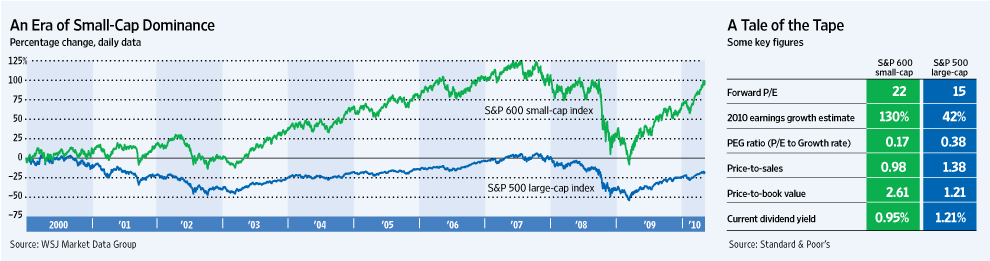
A recent article in the Journal titled “Small Caps Loom Large” notes that the small cap stocks in the U.S. have rallied strongly since the decade that began Jan 1, 2000 when large caps have lost ground.

Some key points from the article:

  • The S&P 600 Index, a small-stock index, gained nearly 100% during the period, producing an annualized return of 7.1%. In the same period, S&P 500 has lost almost 2% per year for a total loss of about 18%
  • The Russell 2000, another small cap index also shows a similar pattern
  • The S&P 600 is trading at 2010 P/E of less than 22 compared to S&P 500’s P/E of 15
  • Small caps benefit more quickly when the economy recovers

Chart – Small Caps vs. Large Caps :

Click to Enlarge

Small-vs-Large-Cap-Stocks

U.S. Small Cap ETFs:
iShares S&P SmallCap 600 Index Fund (IJR)
iShares Russell 2000 Index Fund (IWM)
iShares Morningstar Small Core Index Fund (JKJ)
SPDR DJ Wilshire Small Cap ETF (DSC)
Vanguard Small-Cap ETF (VB)
Schwab U.S. Small-Cap ETF (SCHA)

International Small-Cap ETFs:
iShares MSCI EAFE Small-Cap Index Fund (SCZ)
International Small-Cap Fund (GWX)
FTSE Developed Ex-US Small Cap ETF (IFSM)
Vanguard FTSE All-World ex-U.S. Small Cap ETF (VSS)
SPDR S&P Emerging Markets Small Cap (EWX)

Source: Seeking Alpha, ETF Trends

As individual small cap stocks can be very volatile and may have low daily trading volumes, it is easier and wise to invest in them with ETFs.

Knowledge is Power: Moral Hazard, Pitchforks, Russian Telecom Edition

canada-hpousing-bubble.jpgCentral banks have blown yet another bubble – here’s how to protect yourself

The dividend strategies that best juice returns

China’s Cut-Throat Railway Revolution

Who’s Got Those Pitchforks?

Was It Really a Bubble?

Russian Telecommunications Prepared to Fly as Data Soars 

Chinese stocks: Canary in the coalmine?

Pimco’s Bill Gross slams rating agencies’ ‘lack of commonsense’

3 Reasons Dividend Stocks Are a “Must-Own”

China’s endless moral hazard

China’s Demand For Coal Continues To Grow

An article in the Wall Street Journal today discusses about China’s voracious demand for  coal. A couple of important points from this article:

  • In March coal imports jumped 165% from March 2009
  • As the country’s power generation capacity is projected to increase by 10% this year, the demand for thermal coal would rise
  • In the first quarter coal imports jumped by 226% from a year earlier

The top five coal producing countries are: China, USA, India, Australia and South Africa. Most of the coal produced is used in the country of production. For example, the US uses most of the coal mined domestically since coal is the main source of fuel for power generation in the country.

The five largest coal users are China, USA, India, Japan and Russia. Asia alone accounts for 56% of global coal consumption. In addition to being used as a source for power generation, coal is also used in cement making and the steel industry. (Source: World Coal Institute).

Some of the major U.S. coal producing companies are: Peabody Energy Corp. (BTU), Consol Energy Inc. (CNX),  Alpha Natural Resources Inc. (ANR), Arch Coal Inc. (ACI), Walter Energy (WLT) and Massey Energy Co. (MEE). Peabody energy is the world’s largest coal producer. Coal stocks that trade on the New York Stock Exchange can be found here. Some of the coal ETFs available are Market Vectors-Coal ETF (KOL) and PowerShares Global Coal Portfolio ETF (PKOL).