New ADR: Seadrill – Norwegian Offshore Deepwater Driller

Seadrill, a leading Norwegian offshore drilling company started trading on the NYSE on April 15th with the ticker SDRL.

From the corporate site:
“The company operates a versatile fleet of 40 units for operations in shallow to ultra-deepwater areas in harsh environment and benign environments,

* Semi-submersibles
* Deepwater drillships
* Jack-ups
* Semi-tender rigs
* Tender rigs

Seadrill has some 7,500 skilled and highly competent employees, representing over 40 nationalities, operating in 15 countries on five continents.”

In the first quarter 2010, the net income net income was US$217M from total revenue of $853M. The company won new contracts and contract extensions totaling $2.7B.

Some interesting facts about Seadrill:

  1. 2nd largest offshore driller based on EV
  2. 2nd largest ultra-deepwater fleet
  3. Most modern offshore drilling rig fleet
  4. Has operations in Gulf of Mexico, Africa, Brazil, Southeast Asia, Norway and South Korea.
  5. The order back log stands at $10.8 B
  6. Top customers include Petrobras(PBR), Exxon Mobil(XOM), Total(TOT), Chevron(CVX), Statoil(STO), etc.

The stock closed at $27.18 on the first day of trading. On May 28th, Seadrill ADR closed at $20.68%. The current dividend yield is 7.98% and the total number shares outstanding is 399 million.

The Ten Most Traded Norwegian Stocks

The ten most traded Norwegian stocks on the Oslo Stock Exchange in April are listed below. If the company is traded in the U.S. markets the ticker and current dividend yield is also shown.

1. Statoil (STO)
Current Dividend Yield: 5.09%

2. Yara International (OTC: YARIY)
Current Dividend Yield: 2.32%

3. Seadrill (SDRL)
Current Dividend Yield: 7.98%

4. Norsk Hydro (OTC: NHYDY)
Current Dividend Yield: N/A

5. Renewable Energy Corporation (OTC: RNWEF)
Current Dividend Yield: N/A

6. DnB NOR (OTC: DNBHY)
Current Dividend Yield: 2.73% on the domestic listed stock

7. Telenor (OTC: TELNY)
Current Dividend Yield: 3.40%

8. Petroleum Geo-Services (OTC: PGSVY)
Current Dividend Yield: N/A

9. Royal Caribbean Cruises(RCL)
Current Dividend Yield: N/A
Note: Royal Caribbean is based in the US and the ticker noted is not an ADR

10. Acergy (ACGY)
Current Dividend Yield: 1.52%
Note: Acergy is based in the UK

Comparison of Dividend Yields Across Major Markets

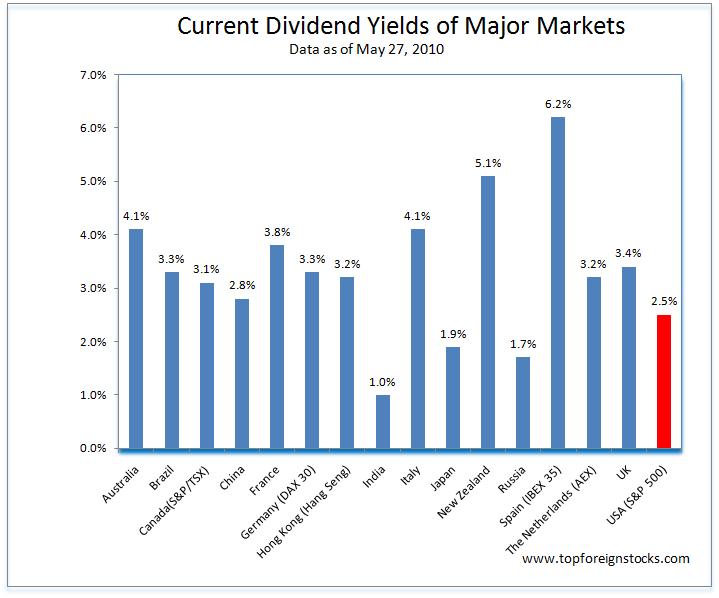
The chart below shows the current dividend yields in some of the major equity markets:

Click to Enlarge

Current-Dividend-Yields-by-Country

Source: FT Market Data

Among the developed markets, except Japan the  U.S. has the lowest yield at 2.5% for the S&P 500. Spain is one of the worst performing markets in the first five months of this year. Due to this fall and other factors, the yield on the IBEX 35 at 6.2% is the highest among developed countries. New Zealand equities have traditionally paid high dividends. Hence the New Zealand has the second best yield at 5.1%. Compared to Brazil, Russia and China, India has the lowest yield.

Which is More Important: Job Security or Dividends?

When the property market crashed in the U.S., many experts argued that prices were 25% above trend. By mid-2008, property prices were down about 30% based on the Case-Shiller index. This meant that price correction was complete and the U.S. economy would go back to normal like it did eventually in Japan. However this did not happen.

One of the reasons for this dichotomy is that Japan has a very different kind of economy in terms of corporate governance. Japanese firms are much more stake-holder oriented whereas U.S. firms are shareholder oriented. This implies that Japanese companies care about their workers, suppliers and other stakeholders than just their shareholders. Hence Japanese firms have traditionally reacted very differently to shocks and crises than U.S. firms.

The evidence of this phenomenon is provided by the answer to the following survey question:

“What’s the prevalent view in your country? If times get bad, should firms maintain dividends and lay off workers or should firms cut dividends and keep stable employment?”

The chart below shows the answer to the above question.

Jobs-or-Dividends

The difference in answers between Japan, Germany, France,the U.S. and UK is very interesting. Japanese firms want to cut dividends and maintain employment. However it is the exact opposite in the U.S. and U.K. In these two countries shareholders of a firm take higher priority above everyone including workers. In Germany and France, firms prefer to maintain employment than pay dividends when faced with tough economic conditions.

Source: The Global Financial Crisis by Franklin Allen and Elena Carletti, Banco Central de Chile

The current unemployment rates in the five countries mentioned are:

Japan = 5.10% in April
Germany = 8.10% in April
France = 10.10% in March
USA = 9.50% in April
UK = 8.00% in March

Argentine Stocks May be Ready for a Rebound

After defaulting on its debt in 2001, Argentina was shunned by international investors. Last year, Argentina was booted from the MSCI Emerging Markets Index. However the economy of Argentina may be ready for a rebound and catch up with the growing Latin American economies of Brazil and Colombia. In2001, Colombia was considered a failed state but since then the stock market has shot up fifteen times. Similarly Brazil could not service its debt in 1999 but now is the region’s and also one of the world’s red-hot emerging markets.

According to a recent article in Bloomberg Businessweek some investors are betting on a strong recovery in Argentina. The Merval stock index is up 163% since the credit crisis lows in November 2008.

Merval-Index-Performance

Some of the reasons for the optimism mentioned in the article include:

  • The Argentine government is trying to raise cash and build good relations with global creditors ahead of the presidential elections in 2011. After the rescue of Greece with an estimated $1 Trillion package, the outlook for Argentine debt swap deal is positive.
  • The outlook for the export of agricultural products to other emerging markets is high
  • Due to the availability of plenty of fertile lands, 54%  of Argentina’s export is agricultural
  • Publicly-traded banks are attractive compared to peers in the region

In terms of investment opportunities, there are a few ADRs that investors can consider. BBVA Banco Frances (BFR) has a market capitalization of $1.1B.The current yield on its ADR is 0.98% and the beta is 1.5. Banco Macro(BMA) pays a dividend of 2.38%. Oil and natural gas company YPF SA (YPF) is down about 18% YTD. The current yield is 7.94%. Telecom services provider Telecom Argentina(TEO) has a 11.04% dividend yield. Some of the other Argentina ADRs to review include oil and gas producer Petrobras Energia SA (PZE), food producer Credud (CRESY)and electric utility Edenor(EDN).