Growth of U.S. Personal Consumption, Income and Household Liabilities

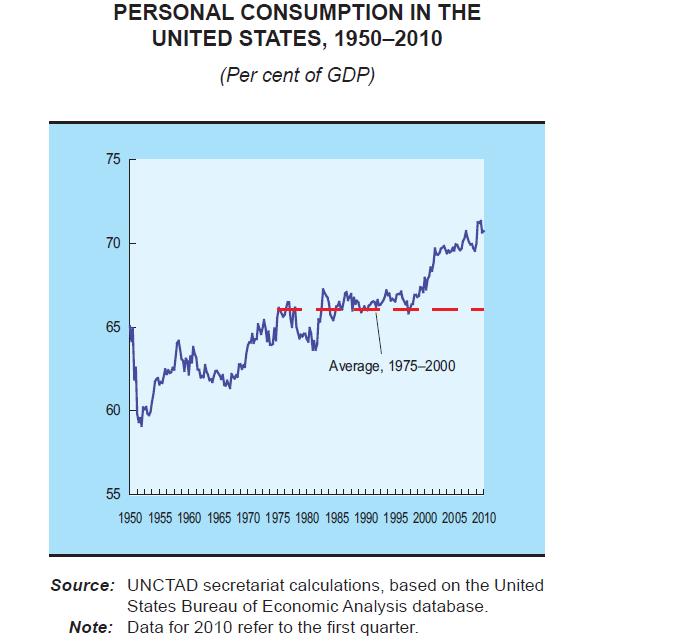
The U.S. economy at over $14.0 Trillion is the largest economy in the world. However personal consumption accounts for most of the GDP. Since the late 1990s, the share of personal consumption in the GDP has been growing consistently and exceeded the long-term average of  about 66%. In 2009 it peaked at 71% of the GDP.

us-personal-consumption.jpg

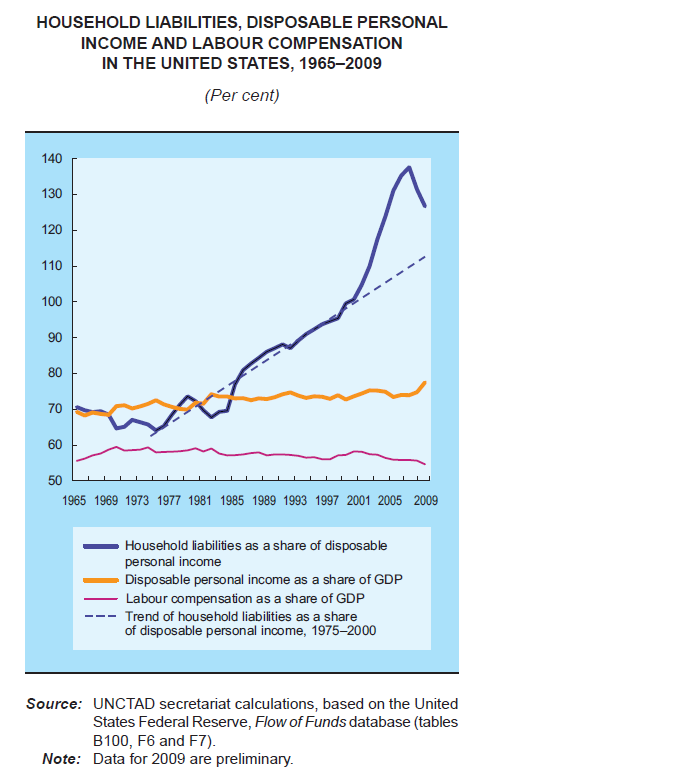
The tremendous increase in consumption was not supported by rise in income but was mostly debt financed thru home equity loans, credit cards, etc.”The increase in household consumption in the United States was unsustainable because it was not supported by a similar expansion of labour compensation.”In 2007, the ratio of debt to personal disposable income reached an all-time high exceeding 130%. The chart below shows that since 2000 labor compensation as a percentage of GDP has steadily declined while household liabilities continued to grow until 2007. As the unemployment rate continues to be stubbornly high, companies are under pressure to increase profits with flat sales which has to led to further reduction in wage levels. Hence economic growth will be anemic until households deleverage their balance sheets to manageable levels and incomes stabilize.


us-hh-liab.png

Source:  TRADE AND DEVELOPMENT REPORT, 2010, UNCTAD

Top 25 Banks in Central and Eastern Europe

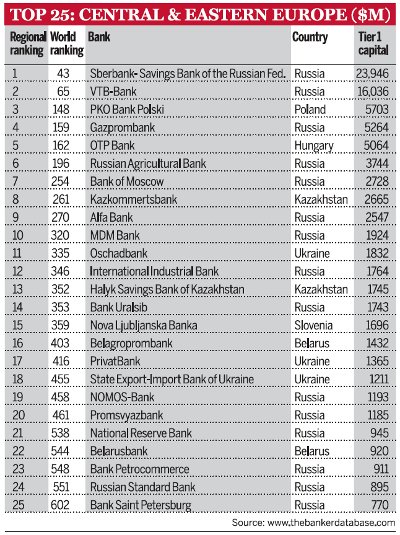
The Top 25 Banks in Central and Eastern Europe based on Tier 1 Capital in 2009 are listed below. This ranking is part of the annual World’s Top 1000 Banks published by the The Banker magazine of the UK.

Top-25-Central-Easter-Europe-banks

Source: The Banker

Most of the banks in the above list are owned either partially or fully by the state. Hungary’s private-sector bank OTP fell from third rank last year to fifth rank this year.

Five Australian Stocks Yielding Over 5% Dividends

Often called as “the Lucky Country”  Australia is blessed with plenty of natural resources and wonderful weather. Similar to the Canadian banking system, the Australian banking system is stable and was least affected during the financial crisis.Australia has many of the commodities such as coal that the growing economies of China and India desperately need.

Australian equities have been one of the best performing in the world over the last 110 years. From 1900 to 2009, Australian stocks have  yielded a real return of 7.5% per year according to the Credit Suisse Global Investment Yearbook 2010.

In this post lets take a quick look at five Australian stocks that have current dividend yields of over 5%. All these stocks trade on the OTC market.

1. Metcash Ltd (OTC:MHTLY) is engaged in marketing and wholesale distribution of grocery, liquor, hardware and other fast moving consumer products in Australia and parts of New Zealand. Some of the brands owned by Metcash include IGA, Cellarbrations, Foodlink, Bottle-O and Bottle-O Neighbourhood. Currently the stock pays a 6.06% dividend yield.

2. Telstra Corp Ltd (OTC:TLSYY) is Australia’s leading telecom company offering both fixed and mobile services. Telstra also owns 50% of FOXTEL which provides cable tv services. Telstra has one of the largest shareholder base in Australia. During 2009-10, it generated A$6.2 billion of free cash flow and paid A$3.5 billion in dividends to shareholders. The current dividend yield of the ADR is 10.16%.

3. Sydney-based QBE Insurance Group Ltd (OTC:QBEIY) is one of the top 25 insurers and reinsurers worldwide and operates in 49 countries. The company’s gross written premium in 2009 was $14.5 billion.  The stock pays a 7.05% yield.

4. Amcor Limited (OTC: AMCRY) is engaged in the business of packaging solutions supplying a range of plastic (rigid & flexible), fibre, metal and glass packaging products. Amcor operates in 43 countries. Annual sales totaled A$12.2 billion last year. The current dividend yield is 5.15%.

5. National Australia Bank Ltd (OTC: NABZY) serves about 11 million customers thru 1800 branches in Australia, New Zealand, U.S. and the UK. The bank operates in the UK under the Clydesdale Bank and Yorkshire Bank brands. In the U.S. the bank owns the Great Western Bank. Yesterday the bank announced “a fiscal-year profit of 4.22 billion Australian dollars ($4.16 billion), up 63.2% from the year-ago period.” The current yield of the ADR is 5.31%.

TARP Profits to the U.S. Treasury

In a post last month, I discussed about the success of the Troubled Asset Recovery Program (TARP) to the U.S. By July of this year, the US government had received $22.7 billion in interest, dividends, sale of warrants, stocks and other income.

The graphic below shows that the TARP has been profitable to the U.S. Treasury and the top 1o firms that have paid the most money:

Click to Enlarge

tarp-profits-to-us.jpg

Source: Bloomberg BusinessWeek

Bank of America(BAC), Wells Fargo(WFC), JPMorgan Chase(JPM), Goldman Sachs(GS), Morgan Stanley(MS), Hartford Financial(HIG), PNC Financial Services(PNC) have all fully repaid their TARP loans.