Why Country ETFs Are Not the Best Way to Invest in Emerging Markets

ETFs offer one of the simplest and easiest ways to gain exposure to emerging markets.Investors have poured billions of dollars in emerging market funds making them some of the largest in the fund universe.However investing in emerging markets via ETFs or an index fund is not the best way to capture the growth of these economies. In this post let me explain this theory using two examples.

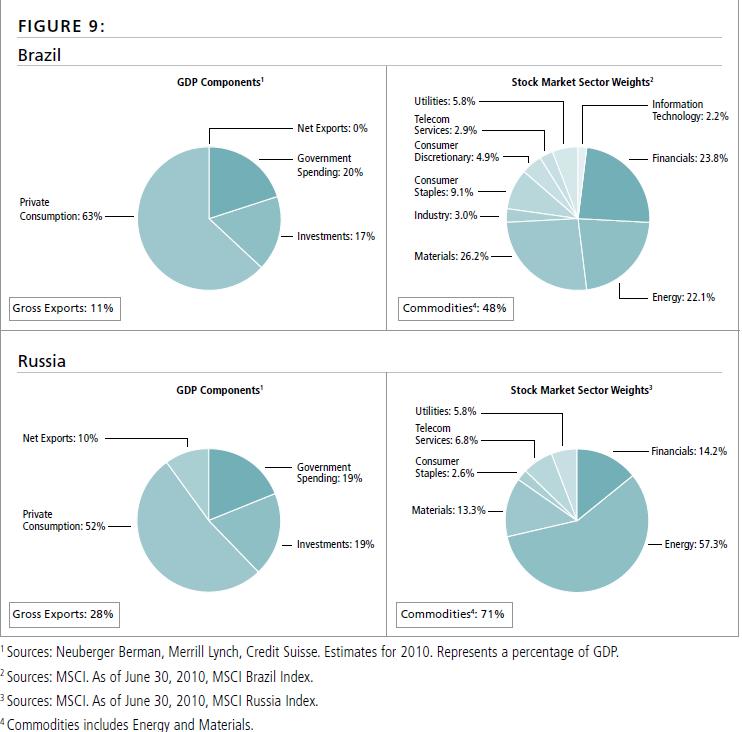
The graphic below shows the comparison of GDP composition and the respective MSCI Indices for Brazil and China:

Click to Enlarge

Brazil-Russai-GDp_MSCi-Index-Comparison

Source: Does Economic Growth in Emerging Markets Drive Equity Returns?, Neuberger Berman

P.S: The MSCI data shown above are as of June 30, 2010.

1. Brazil
Private consumption accounts for 63% of the domestic economy. But the Materials and Energy sector comprise 48% of MSCI Brazil Index. The allocation for consumer sector is very less especially when excluding Financials. As the iShares Brazil ETF (EWZ) tracks the performance of the  MSCI Brazil Index, the ETF does not offer a complete representation of the local economy. Sales of consumer goods such as household appliances, cars, etc. are growing strongly in Brazil. However as of September end, the iShares Brazil ETF has about 14% assigned to the consumer sector. Hence instead of picking up this ETF, investors looking to gain exposure to the Brazilian market may want to do a bottom-up approach and select individual companies.

2. Russia
Similar to Brazil, disconnect exists between the composition of the Russian economy and the underlying index. Private consumption is about 52% of the GDP. But commodities(Energy and Materials) constitute about 70% of the MSCI Russia index. The two country-specific ETFs available for Russia do not track the MSCI Russia Index. The SPDR S&P Russia ETF (RBL) tracks the S&P Russia Capped BMI Index  and allocates about 64% to commodities. Consumer sector accounts for just over 4% in this ETF. Van Eck’s Market Vectors Russia ETF (RSX) which replicates the DAXglobal® Russia+ Index also invests the most of the assets in the commodity sector. So investing in Russia via these two ETFs may not be the best way either.

Disclosure: No positions

Top 10 Gold and Forex Holding Countries

Gold prices have continued to rise since the July low of $1,160 an ounce. After the Fed’s meeting on Thursday, prices rose sharply and continued to go even higher on Friday and closed at $1,393.21. A Reuters article says that gold prices should continue for at least another six months.

From the article:

“Gold’s record-breaking climb should continue for at least six months, corresponding to the planned duration of the Federal Reserve’s monetary stimulus, according to a Reuters poll conducted on Thursday and Friday.

Two out of three respondents see  gold prices topping out between $1,400 and $1,500 an ounce on an interim basis, with most analysts surveyed expecting prices to peak during the first or second quarter of next year.

Thirteen of the 20 analysts, traders and fund managers polled by Reuters said the price of bullion will remain in an uptrend well into the first half of 2011, after the Fed on Wednesday unleashed a program to buy $600 billion of government bonds in a new round of quantitative easing (QE).

The Fed’s QE package has reinforced the argument for holding gold, as it pushes the dollar firmly onto a downward path and raises the risk of inflation.

“QE devaluates the currency, so gold…and almost all commodities will be beneficiaries as people start to switch from financial assets to commodities, something they feel more tangible as the money printing continues,” said Standard & Poor’s Equities and Metals analyst Leo Larkin.”

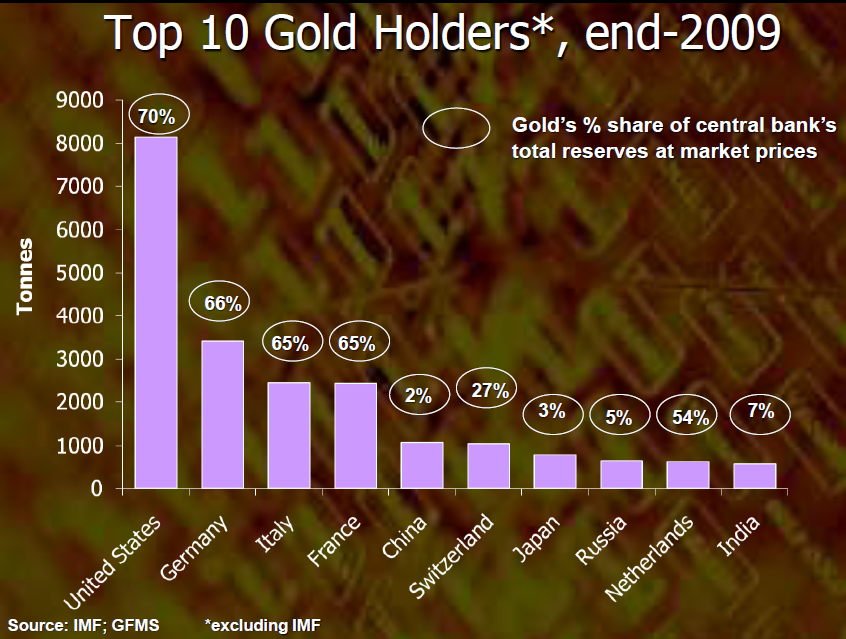
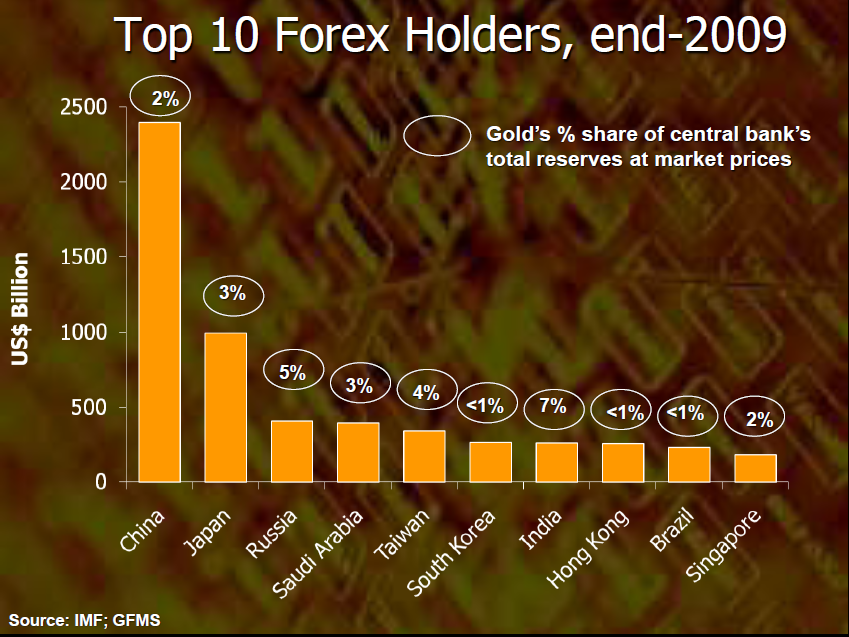
According to London-based GFMS, the world’s foremost precious metals consultancy, specializing in research into the global gold, silver, platinum and palladium markets, the total officially declared gold holdings at the end of 2009 was 30,623 tonnes with the IMF,US and China holding  10%, 27% and 3% respectively.

1) The Top 10 Gold Holders

Click to Enlarge

Top-10-Gold-Holders

2) The Top 10 Forex Holders

Top-10-Forex-Holders

Source:  The Official Sector: Gold Rehabilitated?, A presentation by Philip Klapwijk, GFMS Ltd.

Some of the key predictions made by Philip in the presentation are:

  • “Sovereign debt crisis will not last forever
  • Alternative investments may be attractive, e.g. Chinese government bonds
  • Gold price will eventually change direction
  • US sales unlikely but cannot be entirely ruled out over next decade
  • Off-market purchases may facilitate ‘transfer’ of bullion from West to East “

Will Investors Get Back into U.S. Bank Stocks?

During the credit crisis many U.S. banks suspended dividend payments entirely or reduced them significantly. Currently most of the banks pay dividends. But the yields on them is so small that investors are not attracted to them. For example, the current yields of the big four superbanks are follows:

1. JPMorgan Chase (JPM)
Current Dividend Yield: 0.50%

2.Bank of America Corp (BAC)
Current Dividend Yield: 0.33%

3. Wells Fargo (WFC)
Current Dividend Yield: 0.73%

4. Citigroup (C)
Current Dividend Yield: No dividends paid

Compared to the U.S. banks noted above, many foreign banks have high dividend yields. Banco Santander (STD) of Spain pays 5.66%, Deutsche Bank(DB) of Germany yields 1.41% and Westpac Banking Corp(WBK) pays 6.07%. U.S. banks are unable to pay higher dividends due to regulatory restrictions placed on them despite shoring up their capital and rising earnings.But those restrictions are to be lifted according to an article in the Wall Street Journal.

From the article:

“Dividend payments are especially important for banks now that the financial industry’s outlook is clouded by the sluggish economy, toughened regulation and looming capital requirements. But as profits have rebounded, a big-bank stock index from Keefe, Bruyette & Woods Inc. is up 11.6% so far this year after Thursday’s rally, surpassing the Dow Jones Industrial Average’s gain of 9.7%.

While the banks were waiting for the green light to restore their payouts, other companies have been boosting dividends in recent months, making their shares more attractive, especially given the slow growth in the economy. Financials on average yielded 4.4% in 2008, making them one of the highest-yielding sectors, according to Standard & Poor’s. Now they yield 1.1%, making them the second-lowest yielding sector in the market, according to S&P.

Only a handful of banks are expected to meet the Fed’s test, said Frederick Cannon, co-director of research at KBW. Among those with strong enough capital ratios are J.P. Morgan Chase, US Bancorp, State Street Corp. and Bank of New York Mellon Corp., he said.”


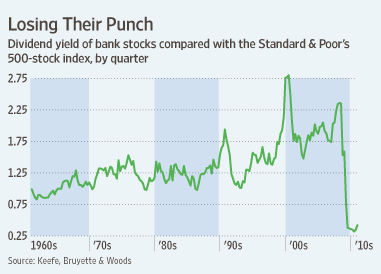
US-Bank-Dividends-Relative-To-Sp-Yields

The chart above shows the depth of the fall in bank dividend yields. Like utilities, banks traditionally paid high dividends before the financial crisis and were a core holding in income investors’ portfolios. Those investors got burned when these stocks crashed. When banks increase dividends some investors who bailed out may get back in. However there many factors that still make these stocks scary to hold. Hence it is better to keep an eye on this sector and be very selective in any new investments if one wants to add to their portfolio.

Disclosure: Long STD, USB

Four Chinese Healthcare Stocks To Consider

In an article back in July I discussed about some of the reasons to invest in the Chinese healthcare market and mentioned five foreign healthcare companies as potential investment options. In this post lets take a quick look at four Chinese healthcare stocks that trade on the U.S. markets.

1. Mindray Medical International Ltd (MR) is a leading developer, manufacturer and marketer of medical devices worldwide. Mindray operates in three segments: Patient Monitoring and Life Support Products, In-Vitro Diagnostic Products and Medical Imaging Systems.The stock is down about 12% YTD. Last year the company had a total revenue of $665 M. Mindray is experiencing strong international growth as well. In 2Q, 2010 the company’s overseas sales was about $107M.

2. Concord Medical Services (CCM) operates a network of radiotherapy and diagnostic imaging centers in China. At the end of last year, the Company’s network comprised of 88 centers based in 57 hospitals, spanning 36 cities in China. This is a small-sized company with a market cap of about $350 M.In the second quarter the company added 11 centers bring the total number of centers to 100.

3. China Medical Technologies Inc (CMED) is engaged in the commercialization, manufacture and sale of medical devices and supplies to customers primarily in China. The ADR is down 13% YTD.

4. China Kanghui Holdings (KH) is a developer, manufacturer and marketer of orthopedic implants in China. Kanghui offers a wide array of proprietary orthopedic implant products in trauma and spine. Since its mid-August listing, the stock has performed well. From an IPO price of $10.25 the stock price has grown to close at $18.95 today. The third quarter financial results will be released on Monday, November 8, 2010, before the market opens.

Is Canada a Play on China?

Earlier this year Murray Leith of Odlum Brown, a British Columbia,Canada-based financial services firm made a presentation in which he suggested the theory that Canada is a play on China. He stated that”the Canadian stock market really hangs on China’s fortunes.” I wondered if his theory is indeed correct.

Murray noted that the Canadian stock market is not well diversified like the U.S. markets. The composition of the S&P/TSX Composite Index is shown below:

sp-tsx-composite-makeup.jpg

About 49% of the index is made of the resources sector and 29% is concentrated in financials.Together they makeup more than three-quarters of the Canadian markets. So when compared to the US S&P 500, the Canadian market is highly concentrated on just two sectors.

Murray said that “Financials are not directly tied to China like Resources, but they are from an indirect perspective considering that China’s resource demand has a major influence on the overall health of our country.”  The Canadian financial sector has more exposure to Latin America, the Caribbean and the U.S. than China. Hence even if China imports a large amount of Canadian resources, the financial system is more likely to be impacted by the economic situation in Latin America and the U.S.

It is a well known fact that Canada is the largest trade partner of U.S. Thru August this year trade between Canada and the U.S. exceeded $346 billion while trade between U.S. and China totaled  $285 billion.In 2009, total trade between U.S. and Canada was $429 billion.

Last year Canada exported just over C$10 billion to China but imported goods worth C$39 billion from China. The majority of the exports were oil seeds, fruit, grain, woodpulp, paper or paperboard scraps, ores, slag and ash. In the first half of this year Canadian exports to China exceeded C$5.5 billion.

From The Canadian Chamber of Commerce report titled “Canada–China: Building a strong economic partnership”:

“Two-way trade between Canada and China continues to expand, albeit at a slower pace following the 2008 financial crisis; the total value of two-way trade was C$50.8 billion in 2009 versus C$47.8 billion in 2007. A 2009 Fraser Institute study found that despite this growth,Canada’s two-way trade with China remains well below potential.

Indeed, while China is Canada’s third-largest trade partner and third-largest export market, Canada’s trade with China still represents only seven per cent of our country’s overall merchandise trade. Only three per cent of Canada’s merchandise exports went to China last year, versus 75 per cent to the United States. It is clear there is room to achieve substantial growth in Canada’s commercial exchanges with China.”

Click to Enlarge

china-canada-trade.jpg

Hence based on the analysis noted above I do not agree with the view that Canada is a play on China. China is dependent on Australia and other economies in Asia for trade and economic growth than Canada. Despite the Chinese demand for many commodities that Canada has, our northern neighbor’s fortune is still dependent on the U.S. economy.

Sources: Asia Pacific Foundation of Canada, U.S. Census Bureau and others