U.S. Corporate Profits Rising With No Job Growth

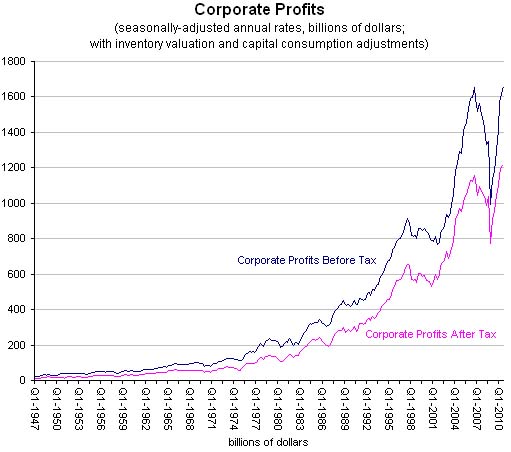
U.S. companies earned profits at an annual rate of $1.659 trillion in the third quarter, according to a Commerce Department report released Tuesday. In non-inflation adjusted terms, this is the highest figure since the government started keeping track over 60 years ago. Since the credit crisis ended, many businesses have resumed growing profits but not with creating more jobs.

The unemployment rate remained unchanged at 9.6% in October with 14.8 million persons unemployed according to official figures.

U.S. firms slashed 8.5 million jobs during the last recession. Millions of these workers still remain unemployed. However corporate profits are soaring to pre-crisis levels. This is because American businesses are able to increase profits by rising productivity, increasing exports, cutting costs and in some cases raising prices. Productivity simply means extracting more or the same amount of work using fewer number of numbers.Globally U.S. companies are leaders in productivity due to the corporate culture prevalent in the U.S. and the fierce competition in many industries. Hence in the current situation they are wringing out more profits with fewer workers. This concept was illustrated in a recent Bloomberg article:

“Campbell, the world’s largest soup maker, DuPont Co., the third-biggest U.S. chemical maker, and United Parcel Service Inc., the world’s largest package-delivery business, are asking workers to help save cash by working smarter with existing technology. A potential cost: Efficiency gains reduce the chances recession-casualty jobs will come back.

“When the productivity growth comes, then watch out because that is when companies start not needing so much labor,” Edmund Phelps, a Columbia University economist and Nobel laureate, said in an interview.

Some 142 non-financial companies in the S&P 500 had improvements in operating margins of three percentage points or more from the final three months of 2007, when the previous expansion peaked, compared with the most recent quarter, according to data compiled by Bloomberg as of yesterday.”

The chart below shows the annualized corporate profits, both before and after taxes since 1947:
Us-profit-growth-corp

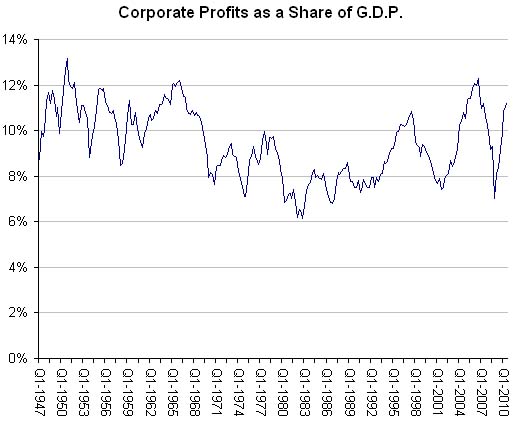
The chart below shows the corporate profit growth in terms of GDP:
Us-profit-corp-GDP

It represented 11.2% of G.D.P. last quarter, a figure that has also been growing for seven consecutive quarters. So for the past seven quarters companies have been earning higher profits with almost no hiring of workers since the unemployment remains stubbornly high at around 10%.

Source: The New York Times

The Economist magazine wrote about this dichotomy in the U.S. economy back in August in an article titled “Profits, but no jobs“. From the article:

“AMERICANS used to love to hear tales of success in business. One of the many oddities of the current joyless economic recovery is that this traditional enthusiasm is strikingly lacking. Corporate America has bounced back impressively. The quarterly results season that is now nearly over has revealed that profits are back within a whisker of the all-time highs achieved before the downturn in late 2008. By some calculations, the rate of recovery of profits from their trough is the strongest since the end of the Great Depression.

Yet nobody seems pleased. Not investors, who have failed to push up share prices in the way this sort of earnings growth would have caused them to do at this stage of previous economic cycles. Certainly not politicians, who complain that firms are “hoarding” cash and creating hardly any new jobs. As Robert Reich, an economist at Berkeley and former labour secretary under Bill Clinton, puts it: “Bottom line: higher corporate profits no longer lead to higher employment. We’re witnessing a great decoupling of company profits from jobs.”

Corporate America is reaping the rewards for tough actions taken after the financial markets collapsed in September 2008.” (emphasis added)

Yes indeed. There is a huge disconnect between rising corporate earnings and job growth. This recovery is not only a “jobless recovery” but also a “joyless recovery”. According to S&P, non-financial companies in the S&P 500 held over $1 Trillions in cash at the end of first quarter. Much of this cash is not getting paid out as higher dividends to investors or being spent on capital investments.

It remains to be unseen how longer this phenomenon of rising corporate profits with no increase in employment numbers can continue.


Some Facts About Ireland and The Largest 10 Companies

Ireland is relatively a little country with a population of about 4.5 million.Until the late 80s the country was a poor performer in terms of growth and prosperity. However Ireland was erroneously dubbed as a “Celtic Tiger” owing to the staggering economic growth achieved until 2007. This Celtic Tiger name was modeled after the “Asian Tigers” – the countries of Singapore, Taiwan, South Korea and Thailand that gained real exponential growth during the 1980s and 90s. However unlike the Asian Tigers, the Irish miracle was built on the boom in real estate market, financial services, low corporate taxes and a free flow of credit. In other words, Ireland did not turn into an economy built on solid foundations almost overnight like South Korea producing high quality products and exporting them. At its peak, Ireland was home to over 1,100 multinational companies that exported billions of dollars worth of goods and services. In fact, Ireland became the world’s largest exporter of software and produced a large portion of drugs for the European market.


dublin-castle.jpg

Dublin Castle, Ireland

Some interesting facts about Ireland:

  • Ireland’s GDP grew on an average 5% to 10% from 1995 to 2007.
  • The average Irish family owes an estimated 132,000 to the banks according to David McWilliams, a former Central Bank of Ireland economist.
  • Housing prices have fallen 36% since the 2006 peak.
  • Unemployment rate has jumped to 14% from a low of 4% during the boom years.
  • Ireland’s GDP soared from about $25 billion in the 1980s to $267 billion in 2008.
  • 33% of first-time home buyers in 2006 bought them with no money down.
  • As many as 29 Irishmen involved in real estate have committed suicide since the crash began.

Source: The Reckoning, Bloomberg BusinessWeek

The 10  Largest Irish companies based on market capitalization as of November 24, 2010 are:

1. CRH (CRH)
Market Cap: $8.70B
Sector: Construction – Raw Materials

2. Ryanair Holdings (RYAAY)
Market Cap: $4.86B
Sector: Airlines

3. Kerry Group
Market Cap: $3.81B
Sector:Food Processing

4.Dargson Oil
Market Cap: $2.27B
Sector: Oil & Gas – Integrated

5.Aryzta AG
Market Cap: $2.19B
Sector:Food Processing

6.Elan Corp
Market Cap: $2.0B
Sector: Biotechnology & Drugs

7. DCC Plc
Market Cap: $1.43B
Sector: Oil & Gas Operations

8.Bank of Ireland (IRE)
Market Cap: $1.37B
Sector: Banking

9. Smurfit Kappa Group Public Ltd
Market Cap: $1.37B
Sector: Containers & Packaging

10.Paddy Power PLC
Market Cap: $1.22 B
Sector: Casinos & Gaming

A Review of Irish ADRs’ Performance YTD

The table below lists the Year-To-Date (YTD) performance of the exchange-listed Irish ADRs:

[TABLE=721]

Similar to Anglo Irish Bank investors, Allied Irish Banks(AIB) and Bank of Ireland(IRE) common investors may be wiped out if Ireland nationalizes these beaten-down banks.CRH (CRH) is in the construction and materials industry. So it can be avoided until the dust settles on the current crisis. Among European discount-carriers Ryanair (RYAAY) operates a vast network and has an efficient management team.

Elan (ELN) used to be a high flier during the dot era but later crashed hard and now trades in the single digits. Another stock worth keeping an eye on is the Irish beverage maker C&C Group plc (CCGGY). C&C is a major leader in the cider market with its Mangers and Bulmers brand.

The New Ireland Fund (IRL), a closed-end fund closed at $6.54 yesterday. The fund used to trade for $35+ in early 2007. It is interesting to note that despite The Wall Street Journal calling Ireland as one of the countries having “the most innovative financial industries”, Irish lenders have a hard time staying afloat. The Luck of the Irish did not work so well for investors in Irish bank ADRs as well.

The Top 10 Global Biopharmaceutical Companies by Sales

A few days ago we reviewed the top 20 global pharmaceutical companies by sales. In this post, lets take a quick look at the top 10 global biopharmaceutical firms based on 2009 revenues.

The table below lists the  Top 10 Global Biopharmaceutical Companies by Sales. These firms were selected based on the following rule:

  • The company is considered a biopharma if more than half of its drug revenues — not royalties — come from large-molecule drugs and vaccines.

insulin.jpgThis year Roche/Genentech has become the world’s top biopharma company. This is the first change at the top position since this list was published for the last 10 years. In March 2009, the Swiss drug company Roche agreed to buy Genentech for $46.8 Billion. This pushed Roche/Genentech to the number one spot.

[TABLE=701]

Source: Contract Pharma

Note: * CSL’s financial year ran from July 1, 2008 to June 30, 2009

Other than Roche/Genentech the rest of the list above is the same as last year’s. According to the report this “is both a sign of the stability among biopharmas and a sign of the difficulty in commercializing new biologics without a major partner.”

When the first list was published 10 years ago, Amgen (AMGN) was the top biopharma company with revuenues of $3.2 billion at that time. Now there are eight companies with revenues higher than that. This shows the tremendous growth and the potential for biopharmas.

Baxter BioSciences is a unit of the Illinois-based global healthcare giant Baxter(BAX) group. Merck Serono is a division of Merck KGaA of Germany. Australia-based CSL is a leader in the development and manufacture of vaccines and plasma protein biotherapies with 10,000 employees working in 27 countries.

Debt Due over the 20 Years From Ireland, Portugal and Spain

The Irish government is negotiating a $110 billion bailout deal with the IMF and EU. Today Ireland unveiled a four-year austerity plan. From an Bloomberg article:

“Ireland’s government said it will cut spending by about 20 percent and raise taxes over the next four years as talks on a bailout of the country near conclusion.Welfare cuts of 2.8 billion euros ($3.8 billion) and income tax increases of 1.9 billion euros are among the steps planned to narrow the budget deficit to 3 percent of gross domestic product by the end of 2014. The shortfall will be 12 percent of GDP this year, or 32 percent including a banking rescue.

“Those who can pay the most will pay most, but no group can be sheltered,” the government said in a report published in Dublin today. “Postponing these measures will lead to great burdens in the future for those who can bear them.””

Ireland plans to maintain the 12.5% corporate tax rate but increase various taxes for consumers. In addition welfare expenditures will be cut further. The low corporate tax rate in Europe attracts many multinationals such as Google (GOOG) who use Ireland as a tax haven. Ireland kept the low corporate tax rate since it allowed Ireland to become as one of the global financial innovation centers during the credit boom years. The financial sector dominated the Irish economy. Despite the credit crisis and the bailout, the Irish government is fully supportive of the financial industry in order to maintain Ireland as a major global financial center.

The bailout package is very favorable to bondholders and other creditors as their debt would be repaid in full. However ordinary citizens will take a big hit in terms of reduces public benefits and higher taxes. Since the pain is not equally shared, some economists are suggesting that Ireland should default on its debt. From a recent Journal piece:

“As another European country edges toward a multibillion-dollar bailout, a number of economists say there is only one way to make creditors share the pain: default.

In Dublin, officials from the International Monetary Fund, European Union and United Kingdom are negotiating a rescue package that is likely to require the Irish government to further squeeze pensions and paychecks but pay off bondholders of Irish banks, whose debts the government guaranteed.

Such a lopsided outcome—which has been repeated since the Latin America debt crises of the 1980s—enrages many voters and signals to investors that there is no price to pay for risky lending because international institutions will always bail them out.

Instead, say economists, lenders should be required to take hits on their investments as a way to reduce a government’s bills and to force lenders to be more careful about where to invest their money next time because they will realize the IMF and others won’t guarantee they will be paid in full.

“The most important effect is that (a country’s) debts won’t build up so much,” said Harvard economist Kenneth Rogoff, who has chronicled centuries of sovereign defaults.”

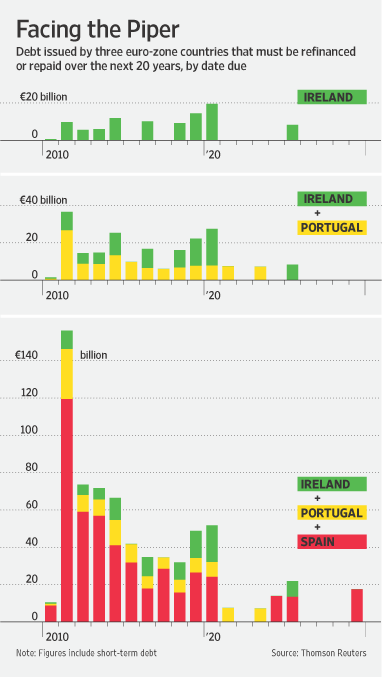
The graphic below shows the debt issued by Ireland, Portugal and Spain that must be repaid or refinanced over the next 20 years:

Debt-Due-Ireland-Portgula-Spain

Last year Portugal  had a budget deficit equal to 9.3% of its GDP. But the country aims to reduce it slowly over the next few years. As the Irish bailout plan takes shape, some investors are worried that Portugal may be the next candidate for a bailout. Though currently Spain is in a much better position, Spain may follow Portugal as well.