MSCI Index Performance: Poland vs. Ireland

An article in The New York Times recently compared the economies of Poland and Ireland. From the article:

WARSAW — With its drab, Soviet-era boulevards and standard-issue glass-and-steel office buildings, Warsaw does not look much like green, elegant Dublin. But there are some striking similarities between Poland today and Ireland in the 1990s.

Like the Irish a couple of decades ago, the Poles are a hardy people battered by history but on the verge of prosperity. Foreign capital is pouring in and investment banks are opening offices, lured by resilient growth and 38.5 million people who are close to shedding the “emerging market” label.

And Poland now, like Ireland then, has its own currency. Being outside the euro zone is working to Poland’s economic advantage.

That is not the only reason Poland is currently that rare species: a financially vibrant member of the European Union. But it is to Poland’s benefit not to be bound by a common currency, at a time when euro zone countries like Ireland will have trouble using cheap exports to grow their way out of trouble.

The author noted that unlike Ireland, Poland is a much larger country with a population of about 38.5 million. The article added:

But Poland was also lucky that, in contrast to Ireland, its banking industry was still small compared with the total size of the economy, with less potential to do damage. Household debt is relatively modest. Poland also benefited from the strong economy in neighboring Germany, which accounts for a quarter of exports.

Output is expected to rise 4 percent or more in 2011, after an estimated 3.6 percent this year. Commercial real estate prices in Warsaw are rising at a 10 percent annual clip. Foreign direct investment is expected to be up 28 percent this year, drawn by the country’s status as one of the few growth stories in Europe. And hardly anybody is complaining about the influx of foreign money.

Poland has one of the most successful economies in Eastern Europe. The Warsaw Stock Exchange has the highest number IPO listings in Eastern Europe last year and it is leading this year also in raising investment capital. Last month when the Warsaw Stock Exchange listed its own shares on the exchange, shares gained 25 percent on the first day of trading.

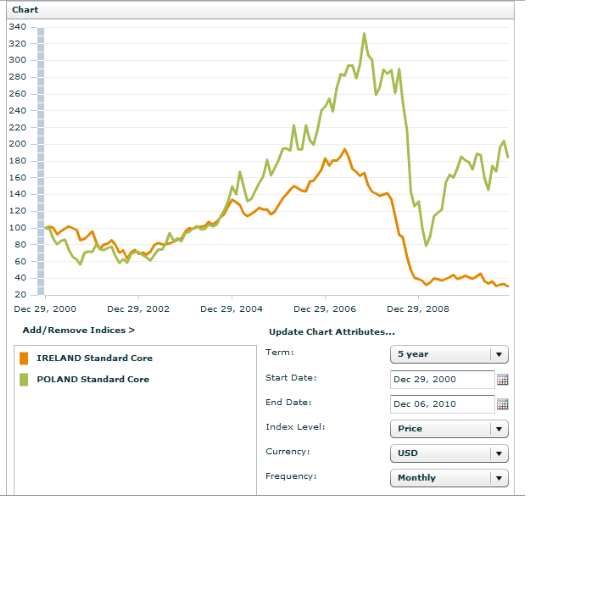
The chart below shows the comparative performance of MSCI indices for Poland and Ireland over the past 10 years:
MSCI-Poland-ireland

Source: MSCI Barra

The MSCI Ireland index attained its peak in 2007 and has since been on a downward spiral mirroring the collapse of the Irish economy. As the Polish index recovered from the March 2009 lows, the Irish index declined further after some minor uplift.The gap between the Poland and Irish indices is so wide now compared to 2003 when it was almost non-existent.Investors looking to gain some exposure to Eastern European equities may want to invest in Poland now. Unlike Ireland which will take many years to recovers the Polish economy holds lot of potential for further growth as the country fully integrates into the global marketplace.

Related ETFs:

iShares MSCI Ireland Capped Investable Market Index Fund (EIRL)
Market Vectors Poland ETF (PLND)
iShares MSCI Poland Investable Market Index Fund (EPOL)

Disclosure: No positions
Citigroup: Emerging Market Stocks to Buy and Sell

The MSCI global emerging markets fell 2.7% in November due to monetary tightening in China, tensions on the Korean peninsula and the continuing European Union fiscal crisis. Despite this pullback, Citigroup’s global emerging markets equity strategist, Geoffrey Dennis stated in a research report that it is a healthy sign of long-running bull market and that such pullbacks are typical for a bull market. According to him, none of the causes of the November decline are long-term threats to emerging markets (EM).

Dennis ran the screener to identify stocks to ride the next wave of the bull market in two categories: laggards with attractive growth rates and valuations & dividend-payers with strong balance sheets and attractive valuations. He also identified some stocks that investors can sell at current levels due to unattractive valuations and/or poor earnings outlooks.

Shares of Brazilian oil-giant Petrobras (PBR) has lagged in recent months despite the rise in crude oil prices. Petrobras had a successful record share offering of some $70 billion at the end of September which increased the total number of outstanding shares substantially.Hon Hai Precision Industry Co. Ltd. (HNHPF) of Taiwan is better known as Foxconn (FXCNY) around the world. Foxconn is a contract manufacturer of computer equipment and other electronic gear for Dell, Apple and others. Foxconn was in the news earlier this year when a few of its factory workers in China committed suicide allegedly due to job stress. Taiwan-based telecom services provider Chunghwa Telecom Co. Ltd. (CHT) has a dividend yield of over 4.0%.

Disclosure: Long PBR

Food Stocks Look Attractive for 2011 and Beyond

One of the industries that typically pays out high dividends is the food products industry. According to an October research report by Credit Suisse, three factors make dividend payments in this industry reasonably secure for the foreseeable future.

1. Sound and strong operating cash flows:  Companies in the industry generate high cash flows because of relatively high and stable EBITDA-margins, amount of profit converted into cash and cash flow return on investments.

2. High surplus cash available: Over the last few years, most companies in the industry have restructured, partially disposed businesses and substantially deleveraged their balance sheets leading to high amounts of surplus cash.

3. Lack of M&A opportunities: Credit Suisse does not see any transformational M&A activity in this sector due to anti-trust considerations. The industry is already highly concentrated globally. So despite being cash-rich companies are unlikely to spend excess cash on insensible acquisitions. However small  round-up acquisitions whereby companies buy parts of a competitor’s business are possible. Nestle recently bought Kraft’s frozen food business.

As companies in the sector have relatively low levels of debt and there is limited scope for large increases in capital expenditures, companies may consider raising their cash payouts to shareholders in the coming years. Hence investors looking to add some stable and potentially rising dividend payers may want to pick up some stocks in this sector.

Some of the U.S. and foreign food stocks are listed below with their current dividend yields:

a) U.S. Companies
1. Heinz(HNZ)
Current Dividend Yield: 3.69%

2. Kraft Foods (KFT)
Current Dividend Yield: 3.83%

3. Kellogg (K)
Current Dividend Yield: 3.27%

4. General Mills (GIS)
Current Dividend Yield: 3.15%

5. Campbell Soup (CPB)
Current Dividend Yield: 3.41%

6. The J.M. Smucker Company (SJM)
Current Dividend Yield: 2.46%

7. Sara Lee Corp.(SLE)
Current Dividend Yield: 3.02%

b) Foreign Companies:
1. Danone (DANOY)
Current Dividend Yield: 2.38%

2. Nestle (NSRGY)
Current Dividend Yield: 2.43%

3. Unilever plc (UL)
Current Dividend Yield: 3.97%

4. Unilever NV (UN)
Current Dividend Yield: 3.89%

Disclosure: Long GIS

The Banker Awards 2010: The Best Banks by Country

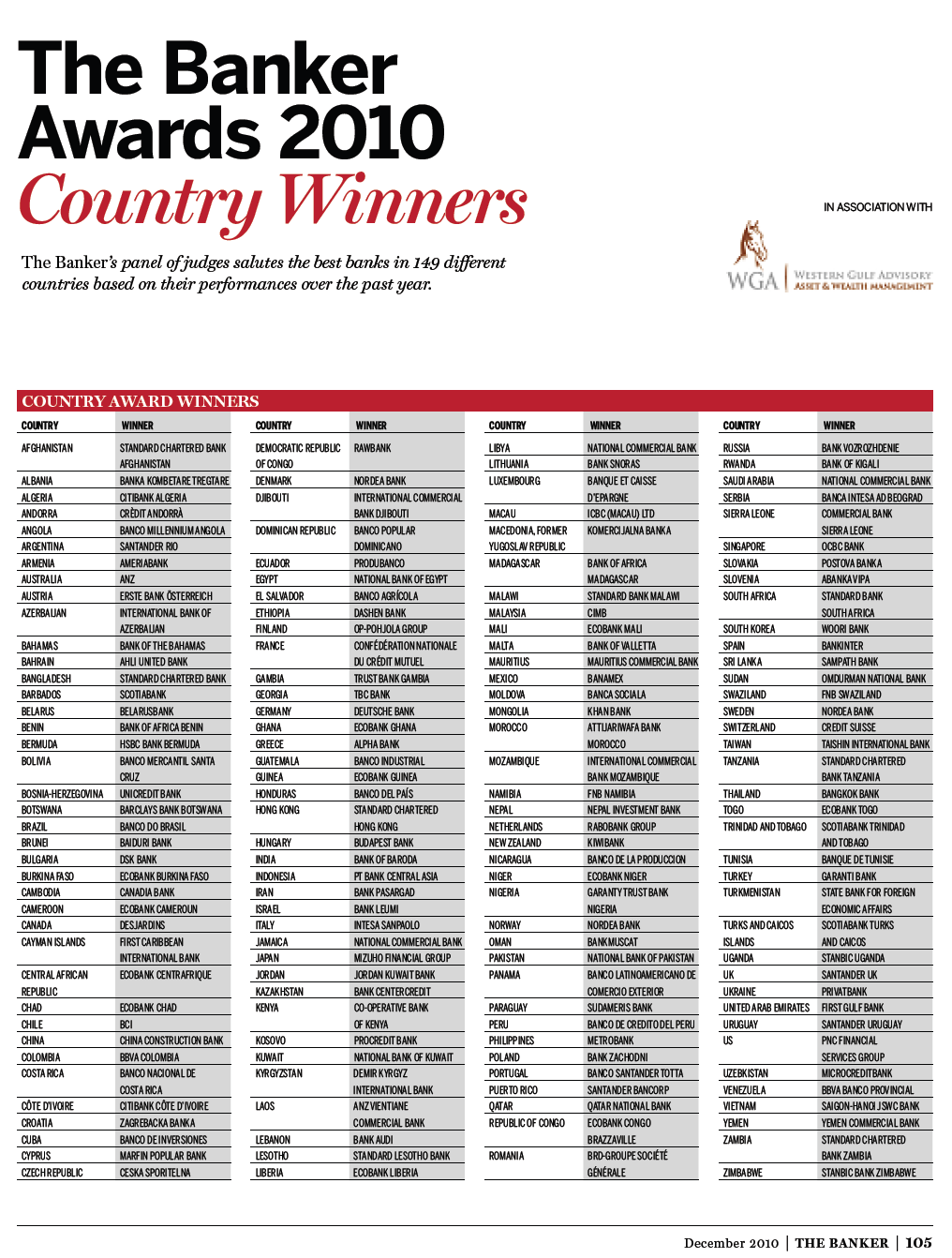
The Banker magazine awarded the annual ranking of the best banks by country for 2010 this week. The winners were selected from more than 500 entries. The best banks were selected based on their performances over the past 12 months.

The global winner for this year is UK-based Standard Chartered Bank.

The winners of The Banker Awards for 2010 are shown in the graphic below:

Click to enlarge

Banker-Best-banks-2010

Source: The Banker

Some of the notable winners are:

1. USA: PNC  Financial Services Group (PNC)

2. Canada: Desjardins

3. Australia: ANZ (ANZBY)

4. UK: Santander UK (a unit of Banco Santander (SAN) Spain)

5. Germany: Deutsche Bank (DB)

6. Spain: BankInter

7. China: China Construction Bank (CICHF)

It is interesting to note that PNC was selected as the best bank in the U.S. This is because PNC acquired the former National City Bank on the cheap at the height of the credit crisis and gained significant market share in the midwest. In addition PNC has performed well and the integration of National City appears to go smoothly. Quebec-based Desjardins beat the five major Canadian banks this year. There have been many complaints against Santander UK in terms of customer service when the Spanish giant expanded into the UK market. Despite this the bank has been chose as the winner in UK.

Disclosure: Long PNC, STD

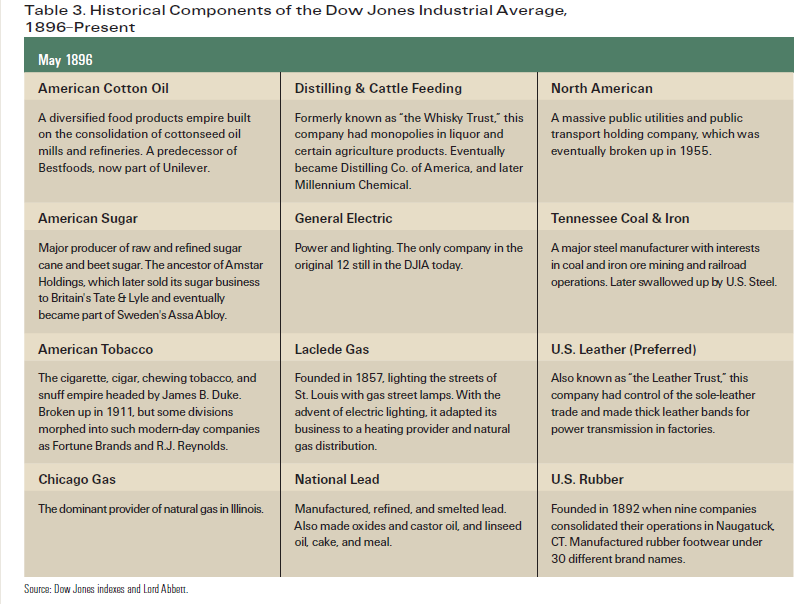
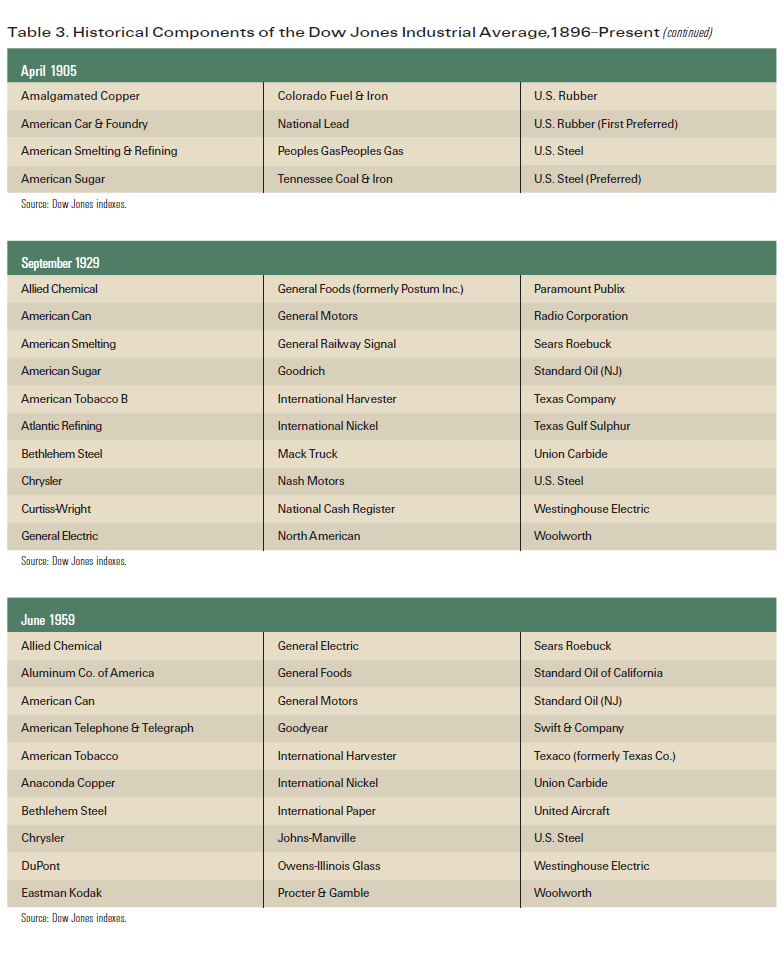
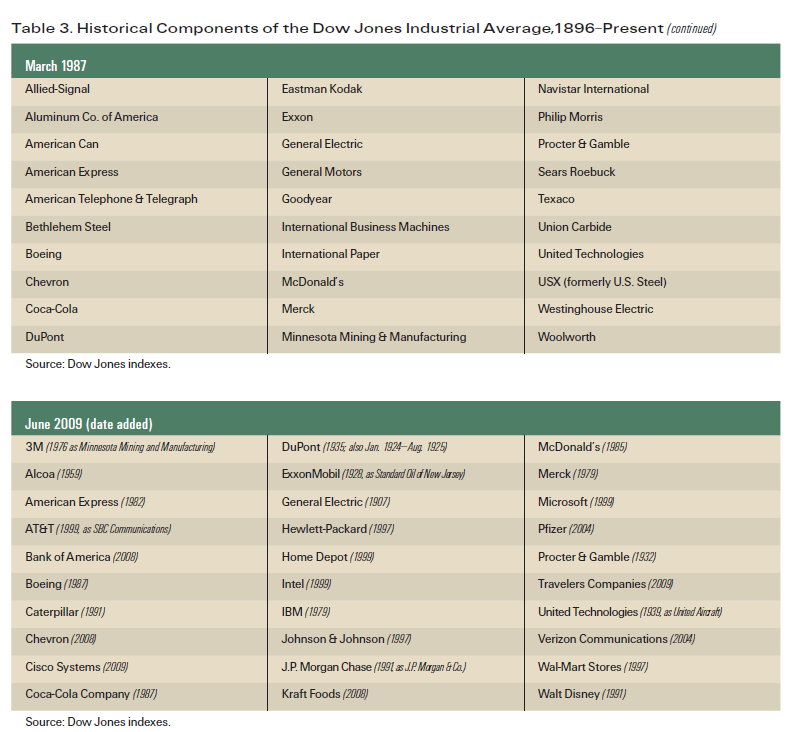
Historical Components of Dow Jones Industrial Average Since 1896

In this chart post, lets take a look at the evolution of Dow Jones Industrial Averages over the years. The composition of the index has mirrored the changes in the U.S. economy. As the U.S. economy evolved from agrarian to industrial to knowledge hi-tech economy, the components of the index have changed accordingly.

Click to enlarge

Dow-Jones-Historical-Components-1

Dow-Jones-Historical-Components-2

Dow-Jones-Historical-Components-3

Source: Appreciating Blue Chips, Lord Abbett

General Electric Co (GE) is the only company of the original 12 constituents that is still in the index today.