MSCI Index 2010 Performance by Country: Emerging, Developed and Frontier Markets

The MSCI indices are a group of indices that measure the performance of individual countries, regions, etc. ETFs and other products use these indices as benchmarks to track their performance. Hence it is important to analyze the performance of these indices at least annually. Lets take a quick look at the MSCI Index performance for individual countries for 2010.

1) Emerging Countries

Click to enlarge
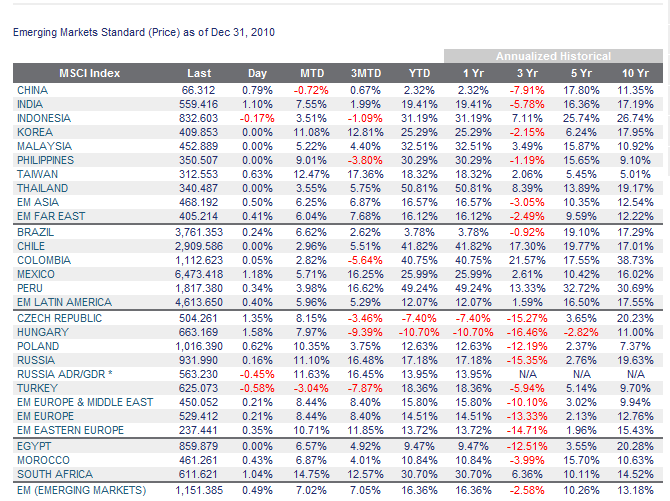
MSCI-EM-Returns

Some Observations:

  • Among the MSCI indices for Emerging countries, Thailand was the best performer with a return of about 51% and Hungary was the worst performer.
  • The indices for Chile, Colombia and Peru also returned over 40% each.
  • Among BRIC countries, India and Russia grew about 18% and 17% respectively.
  • On a 5-year basis, Peru and Indonesia are two of the best performing markets.

2) Developed Countries
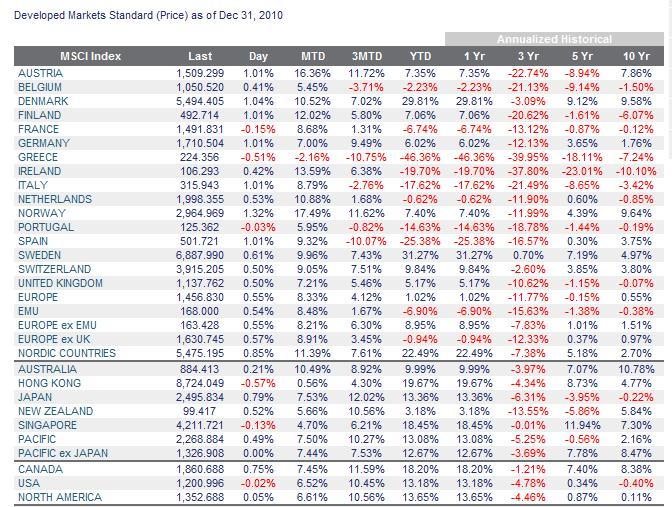
MSCI-DM-Returns

Some Observations:

  • Many Western European countries were the worst performers.
  • Sweden was the best performer with a return of about 31% followed by Denmark with about 30%.
  • Singapore tops the indices on the 5-year returns with about 12%.
  • While the U.S. returned a negative 0.40% based on 10-year returns, Canada, Australia, Norway and Denmark returned over 8% each. This vast difference in returns is significant.

3) Frontier Countries
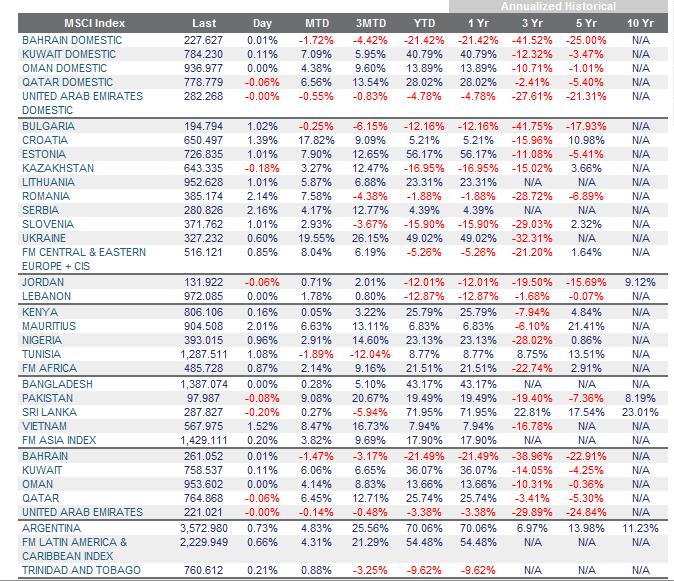
MSCI-FM-Returns

Source: MSCI Barra

Some Observations:

  • Sri Lanka beat all the other countries in this category with a return of an incredible 72%. The market there as been on a tear since the end of the decades-old civil war.
  • The indices for Argentina and Estonia also returned over 50%.

Note: All returns are noted in US Dollar terms

Related ETFs:
Claymore/BNY Mellon Frontier Markets ETF (FRN)
Market Vectors Africa ETF (AFK)
PowerShares MENA Frontier Countries Portfolio ETF (PMNA)
iShares MSCI Emerging Markets Index (EEM)
Vanguard Emerging Markets ETF (VWO)
SPDR S&P 500 ETF (SPY)
SPDR STOXX Europe 50 ETF (FEU)

Disclosure: No Positions

The 10 Biggest Banks in Africa 2010

The Global Finance magazine recently published the list of biggest banks in emerging markets.  The table below lists the ten biggest banks in Africa for 2010. These banks were ranked based on their total assets as of September, 2010. The data was provided by Bankersalmanc.com.

[TABLE=863]

South Africa-based Standard Bank Group Ltd (OTC:SBGOY) and Nedbank Group (OTC:NDBKY) have a 2.38% and 2.93% yield respectively.

Disclosure: No Positions

Why the U.S. Unemployment Rate Remains Stubbornly High?

In an earlier article I wrote about how U.S. corporate profits are rising with no job growth. The unemployment rate continues to remain high at 9.8% in November with about 15.1 Americans unemployed according to BLS data.

An article in Salon.com discussed about this conundrum facing the U.S. From the article titled “Where are the jobs? Overseas, of course“:

Corporate profits are up. Stock prices are up. So why isn’t anyone hiring?

Actually, many American companies are — just maybe not in your town. They’re hiring overseas, where sales are surging and the pipeline of orders is fat.

More than half of the 15,000 people that Caterpillar Inc. has hired this year were outside the U.S. UPS is also hiring at a faster clip overseas. For both companies, sales in international markets are growing at least twice as fast as domestically.

The trend helps explain why unemployment remains high in the United States, edging up to 9.8 percent last month, even though companies are performing well: All but 4 percent of the top 500 U.S. corporations reported profits this year, and the stock market is close to its highest point since the 2008 financial meltdown.

But the jobs are going elsewhere. The Economic Policy Institute, a Washington think tank, says American companies have created 1.4 million jobs overseas this year, compared with less than 1 million in the U.S. The additional 1.4 million jobs would have lowered the U.S. unemployment rate to 8.9 percent, says Robert Scott, the institute’s senior international economist.

“There’s a huge difference between what is good for American companies versus what is good for the American economy,” says Scott. (emphasis added)

In most U.S. multinational firms, their domestic payrolls are shrinking while the number of their overseas employees is rising fast.  The article further added:

Take the example of DuPont, which wowed the world in 1938 with nylon stockings. Known as one of the most innovative American companies of the 20th century, DuPont now sells less than a third of its products in the U.S. In the first nine months of this year, sales to the Asia-Pacific region grew 50 percent, triple the U.S. rate. Its stock is up 47 percent this year.

DuPont’s work force reflects the shift in its growth: In a presentation on emerging markets, the company said its number of employees in the U.S. shrank by 9 percent between January 2005 and October 2009. In the same period, its work force grew 54 percent in the Asia-Pacific countries.

Due to growing demand for its products in Asia, Coca Cola is investing $2.0 billion in China. In Inner Mongolia the company plans to create 2,000 jobs with a $240 million investment for three bottling plants there.

It must be noted however that most of the one million or so jobs created in 2010 are not in the high-paying sectors but in the service industries such as retail, fast-food, etc. These jobs do not pay decent salaries and benefits that Americans need to maintain their standard of living.