Shift in Global Traffic Flows Will Benefit Foreign Airlines

Many investors tend to avoid airline stocks since the industry suffers from low earnings due to various factors such as regulations, fluctuations in fuel prices, labor issues, business disruptions due to weather like snow, volcano eruptions, flawed business models, incompetent management, etc. This is especially true in the U.S. where the industry is highly concentrated with a few players. In fact, the majority of airlines in the U.S. are not profitable.While the airline industry in developed countries are experiencing stagnant to moderate growth, local airlines in emerging markets and airlines that are well positioned to serve this market are enjoying tremendous growth due to the rising popularity of air travel.

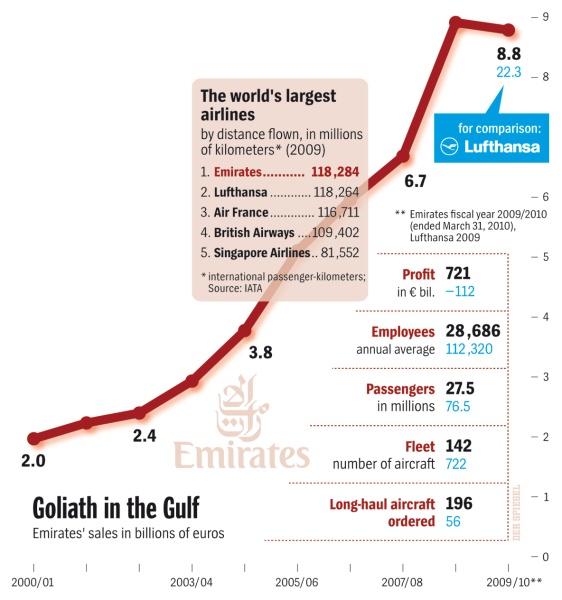
A recent article in the Der Speigel discussed the success of the Dubai-based airline Emirates. This airline has become the world’s largest airline based on distance flown and is also highly profitable. To serve the demand in its operating territory efficiently Emirates already has 15 of the massive Airbus A380s jets and has another 75 on order. Located between the emerging markets of Asia, Africa and Europe, Dubai is also trying to position itself as a major global hub for air travel. Dubai is building the world’s largest airport that will cover 54-square mile in the desert with the capacity to handle 160 million passengers each year.
Top-Airlines

Source:  Der Speigel

From the article:

In the past, the industry’s self-appointed top dogs on both sides of the Atlantic made a good living off the situation — one that was even perhaps a bit too good.

Indeed, since globalization has massively increased the significance of India and China, having connections to those countries has become all the more important. “Where 10 years ago only one person wanted to travel,” Clark says, “now you have 10,000.” And, for all of these new clients, Dubai enjoys a very central position. For example, Nigerian traders take flights connecting through Dubai to reach Shanghai or Hong Kong, where they purchase low-cost goods that they then resell at a profit in their home countries. And, for their part, the Chinese are extremely interested in making business contacts in Africa because they want to benefit from the continent’s wealth of raw materials. Indeed, even Brazilian companies would like to see more and better flight connections.

“In the 21st century,” Clark predicts, “the epicenter of global traffic flows will shift — completely and forever.”

While large industrial corporations recognized the effects of globalization early on and established a foothold for themselves in the emerging economies, Europe’s formerly state-owned airlines were initially slow to react. Until recently, they preferred to focus on taking over troubled competitors or forging alliances with their competitors.

The rigid legal system also blocked airline efforts to expand internationally. Indeed, even today, bilateral agreements between countries stipulate in painstaking detail which airline can fly where, how often and with which aircraft.

Foreign airline stocks that trade on the U.S.-organized exchanges are listed below:

1.Ryan Air (RYAAY)
Country: Ireland

2.Lan Airlines(LFL)
Country: Chile

3.Gol Linhas Aereas Inteligentas(GOL)
Country: Brazil

4.China Eastern Airlines  (CEA)
Country: China

5.China Southern Airlines (ZNH)
Country: China

Some of the foreign airline stocks that trade on the OTC markets are:

1.Deutsche Lufthansa (DLAKY)
Country: Germany

2.Cathy Pacific Airways (CPCAY)
Country: China

3.Air China (AIRYY)
Country: China

4.Air France-KLM (AFLYY)
Country:France

5.Japan Airlines (JALSQ)
Country: Japan

6.All Nippon Airways (ALNPY)
Country:

7.British Airways (BAIRY)
Country: UK

8.Easyjet PLC (ESYJY)
Country: UK

Stocks of European airlines such as British Airways, Deutsche Lufthansa, British Airways and Air France-KLM can be avoided for the reasons discussed above. However Easyjet and Ryan Air which are low-cost airlines based in Europe are growing by adding more routes and competing aggressively with the major carriers. Hence they offer potential investment opportunities.

Disclosure: No Positions

cathay-at-kaitak.jpg

 Kai Tak Airport Landing, Hong Kong
Five Foreign Stocks Under $10

Despite the recovery in global equity markets last year, some of the foreign companies with solid business models are still trading at attractive levels. Investors with a long-term horizon can add a few of these stocks selectively in phases to their portfolios for price appreciation. The following ADRs closed at under $10 as of market close on January 4, 2011:

1. Aegon (AEG)
Current Price: $6.26
Current Dividend Yield: No Regular Dividends Paid
Sector: Life Insurance
Country: The Netherlands

2. Transportadora de Gas del Sur (TGS)
Current Price: $5.71
Current Dividend Yield: 0.86%
Sector: Natural Gas Distributor and Producer
Country: Argentina

3. Telecom Corporation of New Zealand (NZTCY)
Current Price: $8.25
Current Dividend Yield: 7.36%
Sector: Telecom
Country: New Zealand

4. Torm A/S (TRMD)
Current Price: $7.14
Current Dividend Yield: No Regular Dividends Paid
Sector: Water Transportation
Country: Denmark

5. Sappi (SPP)
Current Price: $5.19
Current Dividend Yield: No Regular Dividends Paid
Sector: Forestry & Paper
Country: South Africa

Disclosure: Long TRMD

How to Grow $100,000 into $462,009 in 5 Years

Investors can build fantastic wealth by picking winning stocks and holding them for a long time. One way to identify multi-baggers is to explore overseas markets. Hundreds of foreign stocks trade on the US markets for easy investment.

Some people invest in a mutual fund or an ETF to cover a region, sector, etc. or  follow a strategy. However though both of these products offer diversification and other advantages, they are not the best way to generate very high returns. Performing research on many companies and then identifying individual stocks to invest in for the long haul is difficult but offers high satisfaction and rewards.One can hold a high-quality stock at least 5 years in order to ride out the ups and downs in the markets and to take advantage of any dividend investment opportunities and tax rates.

In a hypothetical scenario lets say an investor had $100,000 to invest five years ago. This investor opted to put in $10,000 into 10 different Latin American stocks that he/she selected. The table below lists the performance of these stocks in 5 years with dividends reinvested:

[TABLE=864]

Source: S&P Quantitative Stock Report

Note: Past performance is not a guarantee of future performance. So investors have to use the above data with caution. Before making any investment decisions, please do your own research.

In the example scenario noted above, the original investment of $100,000 grew to $462,009 in just five years. The ten stocks are of course focused on just one region but diversified into a few sectors. Mining stocks such as Brazil-based Comp Siderurgica Nacional (SID), Vale SA (VALE) and Chile-based Sociedad Quimica Y Minera (SQM) performed extremely well due to the commodity boom in recent years. Financial institutions such as Credicorp Ltd (BAP) of Peru and CorpBanca (BCA) of Chile also yielded high returns in line with economic growth in those countries. Mexico-based Coca-Cola FEMSA (KOF) and Chile-based Embotelladora Andina – B (AKO.B) are beverage makers who produce and distribute Coca-Cola and other products.

To conclude, the point of this post is to emphasize the importance of selecting stocks and also the tremendous growth that can be attained in a few years. Investing in equities is risky especially when it comes to emerging markets. However if one can allocate some part of their portfolio to these markets and held their investments for some years, the returns can be spectacular.

Disclosure: No Positions

MSCI Index 2010 Performance by Country: Emerging, Developed and Frontier Markets

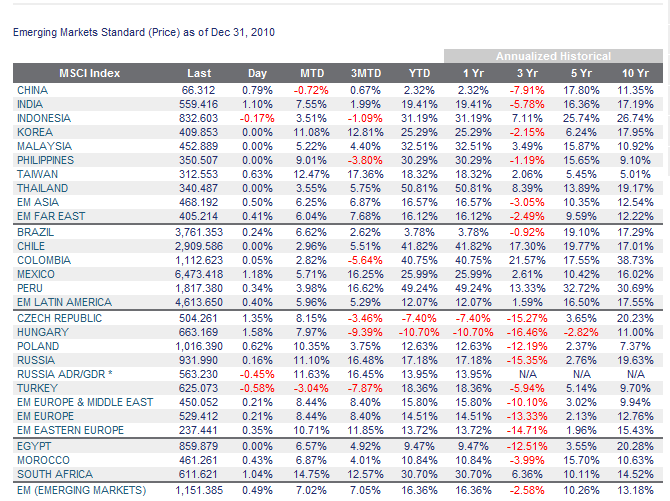
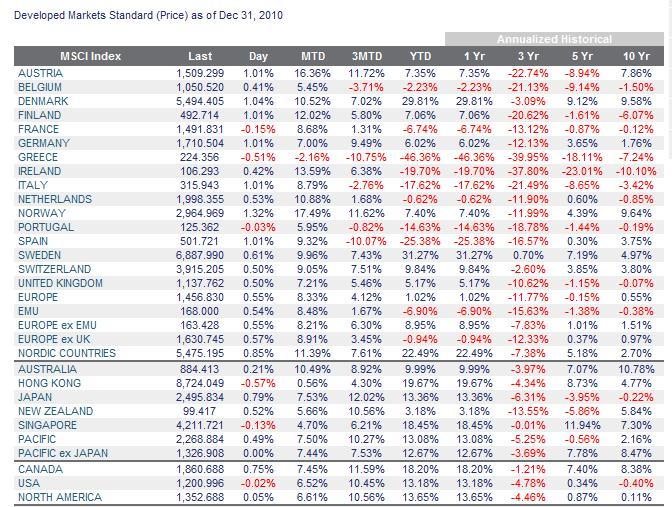
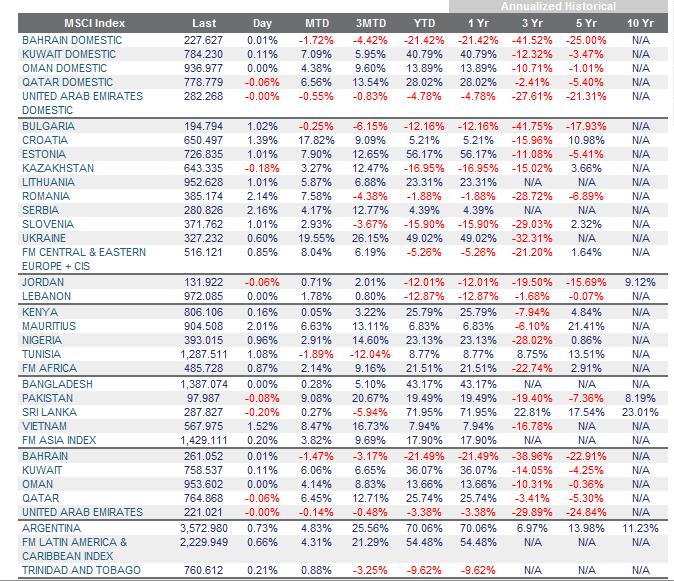
The MSCI indices are a group of indices that measure the performance of individual countries, regions, etc. ETFs and other products use these indices as benchmarks to track their performance. Hence it is important to analyze the performance of these indices at least annually. Lets take a quick look at the MSCI Index performance for individual countries for 2010.

1) Emerging Countries

Click to enlarge

MSCI-EM-Returns

Some Observations:

  • Among the MSCI indices for Emerging countries, Thailand was the best performer with a return of about 51% and Hungary was the worst performer.
  • The indices for Chile, Colombia and Peru also returned over 40% each.
  • Among BRIC countries, India and Russia grew about 18% and 17% respectively.
  • On a 5-year basis, Peru and Indonesia are two of the best performing markets.

2) Developed Countries
MSCI-DM-Returns

Some Observations:

  • Many Western European countries were the worst performers.
  • Sweden was the best performer with a return of about 31% followed by Denmark with about 30%.
  • Singapore tops the indices on the 5-year returns with about 12%.
  • While the U.S. returned a negative 0.40% based on 10-year returns, Canada, Australia, Norway and Denmark returned over 8% each. This vast difference in returns is significant.

3) Frontier Countries
MSCI-FM-Returns

Source: MSCI Barra

Some Observations:

  • Sri Lanka beat all the other countries in this category with a return of an incredible 72%. The market there as been on a tear since the end of the decades-old civil war.
  • The indices for Argentina and Estonia also returned over 50%.

Note: All returns are noted in US Dollar terms

Related ETFs:
Claymore/BNY Mellon Frontier Markets ETF (FRN)
Market Vectors Africa ETF (AFK)
PowerShares MENA Frontier Countries Portfolio ETF (PMNA)
iShares MSCI Emerging Markets Index (EEM)
Vanguard Emerging Markets ETF (VWO)
SPDR S&P 500 ETF (SPY)
SPDR STOXX Europe 50 ETF (FEU)

Disclosure: No Positions

The 10 Biggest Banks in Africa 2010

The Global Finance magazine recently published the list of biggest banks in emerging markets.  The table below lists the ten biggest banks in Africa for 2010. These banks were ranked based on their total assets as of September, 2010. The data was provided by Bankersalmanc.com.

[TABLE=863]

South Africa-based Standard Bank Group Ltd (OTC:SBGOY) and Nedbank Group (OTC:NDBKY) have a 2.38% and 2.93% yield respectively.

Disclosure: No Positions