22 Stocks to Profit from Emerging Market Consumer Sector Growth

Last year many of the emerging and frontier markets were the best performers in equity returns. However that is not the case this year. Year-to-date China’s Shanghai Composite, India’s Sensex, Brazil’s Bovespa, Mexico’s IPC All-Share, Chile’s Santiago IPSA are all down 3.3%, 7.3%, 0.2%, 3.2% and 1.1% respectively.But many developed markets are up nicely. The YTD returns of the S&P, DAX, CAC 40 and Spain’s IBEX 35 are 2.0%, 2.1%, 5.6% and 9.8% respectively. Some of the reasons for the poor performance of emerging markets are soaring inflation, rising interest rates, regulators clamping down on rampant speculation in equity markets, etc. In addition to emerging markets, frontier markets are also falling this year. Big crashes in Bangladesh shares have triggered wide-spread protests there.

Considering the facts above, should investors completely avoid emerging and frontier markets this year?. Absolutely not. Though the markets are falling in the short-term there are plenty of opportunities for the long-term investor. The consumer sector is one of the key areas that investors can focus on to invest in these markets. Consumption of goods and services is growing sharply in India, China, Brazil, Kenya, Nigeria, etc. A recent study by HSBC and Standard Chartered predicts that the share of global output for emerging economies is likely to grow while that of the U.S. and Europe will fall in the coming years. Accordingly, the GDP per capita for those countries is projected to increase faster than developed markets in the next 20 years with China’s per capita GDP rising over 220% (Source: Bloomberg BusinessWeek).

From an article in the Financial Post:

Rising disposable incomes, high savings rates and low credit penetration have made the emerging market consumer one of the most attractive themes for investors in recent years.

Since emerging markets are only at the beginning of their consumer credit cycle, the strong consumption growth witnessed during the past 20 years should continue to for some time.

While the population of emerging markets is more than 3.9 billion people – more than 80% of the global population – the market cap of consumer stocks in emerging markets is just US$500-billion, according to strategists at Bank of America Merrill Lynch. That compares to a market cap of US$4.7-trillion for consumer companies in the United States, Europe and Japan.

“Simply put, there is far more liquidity in the developed market consumer stocks,” they said.

One way to profit from the growth in consumer sector in emerging markets is to invest in developed market companies with high exposure to emerging markets.  The strategists at BofA Merrill Lynch identified the following 22 large-cap companies that generated at least 30% of their 2009 sales from emerging markets:

[TABLE=873]

The majority of the companies in the list are US-based multinationals. German firms Henkel and Adidas have strong brands that are popular in developing countries. European giants Unilever, Nestle, Danone, Heineken are highly successful companies with a portfolio of brands that hold leadership positions across the globe. Switzerland-based Nestle (NSRGY) is a perfect example with a history of innovation and conservative growth .Overall, with the exception of Swatch Group all the companies noted above sell high-quality, affordable consumer products that are in high demand in developing countries. Hence investors looking to gain exposure to emerging markets can add these consumer sector stocks selectively before adding stocks from other sectors.

Disclosure: Long Henkel

Knowledge is Power: Oil Price, Top Canadian Stocks, Microcredit Edition

Six golden rules for profitable investing

Union Membership in U.S. Fell to a 70-Year Low Last Year

Oil price to break $200, says Jim Rogers

Gold’s steel grip on buyers

Bank on dividend compounding

Top 200 Canadian stocks 2011

Emerging Africa Expected To See Rise in Investment

Economy: Well functioning housing markets are key for stability and growth

DRs: BRIC Countries To Lead DRs in 2011

Equities focus shifts back to U.S.

What’s gone wrong with microcredit?

Reunion-Island

Reunion Island, Indian Ocean


The Top 20 Foreign Holders of U.S. Treasury Securities

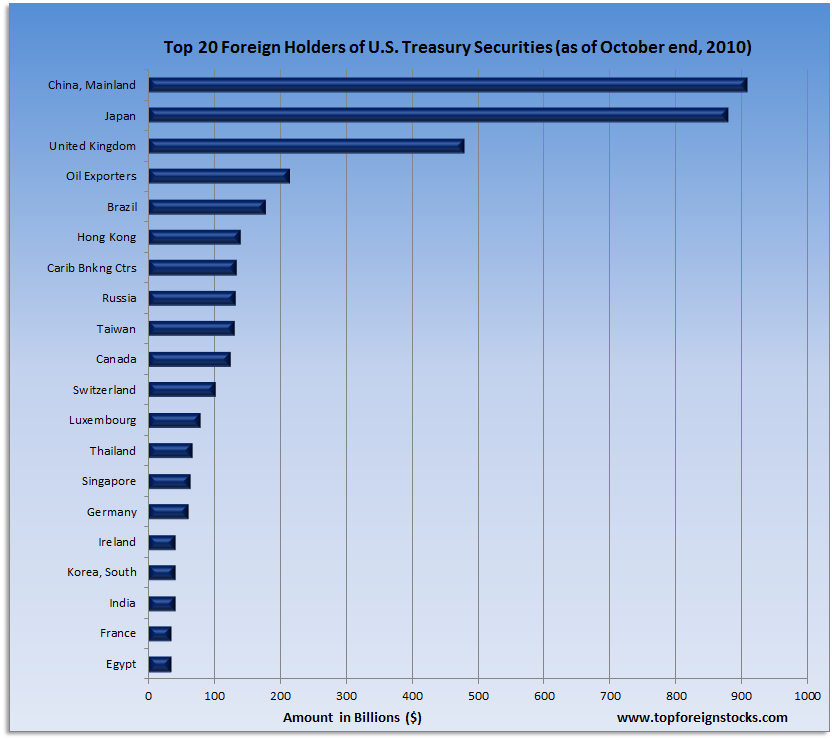
The graphic below shows the top 20 foreign holders of U.S. Treasury Securities at the end of October, 2010:

Click to enlarge

Top-20-Foreign-Holders-US-Debt

Source: Department of the Treasury/Federal Reserve Board

Note:
United Kingdom includes Channel Islands and Isle of Man.

Oil exporters include Ecuador, Venezuela, Indonesia, Bahrain, Iran, Iraq, Kuwait, Oman, Qatar, Saudi Arabia,the United Arab Emirates, Algeria, Gabon, Libya, and Nigeria.

Caribbean Banking Centers include Bahamas, Bermuda, Cayman Islands, Netherlands Antilles and Panama.Beginning with new series for June 2006, also includes British Virgin Islands.

Holdings represent U.S. Treasury marketable and non-marketable bills, bonds, and notes. China continues to be the largest holder of U.S. treasury debt followed by Japan and UK. Japan has increased its holdings from $742 billion in October 2009 to $877 billion in October 2010. The UK has more than tripled its US treasury debt holdings from over a year ago.

The total U.S. debt held by foreign countries jumped from about $3.5 Trillion in October 2009 to $4.3 Trillion in October last year. It must be noted however the data above denotes only the debt held by foreigners. The majority of the total outstanding U.S. debt is still held by the American public.

The World’s 10 Largest Non-German Auto Industry Suppliers Offer Excellent Investment Opportunities

The auto industry is one of the best industries to invest in in emerging markets or developed markets as autos have become the preferred mode of transportation for everyone. However the industry is a low margin business and many automakers are not highly profitable.Then how does one profit from this industry?

One way to profit from the growing auto business worldwide is to invest in the automotive parts suppliers.These suppliers produce everything from tires to wipers that become part of a vehicle.

Germany is one of the largest makers of world-class cars. The automotive industry is the largest in Germany employing over 723,000 workers directly and accounting for about 20% of total revenues of all the German industries. The country is also one of the top leaders in auto production with 20.4 million vehicles produced in 2009 which is equivalent to 17% of global vehicle production. About 70% all vehicles made in Germany are exported.

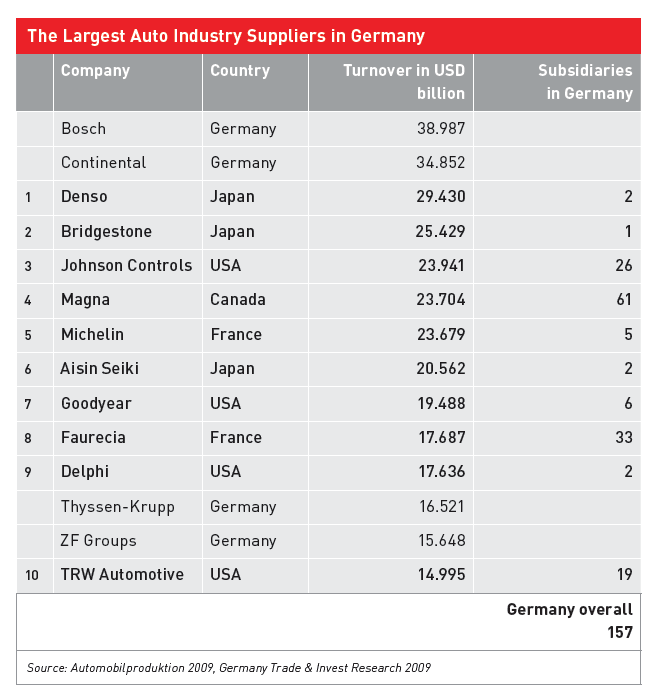
The highly successful German auto industry offers huge market opportunities for auto components suppliers. Hence in addition to thousands of small and medium-sized domestic suppliers, Germany hosts all of the ten largest auto suppliers in the world. As the value added in the industry increasingly moves to the supplier side these international suppliers play an integral part of the growth of the auto makers not just in Germany but in other countries as well.

The chart below shows the 10 largest international auto-industry suppliers in Germany:

Top-10-Non-German-Auto-Suppliers

Source: The Automotive Industry in Germany, Issue 2010/2011, Germany Trade & Invest

The following is a short overview of each of the suppliers:

1.Denso Corp (OTC:DNZOY) is headquartered in Kariya, Aichi prefecture, Japan. Denso is a leading automotive supplier of advanced technology, systems and components in the areas of thermal, powertrain control, electric, electronics and information and safety to the world’s major car makers. The company has more than 200 subsidiaries and affiliates in 34 countries (including Japan) and employs approximately 120,000 people.In the first half of fiscal year that ended in September 2010, Denso announced net sales of $19.0 billion which was a 22% increase from the previous year.In Europe, due to an increase in production volume by BMW, Ford and Land Rover, operating income totaled US$64.2 million, a 115.4 percent increase from the previous year. The ADR closed at about $18 on Friday. After a strong run, the stock split 8 for 1 in October, 2010.

2. Japan-based Bridgestone (BRDCY) operates in two segments: tire segment and diversified product segment. The tire segment is engaged in the manufacture and sale of tires.  The diversified product segment produces auto-related parts, sports products such as golf balls and golf club, etc. The stocks closed at $37.66 this past Friday.

3. Johnson Controls (JCI) provides automotive interiors, batteries for automobiles and hybrid electric vehicles, along with related systems engineering, marketing and service expertise . For buildings, the Johnson Controls offers products and services that optimize energy use.With the market cap of $27.4 billion, the company’s annual revenue has increased about 20% in the last five years.

4. Magna International Inc (MGA) is an Aurora,Ontario based diversified automotive supplier with operations in 25 countries. Magna designs and manufactures automotive systems, components mainly for sale to makers of cars and light trucks. Annual revenue has increased by about 36% in the past 5 years. Magna expects total sales to be between $25.6 billion and $27.1 billion this year.

5. Founded in 1888, French tire maker Michelin owns the Michelin, BFGoodrich, Taurus, Kormoran and Uniroyal (in North America) brands.

6. Aisin Seiki Ltds (ASEKY) is a leading Japanese manufacturer with a complete range of automotive parts. Aisin is a Fortune Global 500 company with operations in many countries.

7. Ohio-based Goodyear Tire & Rubber Company (GT) is a manufacturer of tires. In addition to manufacturing tires, the company operates 1,500 tire and auto service center outlet. Goodyear has 57 manufacturing facilities in 23 countries.

8. Faurecia SA(FURCF), is a French specialist in the engineering and production of automotive solutions. The company operates 200 production sites in 32 countries  and is Europe’s third largest automotive supplier.Annual revenues in 2009 exceeded 92 billion Euros.

9. Based in the U.S., Delphi is a leading global supplier of electronics and technologies for automotive, commercial vehicle and other market segments with operations in 30 countries. In 2009 Delphi exited from bankruptcy protection and is now a private company.

10. Headquartered in Livonia, Michigan, TRW Automotive Holding Corp (TRW) operates in 26 countries and employs over 60,000 people worldwide.TRW’s products include integrated vehicle control and driver assist systems, braking systems, steering systems, suspension systems, occupant safety systems (seat belts and airbags), electronics, engine components, fastening systems and aftermarket replacement parts and services. In 2009, sales totaled $11.6 billion.

German auto suppliers ThyssenKrupp AG and Continental AG trade on the US OTC markets under the tickers TYEKF and CTTAY respectively. A complete list of auto suppliers listed on the NYSE can be found here.

Disclosure: No Positions

Focus on the Long-Term Potential with International Investments

Investing in stocks of foreign companies offers many advantages including diversification benefits, lower correlations with home markets, etc. However investors must focus on the long-term returns of overseas investments and not try to time the markets or trade often looking to make higher returns in the short-term.

The chart below shows the annual total returns of foreign stocks during each of the past 25 years compared with the 25-year average annual total return (13.1%):

foreign-stocks-returns-by-year.PNG
Source: Standard & Poor’s. Foreign stocks are represented by the calendar-year returns of the MSCI EAFE Index. Returns shown include dividends reinvested.

In the short-term, as the chart shows there is high volatility in international investing. However over the long-term such as 25 years investors are nicely rewarded with a double-digit return.

Related ETF:
iShares MSCI EAFE Index Fund (EFA)

Disclosure: No Positions