Top 15 North America-Focused Exploration & Production Companies

Crude oil prices continue to march higher due to geo-political risks and other factors. On the New York Mercantile Exchange March crude rose 0.1% to settle at $90.86 a barrel. Across the U.S. consumers are already feeling the impact of rising oil prices with pump prices well above $3.00 a gallon.With the economy slowly recovering, gasoline demand may increase.

In the production of crude oil and natural gas, North America was considered to be in terminal decline for many years.However that has changed with surprising production growth coming from onshore North American wells. The global oil consultancy firm PFC Energy celebrated this revival by publishing a new list of top Exploration and Production (E&P) companies. These North America-focused E&P firms derived at least 80% of their 2010 production from North America.

The table below lists the top 15 North America-focused E&P firms:

[TABLE=877]

Source: PFC Energy

Encana and Penn West are based in Canada. The share prices of majority of the companies above rose by double digit percentages last year.  Instead of focusing their attention on the integrated global oil majors such as BP plc (BP) or ExxonMobil(XOM), investors looking to profit from growth in North American production may want to consider some of these E&P companies.

Knowledge is Power: Corporate Taxes, Newton, German Recovery Edition

Big companies should pay as little tax as they can get away with

The Paradox of Corporate Taxes

500,000 Britons have never worked

US vs UK: Two countries, divided by a deficit

2011: The year for aluminum, molybdenum, zinc and potash

Will risk on, risk off continue into 2011?

‘Germany Is Admired for How Quickly It Emerged from the Crisis’

Crash landing

Newton moves markets too

Economy: Well functioning housing markets are key for stability and growth

thailand.jpg

Floating Market, Thailand


New ADR Listings: Interxion, Adecoagro and BCD Semiconductor

Last week three new foreign companies were listed on the U.S. organized exchanges. The following is a brief overview of them:

1. InterXion Holding N.V. (INXN) is an Amsterdam, The Netherlands-based provider of colocation data center services. InterZion serves over 1,100 customers through 28 data centres in 11 European countries. The company offered about 20 million shares at $13.00 per share. Shares closed at $13.80 on the first day of trading.

In 2009, total revenue was $171.7 million €. Revenues have grown over 23% year-over-year since 2006. InterXion was founded in 1998 and is backed by major investors including Credit Suisse First Boston, Goldman Sachs and Morgan Stanley Dean Witter. More information about InterXion is available at their investor relations site here.

2. Adecoagro S.A is an agricultural company in South America involved in the production of many agricultural products, including corn, rice, wheat, soybean and sugar among others, as well as ethanol and milk.Founded in 2002, the company owns over 270,000 hectares with operations in Argentina, Brazil and Uruguay. Ethanol is the main source of fuel for transportation in Brazil and the demand for rice, sugar and beef is growing in other emerging countries. Adecoagro is in a sweet spot to capitalize on this demand since the land it owns is highly fertile and hence yields will be high relative to yields in developing countries such as China, India, etc. Hence this company is worth monitoring for potential investment in the future.

Adecoagro priced about 28.5 million shares at $11.00 per share and trades under the ticker AGRO. On debut, shares jumped about 10% and ended the day at $12.00 even. For further research please visit their corporate site here.

3. BCD Semiconductor Manufacturing Ltd. (BCDS) is a Shanghai,China-based designer and manufacturer of analog integrated-circuit semiconductors for Asian makers of consumer electronics, ranging from computers to mobile-phone chargers. BCD began operations in 2002. BCD’s website has more detailed information on their products.

BCD offered 6 million shares in the $10.50 to $12.50 range. The stock closed flat on the NASDAQ market at $10.50.

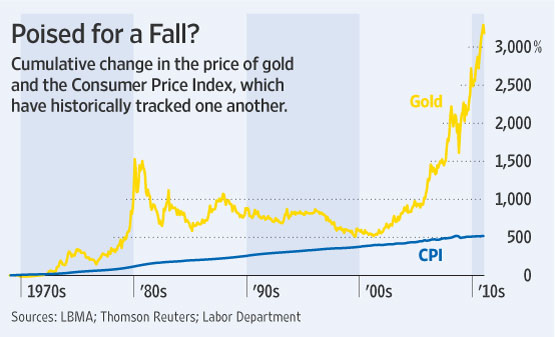
Relationship Between the Price of Gold and CPI

Gold prices surged 1.8% to close at $1,340.70 an ounce yesterday as investors sought the safety of the yellow metal. Despite the slight fall in gold prices so far this year, gold has had an incredible run in recent years.

An article in The Wall Street Journal takes a bearish view on gold suggesting that gold’s golden era may be over.

gold-cpi.jpg

 From the article:

How far could gold fall in the short term? Technical measures suggest that gold’s current price is close to its near-term “support” level—the price at which investors, attracted by a perceived bargain, are expected to rush in. If it falls below $1,320 and stays there, the next price where buyers would be expected to cluster would be near $1,280.

Over the longer term, too, the case for gold seems less compelling, say some analysts. While the metal has traditionally been seen as a buffer against runaway inflation and a collapsing dollar, at these prices gold may have less value as an insurance policy than investors might think.

Take inflation. From 1968—when investors started to price in the possibility of the U.S. dropping the gold standard—to 2001, the price of gold rose 5.6% a year, while the Consumer Price Index gained 5.1% annually. That hasn’t been the case recently: Since 2001 gold has surged 18.8% annually, while the CPI has risen just 2.3%.

To restore their historical relationship, inflation would have to rise by 8.3% a year for the next 20 years to justify current prices. If inflation were to rise by its average since 1968 of 4.7%, gold would have to drop 3.6% a year for the next 20 years, according to Tim Courtney, chief investment officer at Burns Advisory Group. “This latest gold craze is way overdone,” he says.

It remains to be seen if gold prices would decline or gain further this year.

Five European Utility Stocks Trading Under $10

The following five European utilities trading on the OTC markets have dividend yields of over 3% and prices under $10. All of them are large companies in their respective countries. For example, Electricite de France SA (ECIFY) has a market cap of $80.4 billion.However ECIFY is not on the radar of most U.S. investors as it is traded on the OTC markets.  But the stock is fairly liquid with a daily average trading volume of over 100,000. So investors looking to gain some exposure to established European utilities that pay dividends can consider adding these stocks.

1. EVN AG (OTC:EVNVY)
Sector: Electric Utility
Country: Austria
Current Dividend Yield: 3.51%
Current Stock Price: $3.05

2. Verbund AG (OTC:OEZVY)
Sector: Electric Utility
Country: Austria
Current Dividend Yield: 3.28%
Current Stock Price: $8.05

3. Electricite de France SA (OTC:ECIFY)
Sector: Electric Utility
Country: France
Current Dividend Yield: 3.38%
Current Stock Price: $8.70

4. Gas Natural Sdg SA (OTC: GASNY)
Sector: Gas Utility
Country: Spain
Current Dividend Yield: 6.05%
Current Stock Price: $3.00

5. Enel (OTC:ENLAY)
Sector: Electric and Gas Utility
Country: Italy
Current Dividend Yield: 4.64%
Current Stock Price: $5.57

Disclosure: No Positions