Sir John Templeton: 16 Rules For Investment Success

sir-john-templeton.jpgSir John Marks Templeton, the great American-born British stock investor and a mutual fund pioneer was a believer in fundamental analysis and followed the “buy when there’s blood in the streets” philosophy.  He published the following 16 Rules For Investment Success in World Monitor: The Christian Science Monitor Monthly in 1993.  Though published many years ago, these core investment philosophies are still relevant today for any investor.

  1. Invest For Maximum Total Real Return
  2. Invest—Don’t Trade Or Speculate
  3. Remain Flexible And Open-Minded About Types Of Investment
  4. Buy Low
  5. When Buying Stocks, Search For Bargains Among Quality Stocks
  6. Buy Value, Not Market Trends Or The Economic Outlook
  7. Diversify. In Stocks And Bonds, As In Much Else, There Is Safety In Numbers
  8. Do Your Homework Or Hire Wise Experts To Help You
  9. Aggressively Monitor Your Investments
  10. Don’t Panic
  11. Learn From Your Mistakes
  12. Begin With A Prayer
  13. Outperforming The Market Is A Difficult Task
  14. An Investor Who Has All The Answers Doesn’t Even Understand All The Questions
  15. There’s No Free Lunch
  16. Do not be fearful or negative too often

Source: World Monitor:The Christian Science Monitor Monthly, 1993
MoneySense: Canada’s Top Value, Growth and All-Star Stocks for 2011

In an earlier article I wrote about why Canadian stocks are projected to offer the best returns this year based on a research report by CIBC. In this post, lets take a quick look at some of the top Canadian stocks as identified by MoneySense magazine in the beginning of this year.

1) Top Value Stocks

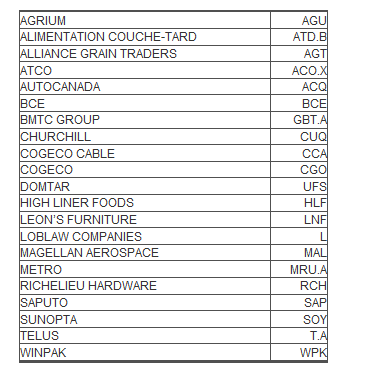
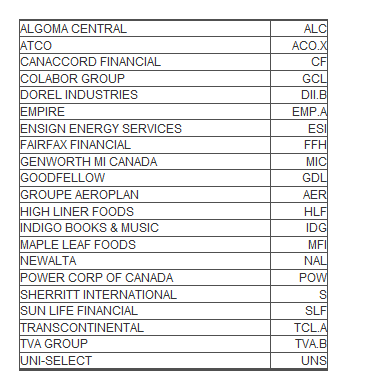
MoneySense evaluated all Canadian stocks based on many factors such as price-to-book-value ratio, price-to-tangible-book-value ratio, price-to-earnings ratio, leverage ratios, dividend payments, etc. and awarded a grade of A to the best firms. This methodology yielded the following 21 ranked value stocks:

top-ca-value-stocks.png

2) Top Growth Stocks

Using factors like earnings-per-share, sales-per-share growth over the past three years, etc. the following top ranked growth stocks were identified:

top-ca-growth-stocks.png

3) All-Star Stocks

For this category, only 12 stocks earned at least one A and one B on MoneySense’s value and growth tests. In 2010, these all-stars beat the market with a huge gain of 19.7%. In the last five years, this All-Stars list has outperformed every Canadian equity mutual fund.

The All-Star stocks for 2011 are:

  1. ALIMENTATION COUCHE-TARD (ATD-B.TO)
  2. ATCO (ACO-X.TO)
  3. AUTOCANADA (ACQ.TO)
  4. DOMTAR (UFS)
  5. DOREL INDUSTRIES (DII-A.TO)
  6. FAIRFAX FINANCIAL (FFH.TO)
  7. GOODFELLOW (GDL.TO)
  8. GROUPE AEROPLAN (AER.TO)
  9. HIGH LINER FOODS (HLF.TO)
  10. LEON’S FURNITURE (LNF.TO)
  11. MAGELLAN AEROSPACE (MAL.TO)
  12. TVA GROUP (TVA-B.TO)

In addition to Domtar, some of the above-mentioned stocks trading on the US exchanges include BCE Inc (BCE), Telus (TU), Sun Life Financial (SLF) and Agrium (AGU).
Disclosure: No Positions

Will This Jobs Recovery Lead a Strong U.S. Economic Recovery?

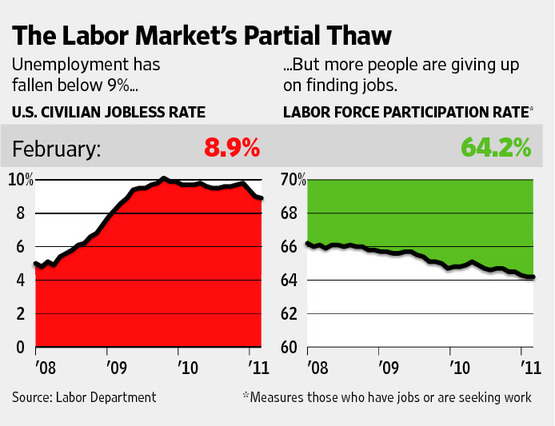
U.S. employers created 192,000 jobs in February pushing the unemployment rate to below 9% according to the Department of Labor. While this is a positive news, investors may want to dig a little deeper before making any conclusions on the state of the U.S. economy.

us-unemp-rate.jpg

Source: The Wall Street Journal

An editorial in the Journal praises the supposed economic recovery commenting the following:

With 192,000 new jobs created in February, the U.S. economic engine clearly has shifted into forward recovery. The unemployment rate for the first time in 20 months nudged below 9%, settling at 8.9%.

In the private economy, the source of real wealth, hiring expanded by 222,000. Government employment receded. Gains in jobs were particularly welcome in manufacturing and construction (each up 33,000), transportation (22,000) and business services (47,000). The construction hiring hints that perhaps the worst of the housing depression is over.

The pace of job growth from a recession that vaporized some eight million jobs has been the most anemic of all post-World War II recoveries. Keynesians will have a hard time explaining why the jobs recovery started long after the bulk of the stimulus dollars were spent.

We still have 13.7 million officially unemployed Americans, with 2.7 million more who stopped looking for jobs. Nearly half (43.9%) of those without jobs have been out of work at least six months. The main reason the unemployment rate has fallen the last several months is that the number of working-age Americans not in the labor force dropped by two million over the past year. The U.S. economy needs to maintain a pace of 190,000 net new jobs for at least the next 12 months merely to get the jobless rate back to a still awful 8%. At least the jobs recovery is finally headed in the right direction.

But is this type of job recovery good enough to sustain a strong economic recovery?. The answer is absolutely no in my opinion.

The majority of the jobs that are being created are not high-paying permanent jobs but temporary and low-paying jobs. This has implications for the consumption-based U.S. economy as most of these workers will not able to stimulate consumer spending like they did before the recession. A recent article in Bloomberg BusinessWeek discussed this aspect of the current recovery. From the article titled “A U.S. Recovery Built on Low-Paying Jobs“:

Before she lost her job last November as a full-time health department caseworker in Aurora, Ill., Amy Valle was making $23 an hour. Now she’s paid $10 an hour as a part-time assistant coordinator in an after-school program. “From here on out, it will be a struggle,” says Valle, 32, whose husband lost his $50,000 government job and still is out of work after a year. “I don’t feel like there’s any place we can go to get what we were getting paid.”

While the unemployment rate dropped to 9 percent in January, from a two-decade peak of 10.1 percent in October 2009, many of the jobs people are now taking don’t match the pay, the hours, or the benefits of the 8.75 million positions that vanished in the recession, according to Paul Ashworth, chief U.S. economist at Capital Economics in Toronto.

This may restrain wage and salary growth, limiting gains in consumer spending, which accounts for 70 percent of the U.S. economy. The good jobs that would trigger a solid boost in spending just don’t seem to be there. “In the last recovery we were adding management jobs at this point, and this time it’s disappointing,” says Ashworth, who published a report on Jan. 27 about pre- and post-slump employment based on U.S. Labor Dept. data. “The very best jobs, we’re still losing those.”

Projections from the Bureau of Labor Statistics reinforce his pessimism. While the number of openings for food preparation and serving workers will grow by 394,000 in the decade ending in 2018, the average wage is only $16,430 including tips, based on 2008 data. Meanwhile, the number of posts for financial examiners, who work at financial-services firms to ensure regulatory compliance, will expand by just 11,100. The average pay for examiners is $70,930.

Like the article notes above, the growth of low-paying service sector jobs such as food preparers and servers are not going help much to this economy. Jobs that pay excellent pay and benefits such as those in the IT and manufacturing industries are not being created in this recovery.Most of the jobs in these sectors that were off-shored or eliminated due to technological advancements are not coming back anytime soon.So from an investment standpoint, it is better to avoid U.S. consumer sector stocks as consumer spending is not going to pick up steam with the current recovery.

Six Reasons to Invest in German Chemical Stocks

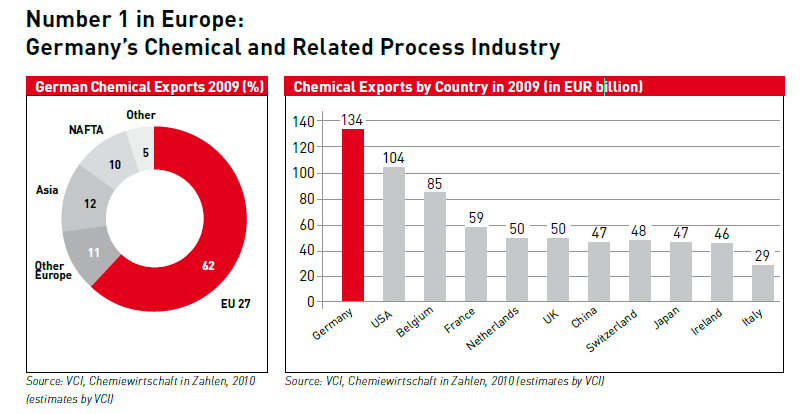
The German chemical industry is the fourth largest in the world and number one in Europe. Traditionally Germany has maintained leadership position in this industry beating other countries due to innovative policies encouraging investment, highly specialized educational programs fostering the advancement of chemical science, world-class infrastructure, sustainable development with public and private sector partnership, substantial development, high investment in R&D, etc. As chemicals are an ingredient in most of the products we consume, this sector offers attractive opportunities for long-term investment. German companies are especially well-positioned to profit from growth in the developed world and in the emerging countries.

The following are some of the reasons to invest in German chemical stocks:

  • Germany is Europe’s preferred location for chemical investment.
  • Germany is the world’s largest exporter of chemicals.

Click to enlarge

german-chemcial-industry.png

  • German chemical firms set the benchmarks for advancement of various state-of-the-art technologies in other sectors.
  • Located in heart of Europe, chemical firms supply their products to other industries in Europe with easy access to a market of more than 450 million customers.
  • The country is home to 40 large-scale chemical parks that offer excellent infrastructure including their own power plant.
  • Global chemical firms such as Dow Chemical, Ineos and Sabic have a significant presence in Germany.

Source: Germany Trade and Invest

The four German chemical companies available for US-investors as sponsored ADRs  on the the OTC market are listed below:

1. BASF AG (BASFY)
Current Share Price: $84.48
Current Dividend Yield: 2.63%
Total Revenue: $89.3B

2. Bayer (BAYRY)
Current Share Price: $79.10
Current Dividend Yield: 2.33%

3. K+S  AG(KPLUY)
Current Share Price: $39.26
Current Dividend Yield: 0.32%

4. Linde AG (LNEGY)
Current Share Price: $15.76
Current Dividend Yield: 1.46%

Note: Stock prices and dividend yields noted are as of market close Mar 4, 2011

Disclosure: No Positions

Factors Affecting Global Food Prices

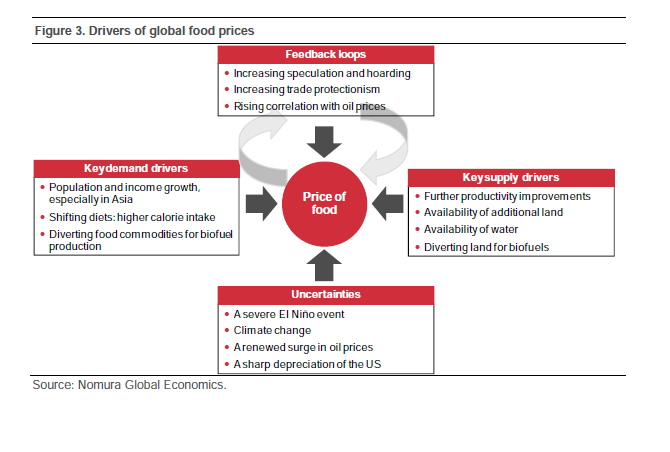
Crude oil is the most traded commodity in the world. However other than just supply and demand, a multitude of factors impact oil prices on a daily basis. Similar to the crude oil example, the prices of food are affected by a variety of complex factors. While in the past, food prices were determined just by the variables of supply and demand, today many factors come into play. The following graphic shows some of the factors and their impact on global food prices:

Factors-affecting-global-food-prices

Source: Nomura Global Economics

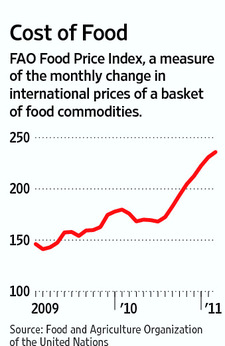
One of the main factors that affect food prices is the price of oil. As the price of oil has shot up in recent months food prices have also followed suit. The following chart from a Journal article confirms this trend:

food-chart.jpg

From the article:

The Food and Agriculture Organization price index rose by 2.2%—the eighth consecutive rise since June—to an average of 236 points last month, the highest record in real and nominal terms since the agency started monitoring prices in 1990.

Global cereal supplies are also expected to tighten sharply this year due low stock levels, the FAO said. The body raised its estimate for world cereal production in 2010 by eight million metric tons from its December estimate to 2.2 billion tons but said it expects that to be outpaced by an 18 million-ton increase in world consumption.

But while the world isn’t yet facing a food crisis, the secretary of the FAO’s Intergovernmental Group on Grains, Abdolreza Abbassian, said the recent rise in Brent oil prices to above $120 a barrel could create the same potent mix of factors that pushed grain prices to record highs three years ago.

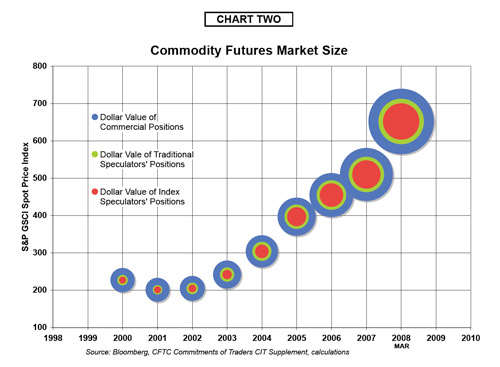
Another factor affecting global food prices is the rise in speculation in food commodities. From a CFR 2009 article on food prices:

food-specualtion.jpg

Source: CFR

Rising food prices may also affect the fragile economic recovery. As struggling consumers battle on two fronts – one with soaring fuel prices and the other with food costs – they may cut down on spending on other goods and services. A recent article in This is Money website of UK noted this point:

“Economists also fear that food price hikes will reduce economic activity and squeeze household spending as families desperately cut back elsewhere.

A UN report yesterday revealed that rises in bread, pasta, breakfast cereal, dairy and meat prices are on the horizon – irrespective of future oil price hikes.

The commodity price of key foods rose again in February, making it the eighth successive month of increases, according to the UN Food & Agriculture Organisation. It pointed out the export prices of wheat, corn and rice are up by a staggering 70% in one year.”

Overall if oil prices do not fall there is a serious risk for the global economy to enter into a recession again.