Investing in Emerging Markets is a Must

Emerging markets have not performed well in recent months compared to many developed markets. Investors are concerned about investing in emerging markets due to inflation, political risks and other factors. However according to a report by Josephine Shea of Hartford Investment Management the best days of emerging markets(EM) are in fact ahead of us. He offers the following reasons on why investing in emerging markets is a must:

  • The future growth of U.S. multinationals is in emerging markets and not in the domestic market.
  • Global GDP is expected to grow 4.4% this year with roughly two-thirds driven by EM.
  • According to the IMF, the growth rate for China and U.S. are estimated to be 4.4% and 11.7% per year for 2011-2015.
  • Emerging and developing economies already produce 36.5% of global GDP.In ten years that could be 50% and by 2030, as high as 60%.
  • Foreign Direct Investment (FDI) flows into emerging markets have rebounded since the financial crisis according to a United Nations Conference on Trade and Development (UNCTAD).
  • In just five years, the market capitalization of the Hang Seng Index grew 48%, the Bombay 200 Index 55%, the Shanghai Composite Index 123%, the Brazil Bovespa Index 77% and lastly Russia’s RTS Index 38%, while the market capitalization of the S&P 500 Index has gone up only 2.5%.
  • Large EM corporates have stronger credit rating than their U.S. peers.

Source: Emerging Markets No Longer a Choice; A Must – Hartford Investment Management

Some of the large-cap emerging market giants are Petrochina Co Ltd of China (PTR), Vale SA (VALE) of Brazil, HDFC Bank Ltd (HDB) of India and Gazprom OAO (OGZPY) of Russia. While investing in EM companies directly is one way to profit from their growth another option is to simply invest in U.S. and European multinationals who have a strong presence in developing countries. Examples of such western multinationals include Nestle (NSRGY), Caterpillar Inc(CAT), Unilever (UN, UL), Coca Cola (KO), etc. A list of the top 25 U.S. and European multinationals with high exposure to emerging markets can be found here and here.

Disclosure: No positions
Brazil’s Trade With China Soars

One of the factors that investors need to consider when selecting an emerging market for investment is the country’s trade with other emerging markets. Countries such as China that depend heavily on exports to the developed world will not fare better should the developed countries experience another downturn again. Emerging market countries that depend on exports to other emerging countries offer better investment options. Brazil matches the profile of such an emerging country.

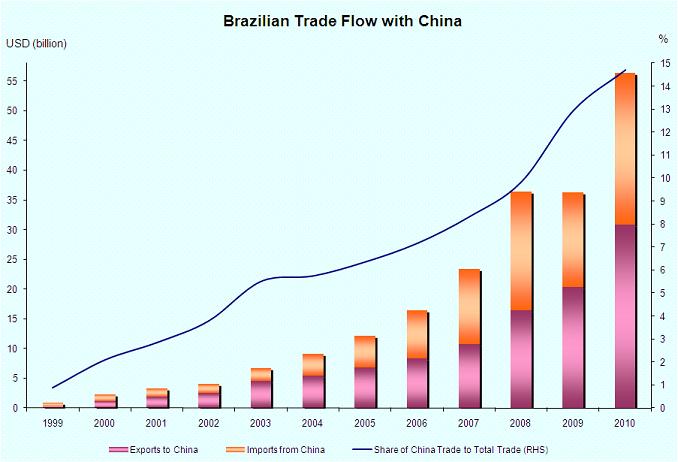
Brazil’s trade with China from 1999 to 2010 is shown in the chart below:

Click to enlarge

brazil-china-trade.jpg

Source: CEIC Data

From CEIC Brazil Data Talk Report:

The total trade between Brazil and China has expanded aggressively during the past 12 years. Brazil’s exports to China grew by a Compound Annual Growth Rate (CAGR) of 46.9% annually while imports from China grew by a CAGR of 37.8% annually from 1999 to 2010. The growth rates are high compared to its aggregate exports and imports which saw a CAGR of 12.7% and 11.5% respectively.

The growth in Brazil’s exports to China are largely commodities based, led by iron ore, soybeans and crude oil. Total exports of iron ore amounted to USD13.34 billion in 2010, representing 43% of Brazil’s exports to China. At the same time, soybeans and crude oil combined exports constituted USD11.19 billion or 36.34% of Brazil’s exports to China. These commodities have been displayed an upward export trend since 1999, coinciding with China’s increasing demand for commodities and fuel sources, as China broaden its net beyond its established suppliers in Asia and the Middle East.

Brazilian companies operating in the industrial metals and mining sector are listed below with their tickers:

  • MMX Mineracao e Metalicos (MXHMY)
  • Gerdau (GGB)
  • Companhia Siderurgica Nacional (SID)
  • Paranapanema (PNPPY)
  • Usiminas (USDMY)
  • Vale (VALE)

Three of the Brazilian oil companies include:

  • Petrobras (PBR)
  • OSX Brasil  (OSXRY)
  • OGX PETROLEO E GAS PARTICIPACOES (OGXPY)

The iShares MSCI Brazil ETF (EWZ) offers a simple and easy way to gain exposure to the Brazilian market.

Disclosure: Long PBR

12 Components of the STOXX Global Grand Prix Index

The Formula One is the world’s most prestigious race car championship in the world. Wikipedia notes the following about Formula One:

Formula One, also known as Formula 1 or F1 and referred to officially as the FIA Formula One World Championship,[2] is the highest class of single seater auto racing sanctioned by the Fédération Internationale de l’Automobile (FIA). The “formula” in the name refers to a set of rules with which all participants’ cars must comply.[3] The F1 season consists of a series of races, known as Grands Prix (translated to English as “Big Prizes”[4]), held on purpose-built circuits and public roads. The results of each race are combined to determine two annual World Championships, one for the drivers and one for the constructors, with racing drivers, constructor teams, track officials, organizers, and circuits required to be holders of valid Super Licences, the highest class of racing licence issued by the FIA.[5]

Formula One cars are considered to be the fastest circuit-racing cars in the world, owing to very high cornering speeds achieved through the generation of large amounts of aerodynamic downforce. Formula One cars race at high speeds – up to 360 km/h (220 mph) – with engines the performance of which is limited to a maximum of 18,000 revolutions per minute (rpms). The cars are capable of lateral acceleration in excess of 5 g in corners. The performance of the cars is very dependent on electronics – although traction control and other driving aids have been banned since 2008 – and on aerodynamics, suspension and tyres. The formula has had much evolution and change through the history of the sport. Europe, where all the Formula One racing teams are based, is the sport’s traditional basis and where about half of each year’s races occur. However, the sport’s scope has expanded significantly during recent years and an increasing number of Grands Prix are held on other continents.

Formula One had a total global television audience of 527 million people during the course of the 2010 FIA Formula One World Championship.[6] The Formula One Group is the legal holder of the commercial rights.[7] With annual spending totalling billions of US dollars, Formula One’s economic effect is significant, and its financial and political battles are widely reported. Its high profile and popularity make it a merchandising environment, which results in great investments from sponsors and budgets in the hundreds of millions for the constructors.

The STOXX Global Grand Prix Index tracks the performance of the major players in the Formula 1 industry. The index covers auto engine manufacturers, tire suppliers, oil and fuel suppliers in the Formula 1 as well as title sponsors.

The twelve components of the STOXX Global Grand Prix Index are listed below:

1.Altria Group Inc.(MO)
Personal & Household Goods
Country: USA

2.AT&T Inc.(T)
Telecommunications
Country: USA

3.DAIMLER
Automobiles & Parts
Country: Germany

4.Exxon Mobil Corp.(XOM)
Oil & Gas
Country: USA

5.FIAT    (FIATY)
Automobiles & Parts
Country: Italy

6.Petronas Gas BHD
Oil & Gas
Country: Malaysia

7.PIRELLI & Co.
Automobiles & Parts
Country: Italy

8.RENAULT
Automobiles & Parts
Country: France

9.ROYAL DUTCH SHELL A (RDS.A)
Oil & Gas
Country: UK

10.TOTAL (TOT)
Oil & Gas
Country: France

11.VODAFONE (VOD)
Telecommunications
Country: UK

12.WILLIAMS GRAND PRIX
Travel & Leisure
Country: UK

Disclosure: No positions

European Chemical Stocks Reach Record Highs

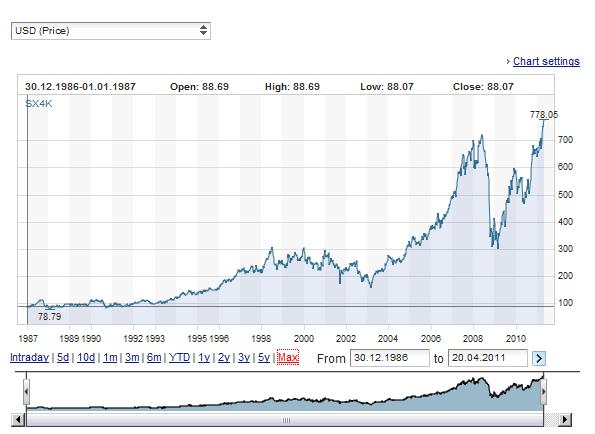
Many European chemical companies are projected to report strong earnings for the last quarter. Ahead of the earnings, the Euro Stoxx Chemicals Index has reach reached an all-time high as shown in the graphic below:

best-chemicals-european.jpg

Source: Stoxx

Some of the reasons for this include the solid recovery in the industry since 2009, optimism on profits and more M&A in the industry. Further consolidation in the industry is likely this year.Earlier this month Belgium’s Solvay (SVYZY) agreed to buy Rhodia of France to expand its footprint in the fast-growing emerging markets. On April 21st Akzo Nobel(AKZOY) announced a 58% rise in first-quarter profits and said it will raise prices and cut expenses to mitigate the increasing cost of raw materials.

Though many of these chemical stocks have reached their 52-week highs recently, there is still potential for further growth. Some of the large European chemical firms are listed below for further analysis and consideration:

1.Arkema SA (OTC:ARKAY)
Current Price: $101.10
Country: France

2.Air Liquide SA (OTC:AIQUY)
Current Price: $ 28.48
Country: France

3.Linde (OTC:LNEGY)
Current Price: $ 17.40
Country: Germany

4.Bayer AG (OTC:BAYRY)
Current Price: $ 82.35
Country: Germany

5.Yara International (OTC:YARIY)
Current Price: $ 53.08
Country: Norway

6.K+S AG (OTC:KPLUY)
Current Price: $ 39.75
Country: Germany

7.Syngenta (SYT)
Current Price: $ 71.02
Country: Switzerland

Note: Prices noted above are as of April 21, 2011

Disclosure: No positions